
Messaging & Value Proposition Design: Build Answers That Sound Customer-Backed, Not Slogan-Driven
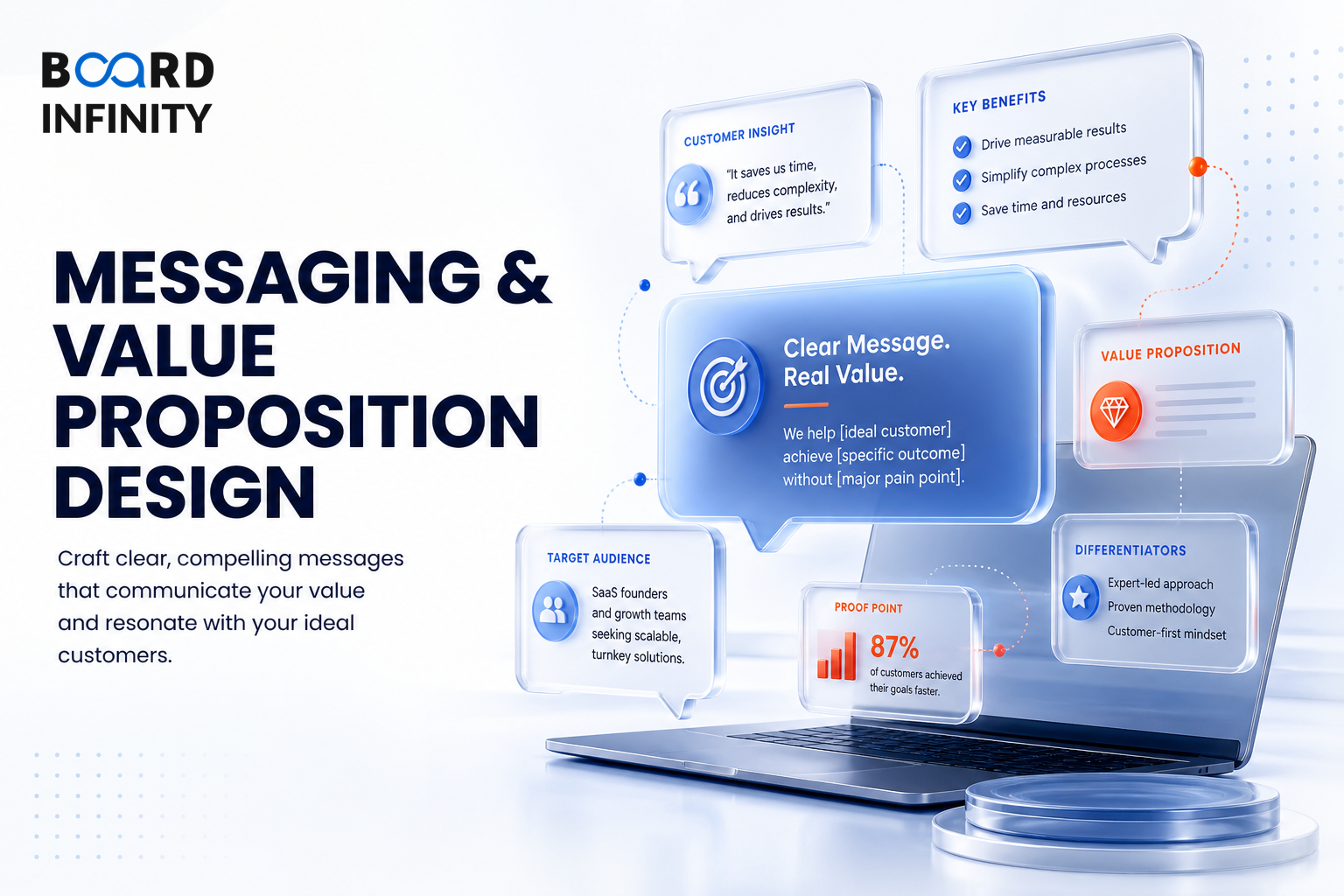
Why do some products sound instantly useful while others sound like a brochure written by committee? The difference is rarely the adjective - it is whether the message translates a real customer problem into a believable reason to choose.
- Value proposition answers: for whom, what problem, what benefit, why better, and what proof.
- Messaging is not copywriting alone - it is the system that turns strategy into customer-facing words.
- The strongest messages sit at the intersection of relevance, differentiation, credibility and clarity.
- Use the chain: customer insight - pain/gain - benefit - proof - message - channel.
- Features tell what the product has; benefits tell what the customer gets; value tells why it matters enough to act.
- Good value propositions are tested through conversion rate, comprehension, recall, click-through rate, CAC efficiency and A/B lift.
- The biggest trap is writing a clever tagline before proving the customer problem and competitive difference.
Big Picture: Messaging Is Strategy Made Sayable
A value proposition is the strategic promise; messaging is how that promise is expressed across ads, landing pages, sales decks, app screens and pitches. Think of it as a bridge between what the business chooses to compete on and what the customer actually understands.
Core Explanation: The Value Proposition Stack
The cleanest way to design a value proposition is to move from customer truth to business choice to communicated proof. Do not start with a tagline. Start with the person whose behaviour you want to change.
1. Customer Segment: Who Is This For?
A good segment is not “young Indians” or “working professionals.” It is a group with a shared job, pain, trigger and buying context. For example, “urban renters setting up their first apartment and comparing appliances online” is more useful than “millennials.”
2. Job, Pain and Gain: What Is the Customer Trying to Achieve?
Use the Jobs-to-be-Done lens: customers do not buy a product category; they “hire” a solution to make progress. The job may be functional, emotional or social.
3. Benefit: What Meaningful Outcome Do We Promise?
A feature is an attribute. A benefit is the outcome created by that attribute. A value proposition becomes powerful only when the benefit is specific enough for the customer to picture.
4. Differentiation: Why Choose This Over Alternatives?
Your message must make the customer choose. That means it must separate you from direct competitors, substitutes and “do nothing.” A bank competes not only with other banks but also with UPI apps, credit cards, cash, family loans and inertia.
5. Proof: Why Should the Customer Believe You?
Proof is where many messages fail. A believable value proposition needs evidence: product demonstration, reviews, certifications, comparisons, free trials, case studies, warranties, brand trust, founder credibility or usage signals.
Duolingo does not merely say “learn languages online.” Its proposition combines an easy daily habit, gamified progress, free access and mobile convenience. The primary driver is reducing friction in language learning, supported by streaks, bite-sized lessons, reminders and a playful brand voice. The strategic so what: value propositions win when they reduce the customer's psychological and time cost, not just price.
The Message House Framework
Use a message house when you need to turn positioning into consistent communication. The roof is the core promise. The pillars are supporting benefits. The base is evidence.
A Practical 6-Step Process to Design a Value Proposition
How to Measure Messaging and Value Proposition Strength
Messaging is creative, but it should not be unmeasured. There is no universal “good” benchmark because categories, ticket sizes and channels differ. A strong result is a clear improvement against your own control, with enough sample size to trust the result.
Definitions You Can Say in One Breath
Value proposition - Kotler and Keller: “the whole cluster of benefits the company promises to deliver.”
Positioning - Kotler and Keller: “designing the company’s offering and image to occupy a distinctive place in the minds of the target market.”
Messaging: the disciplined translation of positioning and value proposition into customer-facing language, proof and channel-specific communication.
Case Study: Atomberg and the Promise of Smarter Fans
Atomberg built its messaging around energy-efficient, technology-led ceiling fans for Indian homes, making a low-involvement category feel worth reconsidering.
Situation: Ceiling fans in India are a huge, familiar category, but many buyers historically treated them as commodity products. The usual purchase logic was simple: price, design, dealer recommendation and basic reliability. That makes messaging difficult because customers do not naturally spend time comparing motor technology.
The move: Atomberg reframed the category around a sharper value proposition: a fan is not just an appliance that moves air; it is a daily-use product where better technology can reduce electricity consumption and improve convenience. Its core promise leaned on BLDC motor technology, energy efficiency, remote-enabled use and modern design. The primary driver was a clear economic and functional benefit for Indian households, supported by product design, e-commerce discovery, reviews, warranty cues and retail expansion.
Outcome and lesson: Atomberg made a mature category more discussable by attaching a concrete benefit to a credible technical difference. The lesson is powerful for interviews: strong value proposition design can create consideration even in categories customers think they already understand.

Strategic so what: Atomberg did not win attention through clever words alone. It connected an Indian household reality - frequent fan usage and power-cost sensitivity - with a product difference customers could understand and verify.
How AI Changes Messaging & Value Proposition Design
AI is making messaging faster to research and easier to test, but it does not remove the need for customer insight. In fact, weak positioning becomes more visible when AI generates twenty equally generic taglines.
- Customer-language mining: Teams can use AI to analyze reviews, support tickets, sales-call transcripts and app-store comments to identify repeated pains, desired outcomes and exact customer phrases.
- Rapid message variant testing: Marketers can generate multiple headline, landing-page and ad variants, then test them through controlled experiments instead of debating opinions in a room.
- Personalized value propositions: AI can adapt the same core promise for different segments - for example, savings for a price-sensitive customer, convenience for a busy parent, and status for a premium buyer.
Use Perplexity to collect recent customer reviews, competitor pages and category trends for one company. Then use ChatGPT to convert the findings into a value proposition canvas, three message territories and likely interview questions. Finally, check every factual claim manually before using it.
Interview Relevance
“Pick a consumer brand and redesign its value proposition for a new customer segment. How would you craft and test the messaging?”
In a marketing interview, say the message out loud as one customer-facing line. If you cannot say it simply, your framework has not landed yet.
Common Mistake
The single biggest mistake is confusing a tagline with a value proposition. A tagline may be memorable, but it does not prove the customer, problem, benefit, differentiation and evidence. The one-line fix: build the value proposition first, then write the tagline last.
What to Revise Next
Next, revise Case Study: Anatomy of a Successful Product Launch in India. Messaging becomes much sharper when you can connect it to launch sequencing - target segment, positioning, channel choice, trial generation, proof-building and post-launch learning.