
Product-Market Fit & MVP Thinking: Interview-Ready Framework for Marketers
A new app spends heavily on Instagram ads, gets thousands of installs, and still watches users disappear after day two. Another tiny brand sells out from a waitlist with almost no media spend. The difference is rarely the logo or the launch video - it is whether the product has found a market that is already pulling it forward.
- Product-market fit means a product satisfies a strong market need so well that customers adopt, return, recommend, and pay.
- MVP thinking is not building a cheap product; it is designing the smallest test that creates the most customer learning.
- For marketers, PMF is visible through retention, activation, referrals, willingness to pay, repeat purchase, and low-friction acquisition.
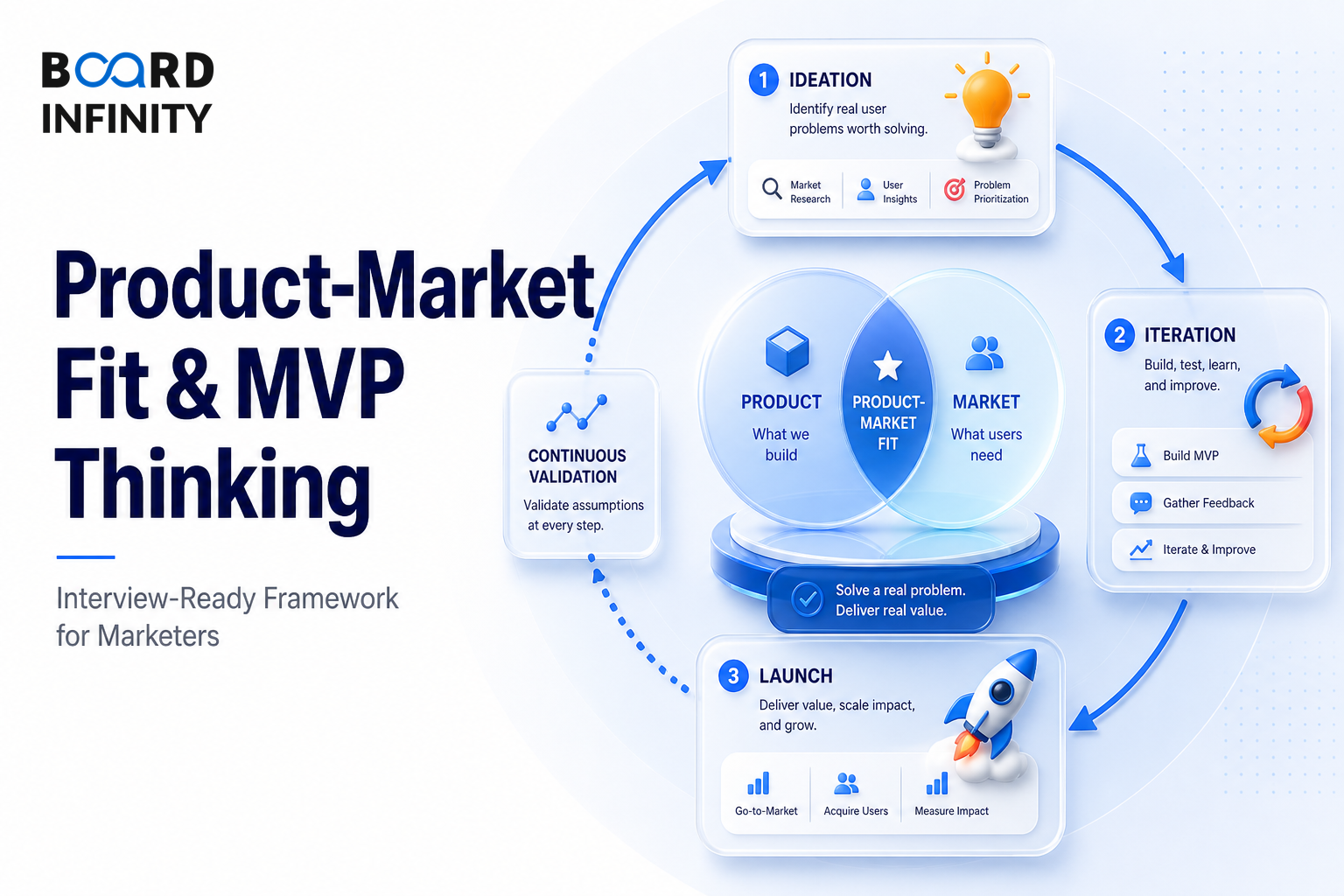
- The right sequence is: identify a painful customer job, build an MVP, test with a narrow segment, learn from behaviour, then scale only after evidence.
- Good MVPs test the riskiest assumption first - demand, price, channel, usage, trust, or habit formation.
- Do not confuse vanity traction with fit. Downloads, impressions, and launch buzz are weak unless users come back and convert.
- In interviews, answer with a loop: segment - problem - MVP - metrics - learning - scale decision.
Big Picture
Think of product-market fit as the moment marketing stops pushing a product uphill and starts amplifying real customer pull. MVP thinking is the disciplined way to reach that moment without wasting months building features nobody values.
Core Explanation: What Marketers Must Actually Understand
Product-market fit is not a feeling. It is a pattern of behaviour. Customers understand the value quickly, use the product repeatedly, tolerate some imperfections, tell others, and become easier to acquire over time.
For a marketer, PMF sits at the intersection of three questions:
- Who exactly has the problem? The segment must be narrow enough to observe clearly.
- How painful or frequent is the job? The problem must matter enough to change behaviour.
- Does the product create a believable reason to switch? Positioning, pricing, trust, and channel all affect adoption.
MVP thinking helps marketers avoid the expensive mistake of launching a full campaign before validating whether the value proposition works. The MVP could be a landing page, waitlist, concierge service, demo video, WhatsApp community, pilot launch, or single-feature version - as long as it tests a real assumption with real customers.
The marketer's PMF question is not “Can we get attention?” It is “Can we get the right customers to change behaviour repeatedly?” That is why retention is usually more important than reach in early-stage validation.
Common MVP formats for marketers:
A practical five-step MVP validation process:
PMF metrics marketers should track:
Notice the pattern: a marketer is not searching for one magic number. You triangulate fit from multiple signals - users understand, activate, return, pay, and spread the word.
Dropbox famously used a demo video to show how file sync would work before the full product was widely available. The move tested whether people understood and wanted the core promise: files available everywhere without friction. The strategic lesson is that an MVP can validate demand through a credible experience, not necessarily through a fully built product.
Definitions
Marc Andreessen: “Product/market fit means being in a good market with a product that can satisfy that market.”
Eric Ries: An MVP is “that version of a new product which allows a team to collect the maximum amount of validated learning about customers with the least effort.”
For marketers, translate these definitions like this: PMF is the proof that a market wants your value proposition; MVP is the fastest ethical way to learn whether that proof exists.
Case Study: Wakefit and the Search for Mattress-Market Fit in India
Wakefit used a focused D2C sleep proposition, risk-reducing trial, and customer feedback loops to make online mattress buying more believable in India.

Situation: Buying a mattress in India was traditionally offline, tactile, and trust-heavy. Customers wanted comfort and value, but online purchase felt risky because the product was personal, bulky, and hard to judge without lying on it.
The move: Wakefit narrowed the problem to sleep products, sold directly online, and reduced perceived risk with a publicly known 100-night trial. Its MVP thinking was not only the mattress; it was the full adoption test - proposition, pricing logic, online education, delivery experience, trial, returns, and feedback. The company also used customer input to improve products and later expanded from mattresses into broader sleep and home categories.
The primary driver: Wakefit solved a high-anxiety purchase with a simple D2C value proposition plus risk reversal. Supporting drivers included online-first distribution economics, clear category education, customer feedback loops, and operational capability around delivery and returns.
Outcome and lesson: Wakefit became a recognised Indian D2C sleep and home brand. The lesson is not “online mattress works.” The real lesson is that PMF often emerges when marketers remove the barrier preventing customers from trying a better solution.
How AI Changes Product-Market Fit & MVP Thinking
AI does not replace PMF judgment; it compresses the learning cycle. The marketer still decides what customer behaviour matters, but AI helps gather, summarise, and test signals faster.
- Faster customer insight mining: Teams can analyse reviews, support tickets, Reddit threads, app reviews, and competitor complaints to identify repeated pain points before defining the MVP.
- Rapid MVP asset creation: AI can generate landing page variants, ad copy, explainer scripts, survey drafts, and positioning alternatives for controlled tests. The risk is testing polished words without testing real behaviour.
- Sharper behavioural analysis: AI-assisted analytics can cluster users by activation paths, churn reasons, and repeat usage patterns, helping marketers see which segment is closest to PMF.
Use NotebookLM or ChatGPT like an interview lab: upload customer reviews, app-store comments, competitor pages, and your MVP concept. Ask it to summarise the top customer jobs, likely objections, possible MVP tests, and five PMF metrics to track. Then verify every insight against actual customer behaviour, not only AI-generated summaries.
Interview Relevance
“Suppose you are launching a new subscription-based fitness app for working professionals in India. How would you use MVP thinking to test product-market fit before a full marketing launch?”
Use the phrase “test the riskiest assumption first”. It instantly signals that you understand MVP thinking as disciplined learning, not just cheap product development.
Common Mistake
The biggest mistake is treating MVP as a half-built product and PMF as launch excitement. That costs candidates because interviewers hear “cheap execution” instead of “validated learning.” The fix: always connect MVP to a specific assumption and PMF to behavioural evidence such as retention, payment, repeat use, or referrals.
What to Revise Next
Once you understand how a product earns market pull, revise how firms manage multiple products and then how they take a validated product to market.