
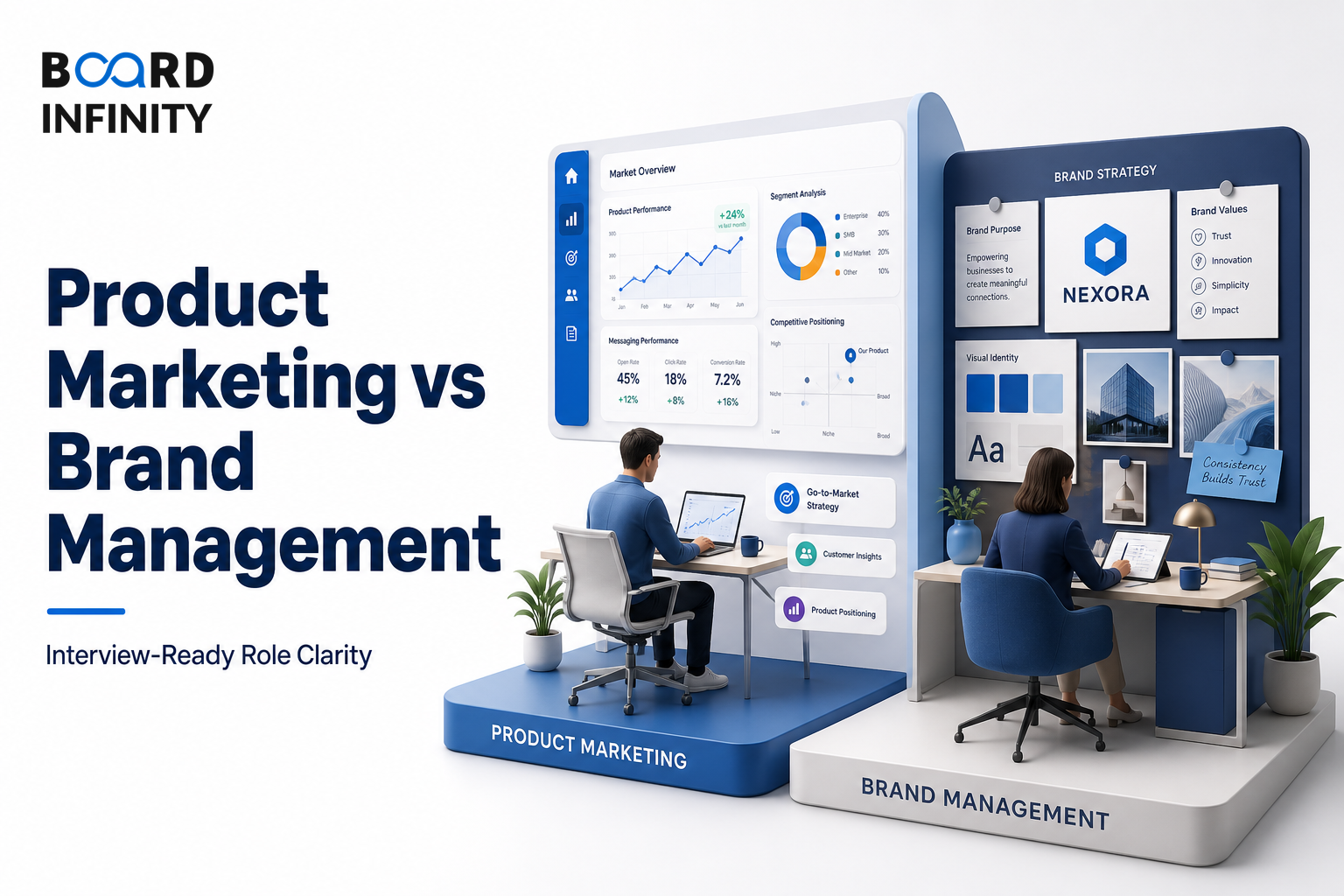
Product Marketing vs Brand Management: Interview-Ready Role Clarity
Ather did not present the Rizta as just another quick electric scooter. In 2024, it framed the product around the practical life of an Indian family - comfort, utility, safety cues and everyday confidence. That shift is product marketing in action: not making the brand famous, but making a specific product easy for a specific buyer to understand, trust and choose.
- Product marketing turns a product's value into positioning, messaging, launch plans, sales enablement and adoption.
- Brand management builds long-term meaning, memory and trust for the brand across products and time.
- PMM is closest to the product-market interface: customer insight, competitor alternatives, use cases, pricing inputs and launch readiness.
- Brand managers ask, "What should people feel and remember about the brand?" PMMs ask, "Why should this buyer choose this product now?"
- PMM success is measured through adoption, activation, win-rate lift, sales enablement usage, message comprehension and launch-qualified pipeline.
- The strongest interview answer compares PMM and brand management by objective, time horizon, buyer specificity, launch role and metrics.
- The trap: saying PMM is only "promotion" or "campaign execution." PMM starts before launch and continues after launch through feedback and adoption.
Big Picture: PMM Owns the Path from Product to Market
Think of product marketing as the bridge between what the product team has built and what the market is ready to buy. It converts features into customer value, aligns internal teams, and keeps improving the story as real buyers respond.
What Product Marketing Really Does
Product marketing management is the function that turns product value into market understanding, positioning, launch, enablement and adoption.
The PMM sits at the intersection of product, marketing, sales and customer success. Their work is not to "make ads." Their work is to make sure the right buyer understands the right value in the right language, and that internal teams can sell, support and improve the product consistently.
The 6 Jobs of a PMM
When a SaaS company launches an AI feature, the PMM does more than announce it. They define which users need it, what workflow it improves, how it differs from competing tools, how sales should demo it, and what adoption metric proves success. The strategic so what: PMM reduces the gap between product capability and customer understanding.
Product Marketing vs Brand Management
The cleanest distinction is this: brand management manages meaning over time; product marketing manages market fit and adoption for a specific product or feature. In many companies they collaborate closely, but they are accountable for different questions.
The PMM Launch Funnel
A useful way to remember PMM is to track where the buyer gets stuck. Brand management often improves memory and preference at the top; PMM is especially powerful when the buyer is evaluating, trying, adopting or renewing a product.
How PMM Is Measured: 6 Interview-Safe Metrics
PMM metrics vary by category, so avoid pretending there is one universal benchmark. Use the ranges below as directional for digital products or B2B-style launches, and always compare against the company's baseline, segment and launch goal.
Definitions You Can Say in One Breath
Product marketing: The function that turns product value into market understanding, positioning, launch, enablement and adoption.
Product, Kotler: "Anything that can be offered to a market to satisfy a want or need."
Brand, American Marketing Association: "A name, term, design, symbol, or any other feature that identifies one seller's goods or service as distinct from those of other sellers."
Ather Rizta: Product Marketing for a New Buyer Segment
Ather used the Rizta launch to stretch from performance-led electric scooters toward family-oriented everyday mobility, making it a strong Indian example of PMM-led repositioning.

Situation: Ather had strong recognition among urban EV enthusiasts, especially for sporty, technology-forward scooters. But the larger Indian scooter market includes family buyers who care about comfort, practicality, trust, service access and daily usability as much as acceleration or app features.
The move: With Rizta, Ather's product marketing challenge was not simply "launch a new scooter." It had to redefine the buyer from tech enthusiast to family decision-maker. The messaging therefore highlighted everyday proof points such as comfort, storage, stability, safety cues and practical commuting use cases, while still borrowing credibility from Ather's EV technology reputation.
Primary driver: The main driver was segment-specific positioning - translating a product built for family utility into a message that a family buyer could immediately understand.
Supporting drivers: The positioning worked only because it was supported by visible product proof points, launch-stage storytelling, dealership and test-ride experience, and Ather's existing credibility in electric scooters. This is the interview-worthy point: no launch wins because of messaging alone; PMM succeeds when message, product proof, channel readiness and buyer education align.
Outcome or lesson: The important learning is not a single sales number. It is that PMM helps a brand stretch into a new segment by changing the product story, proof points and go-to-market readiness together.
How AI Changes Product Marketing
AI does not replace the PMM's judgment. It speeds up research, message testing and sales enablement - but the PMM still decides the segment, positioning and strategic trade-offs.
Use NotebookLM or Claude before an interview: upload the company's product pages, recent launch announcement, annual report excerpts and two competitor pages. Ask: "Create a PMM brief with target persona, positioning, proof points, likely objections, competitor alternatives and three interview questions." Then verify every factual claim manually.
Interview Relevance
"Explain the role of a Product Marketing Manager. How is it different from a Brand Manager? Use an example from India."
If the interviewer asks whether PMM belongs to product or marketing, say: "Structurally it can sit in either, but functionally it must connect product, marketing, sales and customer success around the buyer's reason to choose."
The single biggest mistake is reducing PMM to "promotion for a product." That costs candidates because it ignores positioning, buyer insight, sales enablement and adoption. One-line fix: say, "PMM starts before launch with positioning and continues after launch through adoption data and feedback."
What to Revise Next
Next, revise Messaging & Value Proposition Design to sharpen the core PMM skill of turning features into buyer value. Then study Case Study: Anatomy of a Successful Product Launch in India to see how positioning, launch channels, sales enablement and adoption metrics come together in a full go-to-market plan.