
New Product Development: Answer From Idea to Launch With Confidence
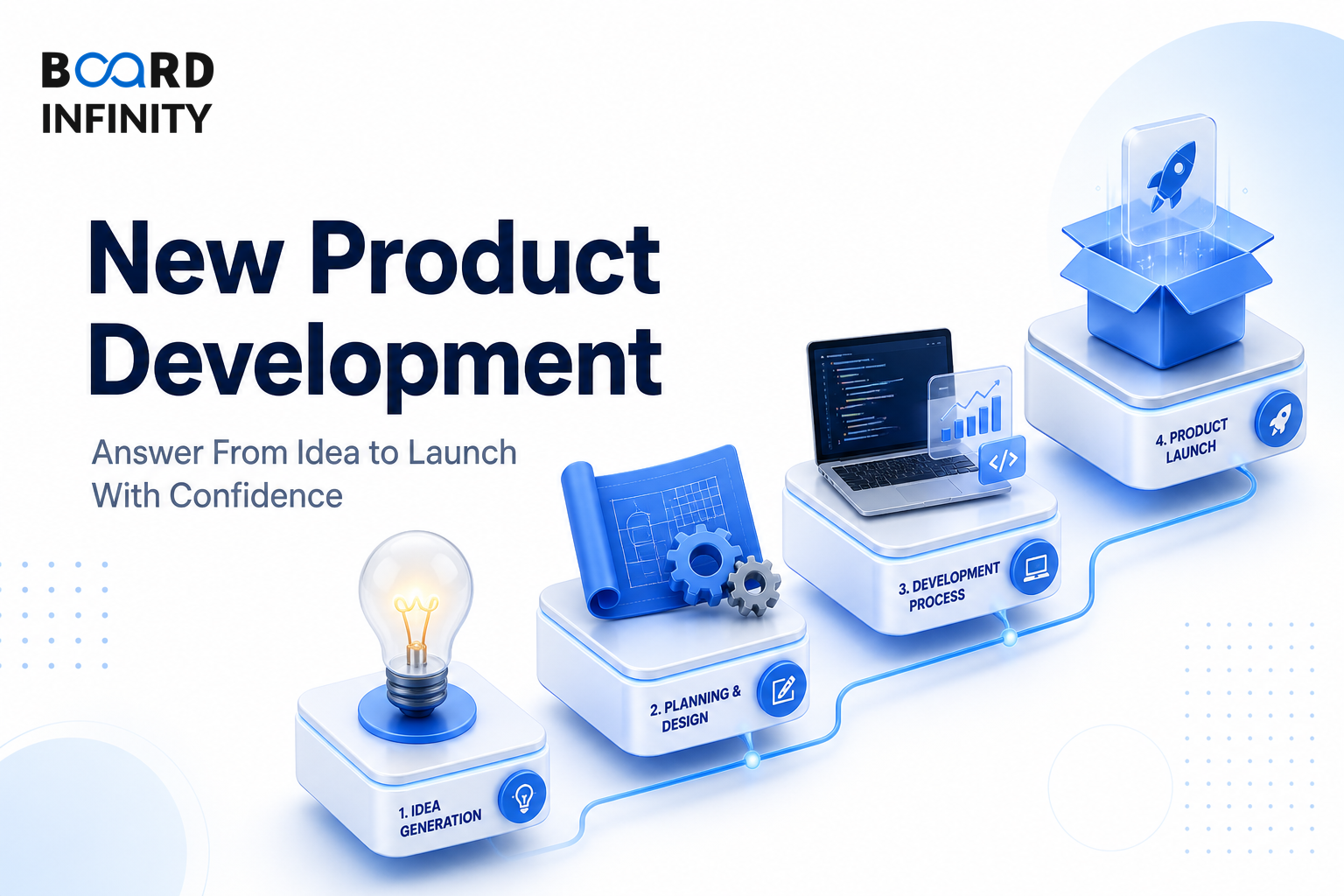
Why do some products feel inevitable the moment they launch, while others look brilliant in a boardroom and die quietly on the shelf? New product development is the discipline that turns an uncertain idea into a tested, commercial launch - without confusing excitement with evidence.
- New Product Development (NPD) is the end-to-end process of creating, testing, launching and improving a new offering.
- The clean interview flow is: idea generation - screening - concept testing - business analysis - development - market testing - launch - review.
- A good product idea must clear three tests: desirability for customers, feasibility for the company, and viability for the business model.
- Stage-gate thinking prevents waste: each stage creates evidence, each gate decides whether to go, kill, hold or pivot.
- Launch is not the finish line. Strong teams track trial, repeat, adoption, unit economics and customer feedback after launch.
- The biggest trap is describing NPD as a linear checklist. In reality, it is an iterative learning loop with disciplined commercial gates.
Big Picture: NPD Is a Learning Funnel, Not an Idea Factory
New product development starts wide and uncertain, then narrows through evidence. The company is not trying to protect its favourite idea - it is trying to discover which idea deserves investment.
Core Explanation: The New Product Development Process
The simplest way to understand NPD is this: every stage answers one risk question. Does the customer want it? Can we build it? Can we make money? Can we scale it?
Notice the discipline: NPD is creative at the front end and brutally commercial at the back end. A company may love an idea, but it should not launch unless customer evidence, operational readiness and business economics support it.
The Three Tests Every New Product Must Pass
A memorable NPD answer always checks the idea through three lenses: customer, company and commercial model. This prevents the classic mistake of praising a cool feature without asking whether it can scale.
Screen Ideas With a 2x2 Risk Matrix
Not all ideas need the same NPD path. A flavour extension in an existing category needs fast testing and execution. A new technology for a new customer behaviour needs more discovery before scale.
Stage-Gate Decisions: What Managers Actually Decide
A stage is where the team does work and creates evidence. A gate is where leadership makes a decision. The four practical gate decisions are:
This is why good NPD cultures do not punish killed ideas. They punish late learning. Killing a weak product early is cheaper than launching it nationally and discovering the truth through returns, discounting and retailer pushback.
Key NPD Metrics to Track After Launch
There is no universal “good” NPD number across FMCG, SaaS, pharma, banking and consumer durables. In an interview, give the formula and say the number is strong when it beats the business case, category benchmark and prior cohort without damaging margin or customer experience.
Definitions You Should Be Able to Say Cleanly
Kotler and Armstrong: “New-product development is the development of original products, product improvements, product modifications, and new brands through the firm’s own product development efforts.”
New Product Development is the structured process of converting an idea into a tested, launched and improved market offering.
Use the Kotler definition when asked for theory. Use the one-breath version when you need to move quickly into application.
Case Study: Paper Boat and the Power of Insight-Led NPD
Hector Beverages built Paper Boat around traditional Indian drinks, showing how a deep consumer insight can guide product, packaging, positioning and launch.

Situation: India’s beverage shelves had carbonated drinks, packaged juices and functional drinks, but many traditional Indian beverages - aam panna, jaljeera, kokum-style drinks and similar nostalgic flavours - were largely consumed at home, regionally or informally. The gap was not just thirst. It was memory, regional taste and convenience.
The move: Paper Boat did not start with a generic “new drink” idea. Its primary driver was a sharp consumer insight: urban Indians often missed familiar homemade flavours but wanted them in a convenient, hygienic, portable format. Supporting drivers made the idea scalable - distinctive pouch packaging, a storytelling-led brand world, recipes adapted for shelf stability, and modern retail plus online distribution.
Outcome and lesson: Paper Boat carved a differentiated position in a crowded beverage category. The strategic lesson is not “nostalgia sells.” The better answer is: a new product wins when the primary insight is strong and is supported by product design, packaging, supply capability, channel fit and brand storytelling.
How AI Changes New Product Development
AI does not replace NPD judgment, but it compresses the learning cycle. In 2026, the biggest impact is not “AI-generated ideas”; it is faster evidence before expensive launch decisions.
Use NotebookLM or Claude: upload a company annual report, recent product pages and customer reviews, then ask, “Identify three possible new product opportunities, map each through desirability-feasibility-viability, and list the launch risks.” Validate every output with real sources before using it.
Interview Relevance
“Suppose an FMCG company wants to launch a new healthy snack for urban Indian consumers. Walk me through the new product development process.”
In your answer, name the gates. Say: “At each gate I would decide go, kill, hold or pivot based on evidence.” That one sentence makes your answer sound managerial, not textbook.
Common Mistake
The mistake that costs candidates is treating NPD as “idea - make product - advertise - sell.” It ignores customer validation, business analysis, operations readiness and post-launch learning. Fix: always frame NPD as an evidence-based stage-gate process from insight to launch review.
What to Revise Next
Now move from “how products are developed” to “how teams know what to build and how firms manage many products at once.” Revise these next: