
Reading an Annual Report with AI: A NotebookLM Workflow for Interviews
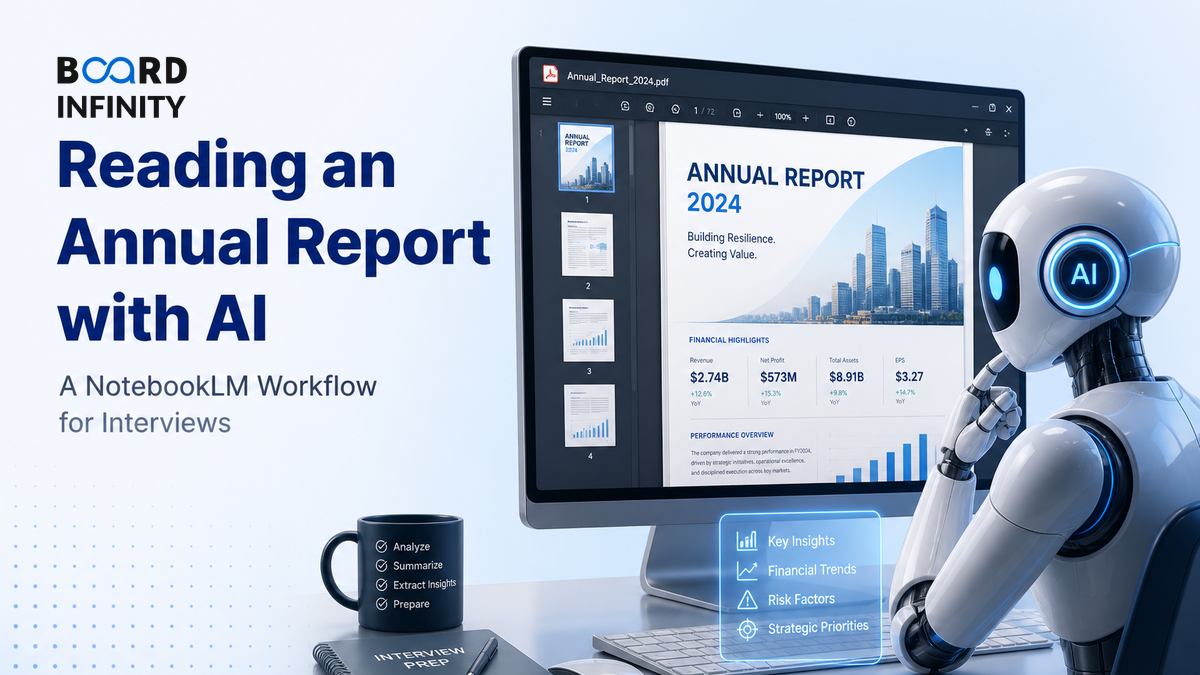
A company can report record revenue and still be under pressure if cash is stuck in inventory, leases are rising, or margins are quietly thinning. The annual report is where that story hides - and AI can either reveal it in minutes or confidently mislead you if you ask lazy questions.
- Do not ask AI to “summarise the annual report.” Ask it to answer source-cited questions section by section.
- Use NotebookLM because it is source-grounded - every important answer should point back to the uploaded report.
- Read an annual report through four lenses: business model, financial performance, risk, and management quality.
- Always reconcile AI outputs with the three statements: income statement, balance sheet, and cash flow statement.
- Track at least six ratios: revenue growth, operating margin, ROCE, current ratio, debt-equity, and CFO/PAT.
- Your final interview answer should be a thesis, not a summary: “The company is growing because X, but watch Y.”
- The biggest risk is hallucination by omission - AI may miss a footnote, related-party item, contingent liability, or accounting change.
The big picture is simple: AI is not your analyst; it is your reading engine. You still own the judgment. The right workflow turns a 250-page annual report into a cited, interview-ready view of how the company makes money, where the numbers are strong, and what could go wrong.
The Core Idea: Use AI to Ask Better Questions, Not to Skip Reading
An annual report is the most complete public document a listed company gives you in one place. For an Indian listed company, it usually includes the Board’s Report, Management Discussion and Analysis, corporate governance report, standalone and consolidated financial statements, auditor’s report, and notes to accounts.
NotebookLM is useful because it works from your uploaded sources. But that strength only matters if your prompts force it to quote, compare, reconcile, and point to page-level evidence. A weak prompt produces a neat paragraph. A strong prompt produces a trail you can defend.
The Five-Step NotebookLM Workflow
The Annual Report Reading Ladder
Most students stop at the bottom two layers: “What does the company do?” and “Did revenue grow?” Interviewers reward the top layers: “Why did performance change, is it sustainable, and what risk is the market underestimating?”
What to Ask NotebookLM: The Four-Lens Prompt Bank
Use prompts that force the model to cite pages and separate management narrative from financial evidence. These are practical prompts you can copy, but always replace the company name and year.
The Annual Report Sections You Must Not Miss
NotebookLM can make the report feel smaller, but some sections deserve manual attention because they often contain the “real story” behind the headline numbers.
Key Ratios to Track While Reading
Do not throw ratios randomly into an interview. Use them to answer one question: is performance improving for the right reasons? The “good” value depends on sector, asset intensity, growth stage, and business model, but these ranges are useful first filters.
A Small Worked Example: Turning Report Numbers into a View
Suppose a company’s annual report shows the following simplified numbers: revenue rose from ₹1,000 crore to ₹1,180 crore, EBIT is ₹165 crore, capital employed is ₹900 crore, current assets are ₹420 crore, current liabilities are ₹300 crore, PAT is ₹110 crore, and CFO is ₹88 crore.
The interview-ready insight is not “revenue grew 18 percent.” It is: “Growth is strong and ROCE looks healthy, but cash conversion is weaker than PAT, so I would check inventory, receivables, and working-capital notes before calling it high-quality growth.”
Definitions You Should Be Able to Say Cleanly
- Annual report - U.S. SEC: “A document that public corporations must provide annually to shareholders that describes their operations and financial conditions.”
- Source grounding: An AI response is source-grounded when its claims can be traced to specific uploaded documents or citations.
- MD&A: Management’s explanation of business performance, industry context, risks, and future outlook in the annual report.
- Financial statement notes: Detailed disclosures that explain accounting policies, line items, assumptions, obligations, and risks behind the primary statements.
Case Study: Reading Trent Limited with NotebookLM
Trent is a strong Indian example because its annual report lets you connect retail strategy, store expansion, private-label economics, leases, inventory, and cash flow in one business.

Situation. Trent Limited, part of the Tata group, operates fashion and retail formats including Westside and Zudio. For a student, the trap is to read the company as “retail store expansion” and stop there. That is too shallow.
The move. A better NotebookLM teardown uploads Trent’s latest annual report, previous year report, and a relevant peer report. Then the questions are structured around retail economics: store count and format mix, like-for-like growth if disclosed, private-label strategy, lease obligations under Ind AS 116, inventory movement, payables, operating cash flow, and risk disclosures.
The lesson. Trent’s story should not be reduced to one cause. The primary driver is its sharp retail operating model - especially value-fashion growth through Zudio alongside Westside. Supporting drivers include store network expansion, format clarity, merchandise discipline, brand architecture, supply-chain execution, and customer demand for accessible fashion. The annual report helps you test whether that strategic story is visible in margins, working capital, leases, and cash generation.
So what: a strong answer on Trent sounds like this: “The growth story is compelling, but I would judge quality through format-level economics, lease intensity, inventory discipline, and operating cash conversion - not revenue growth alone.”
The AI Verification Loop
Use this loop every time NotebookLM gives you a useful answer. It prevents the two most dangerous AI errors: confident hallucination and missed footnotes.
How AI Changes Reading an Annual Report
AI changes annual report reading in three practical ways in 2026.
- Source-grounded compression: NotebookLM can turn long filings into cited answers, section maps, and theme summaries. This is especially useful for MD&A, risk factors, and notes to accounts.
- Cross-document comparison: You can upload two years of annual reports, a peer report, and an earnings call transcript to ask: “What changed in management language, ratios, risks, and capital allocation?”
- Natural-language financial analysis: Tools like ChatGPT, Claude, and Perplexity can help convert extracted numbers into ratio tables, peer questions, and interview scripts - but only after you verify the underlying numbers from the report.
Upload the company’s annual report, previous year report, investor presentation, and one peer report into NotebookLM. Ask it to generate: 10 likely interview questions, 6 ratio observations, 5 risk flags, and a 90-second company thesis with citations. Then manually verify each cited page before rehearsing.
Interview Relevance
“You used AI to read this company’s annual report. Walk me through your process and tell me one insight you found that a surface-level reader might miss.”
Use the phrase: “I treated AI as a citation engine, not as the final analyst.” It signals maturity immediately.
Common Mistake
The biggest mistake is presenting an AI-generated summary without verifying citations, numbers, and notes. It costs candidates because interviewers can ask one follow-up on cash flow, debt, or accounting policy and expose that the answer has no foundation. Fix: every major claim must be tied to a page, a statement line item, or a note.
What to Revise Next
Next, move from workflow to execution: revise Case Study: A Full Statement Teardown of a Listed Indian Company. That will help you convert annual report reading into a complete income statement, balance sheet, cash flow, ratios, risks, and interview thesis teardown.