
Consolidation, Subsidiaries, Associates & Minority Interest: Interview-Ready Accounting Map
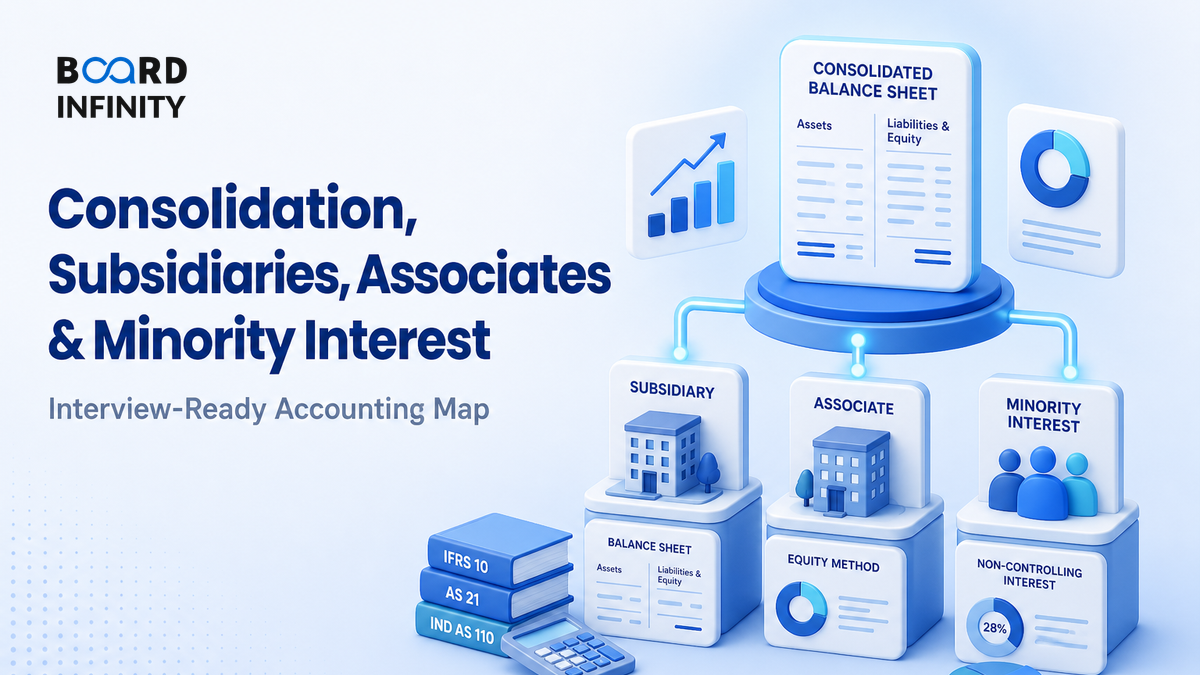
Open the annual report of a large Indian group and you may see two very different worlds: a lean standalone company on one page, and a much larger consolidated business on the next. The difference is not accounting decoration - it is the economic map of who controls whom, whose profits really belong to shareholders, and which numbers can mislead you if you read them casually.
- Consolidation is about control, not just ownership percentage. If the parent controls the entity, it consolidates 100% of its assets, liabilities, income and expenses.
- A subsidiary is line-by-line consolidated. Even if the parent owns only 80%, the consolidated P&L includes 100% of subsidiary revenue and costs.
- Minority interest is now called non-controlling interest, or NCI. It is the share of subsidiary net assets and profit belonging to outside shareholders.
- An associate is not consolidated line by line. It is usually shown using the equity method - one investment line on the balance sheet and one share-of-profit line in the P&L.
- Goodwill appears when purchase consideration exceeds fair value of identifiable net assets acquired. Large goodwill needs impairment vigilance.
- The biggest interview trap: saying “more than 50% means subsidiary, 20-50% means associate” without testing control, contractual rights and decision power.
Big Picture: Consolidation Is the Accounting Version of “Who Runs the Business?”
Think of a corporate group as a set of businesses orbiting one parent. Accounting decides how close each orbit is. If the parent controls the business, the business enters the group accounts fully. If the parent only influences it, the business appears as a one-line investment. If neither control nor influence exists, it is usually treated as a financial asset.
Core Explanation: Subsidiary, Associate, Joint Venture and Passive Stake
The cleanest way to revise this topic is to stop memorising percentage bands and start asking one question: what level of power does the investor have over the investee?
For interview purposes, remember the logic in this order: control first, then accounting treatment, then impact on the financial statements. Percentages help you investigate, but they do not finish the analysis.
What Consolidation Actually Does to the Statements
Consolidation treats the parent and its subsidiaries as if they are one economic entity. That creates four mechanical effects that interviewers love testing.
Definitions You Can Say in One Breath
- Subsidiary: an entity controlled by another entity, called the parent.
- IFRS 10: control requires power over the investee, exposure to variable returns, and ability to use power to affect returns.
- IAS 28: significant influence is power to participate in financial and operating policy decisions, but not control or joint control.
- IFRS 10: non-controlling interest is equity in a subsidiary not attributable, directly or indirectly, to a parent.
- Consolidated financial statements: group statements presenting parent and subsidiaries as a single economic entity.
In Indian listed-company analysis, you will usually see these ideas through Ind AS, which is largely converged with IFRS for consolidation principles. The phrase “minority interest” is still used informally, but NCI is the cleaner modern term.
Worked Example: Why 80% Ownership Still Adds 100% of Revenue
Suppose Parent Ltd buys 80% of Sub Ltd for ₹800 crore. The fair value of Sub Ltd’s identifiable net assets is ₹900 crore. Parent uses the proportionate share method for NCI.
Now add operating results. Parent standalone profit is ₹500 crore. Sub profit is ₹100 crore. Parent also owns 30% of an associate that reports ₹60 crore profit.
The consolidated profit before NCI is ₹500 crore + ₹100 crore + 30% of ₹60 crore = ₹618 crore. NCI share is 20% of Sub profit = ₹20 crore. Profit attributable to parent shareholders is therefore ₹598 crore.
Analyst Checks: What to Track in Consolidated Accounts
There is no universal “good” number for these checks because conglomerates, banks, platforms and manufacturing groups consolidate differently. In an interview, the strong answer is to name the measure, compute it, and interpret whether the pattern is clean, explained and sustainable.
Bharti Airtel consolidates businesses it controls, including subsidiaries with outside shareholders. Where external investors own part of a controlled subsidiary, their claim appears as non-controlling interest rather than as parent shareholder profit. The strategic so what: consolidated scale can show the whole operating platform, but valuation must still separate what belongs to parent owners from what belongs to other shareholders.
Case Study: Tata Consumer Products and the Group Accounting Lens
Tata Consumer Products shows why the same company can contain fully consolidated acquisitions, equity-accounted partnerships and group-level strategy in one annual report.

Situation. Tata Consumer Products has been moving beyond tea and salt into a broader packaged foods and beverages platform. In 2024, it announced acquisitions of Capital Foods, known for categories such as Chinese and condiments, and Organic India, known for health and wellness products. It also has the Tata Starbucks joint venture, a different type of relationship from a fully controlled subsidiary.
The move. The strategic move was not just “buy more brands.” The primary driver was portfolio expansion into higher-frequency packaged consumption occasions. Supporting drivers included the Tata distribution engine, category adjacency, premiumisation potential, procurement scale and the ability to integrate acquired brands into a larger FMCG operating platform.
The accounting lesson. Once control is obtained over an acquired company, its results are consolidated from the acquisition date. That means consolidated revenue can rise because a new subsidiary is added, not only because the existing business organically grew. By contrast, a joint venture such as Tata Starbucks is not simply added line by line in the same way if equity accounting applies; it appears through the investment and share-of-results approach.
Outcome or lesson. The case teaches a crucial interview point: consolidated numbers are not automatically “better” than standalone numbers. They are broader. A strong analyst asks what entered the group, when it entered, whether it was controlled, and how much of the profit truly belongs to parent shareholders.
How AI Changes Consolidation, Subsidiaries, Associates & Minority Interest
AI is making group-account analysis faster, but not judgment-free. The advantage goes to candidates who use AI to map complexity, then verify the accounting logic themselves.
Student workflow: load the company annual report, investor presentation and quarterly results into NotebookLM. Ask: “Create a table of subsidiaries, associates, joint ventures, ownership percentage, accounting treatment, NCI impact and goodwill disclosures. Cite the exact note number for each.” Then cross-check every answer against the annual report because AI can confuse ownership with control.
Interview Relevance
“A company owns 80% of another company. Should it consolidate only 80% of revenue? Also explain how minority interest affects PAT.”
Use the phrase: “Consolidation shows control; NCI shows ownership economics.” That one sentence makes your answer sound structured and mature.
Common Mistake
The costly mistake is treating ownership percentage as an automatic rule: “above 50% subsidiary, 20-50% associate.” That fails because control can arise through board rights, contractual arrangements, de facto power or dispersed shareholding. The one-line fix: test control first, then decide consolidation, equity method or financial-asset treatment.
What to Revise Next
Now that you can read group accounts without getting trapped by subsidiaries, associates and NCI, move to the quality of those reported numbers. Revise Quality of Earnings: The Red Flags That Precede Most Blow-Ups, then practise Reading an Annual Report with AI: A NotebookLM Workflow so you can turn complex disclosures into interview-ready insights quickly.