
Cash Flow Statement for Interviews: Operating, Investing and Financing Flows
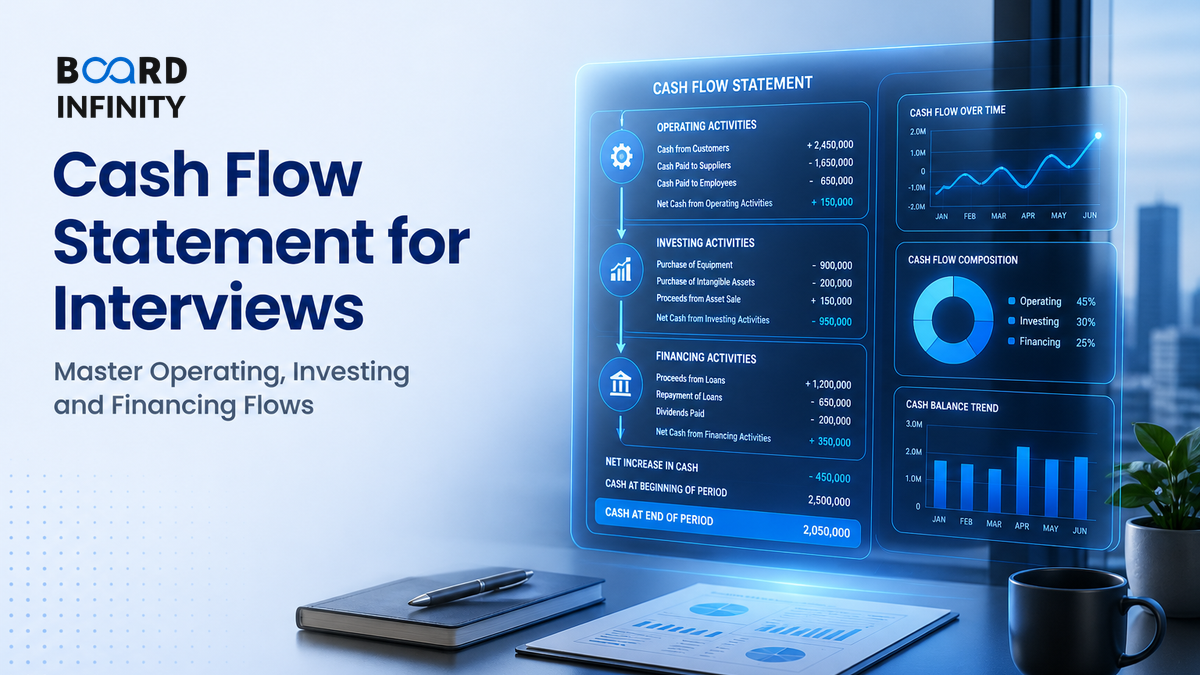
How can a company report profit, celebrate growth, and still feel short of cash when salaries, suppliers and lenders need to be paid? The cash flow statement answers that uncomfortable question by separating accounting performance from actual movement of money.
- Cash flow statement explains changes in cash and cash equivalents over a period.
- Operating cash flow shows cash generated by the core business before long-term investments and financing choices.
- Investing cash flow usually turns negative when a company is expanding capacity, acquiring assets or buying investments.
- Financing cash flow shows how the company raises or returns capital through debt, equity, dividends and repayments.
- Profit is not cash because accrual accounting includes credit sales, depreciation, provisions and working-capital timing.
- Healthy pattern: positive and growing CFO, disciplined CFI, and financing that supports strategy rather than plugs operating losses.
- Interview shortcut: always read cash flows in this order - CFO quality, CFI purpose, CFF funding logic, then link to balance sheet and P&L.
Big Picture: The Cash Flow Statement Is a Three-Bucket Story
The cash flow statement does not ask, “Was the company profitable?” It asks, “Where did cash come from, where did it go, and is that pattern sustainable?” Every line item falls into one of three buckets: operating, investing or financing.
Core Explanation: Operating, Investing and Financing Flows
Operating cash flow, often called CFO or cash flow from operations, is the cash produced or consumed by the company’s main business. For a retailer, it comes from selling goods and paying suppliers, employees, rent and taxes. For a bank or NBFC, the interpretation is different because lending and borrowing are themselves operating activities.
Investing cash flow, or CFI, captures cash spent on or received from long-term assets and investments. Buying plant, machinery, stores, software, subsidiaries or long-term investments is usually an investing outflow. Selling assets or investments creates an investing inflow.
Financing cash flow, or CFF, captures cash raised from and returned to capital providers. Issuing equity, taking loans or issuing bonds creates financing inflow. Repaying debt, paying dividends and buying back shares creates financing outflow.
The clean way to read the statement is not line by line from top to bottom. First judge whether the business generates cash. Then see what management is doing with that cash. Finally check how the company funds any gap.
The Indirect Method: How Profit Becomes Operating Cash Flow
Most listed companies present operating cash flow using the indirect method. It starts with accounting profit and adjusts for non-cash items and working-capital changes to reach cash generated from operations.
Two adjustments matter most in interviews:
- Non-cash charges: depreciation reduces profit but does not use cash in that period, so it is added back.
- Working capital: higher receivables, inventory or other current assets use cash; higher payables or current liabilities usually release cash.
A company reports profit after tax of ₹100 crore. Depreciation is ₹30 crore. Receivables increase by ₹25 crore, inventory increases by ₹15 crore, and payables increase by ₹20 crore. CFO = ₹100 + ₹30 - ₹25 - ₹15 + ₹20 = ₹110 crore. The company earned ₹100 crore in accounting profit but generated ₹110 crore in operating cash because depreciation was non-cash and supplier credit partly funded working capital.
Definitions You Can Say in One Breath
- Cash flows: IAS 7 defines cash flows as “inflows and outflows of cash and cash equivalents.”
- Cash equivalents: IAS 7 defines them as “short-term, highly liquid investments” readily convertible to known cash with insignificant value risk.
- Operating activities: IAS 7 defines them as principal revenue-producing activities and other activities that are not investing or financing.
- Investing activities: IAS 7 defines them as acquisition and disposal of long-term assets and other investments not included in cash equivalents.
- Financing activities: IAS 7 defines them as activities changing the size and composition of contributed equity and borrowings.
The 2x2 Interpretation Matrix: What the Pattern Really Means
A single year of cash flow can mislead you. A loss-making startup, a capex-heavy manufacturer and a mature FMCG company will naturally show different patterns. The trick is to classify the pattern before judging it.
Healthy reinvestor is often the best long-term pattern: strong operating cash flow with negative investing cash flow because the company is building capacity, technology, distribution or acquisitions. Distress zone is the dangerous pattern: negative operating cash flow with low investment, because the business itself is not converting into cash.
Key Cash Flow Ratios and What Strong Looks Like
Ratios make your answer sharper because they move you from description to diagnosis. Use these as rule-of-thumb ranges, not universal laws; sector economics, growth stage and accounting classification matter.
In interviews, avoid mechanically saying “negative investing cash flow is bad.” If a company has strong CFO and is investing in productive assets, negative CFI may be exactly what shareholders want.
Case Study: Varun Beverages and the Cash Flow Logic of Expansion
Varun Beverages shows why a growing company can have strong operating cash generation and still report large investing outflows.

Situation: Varun Beverages, one of PepsiCo’s major franchise bottlers, operates in a working-capital and capex-heavy beverage business. Demand depends on distribution reach, seasonality, cold-chain availability and manufacturing capacity, not just brand pull.
The move: The company has expanded through new territories, capacity additions, distribution depth and product portfolio growth. In cash-flow terms, the story splits neatly: established operations generate cash; investing activities absorb cash for plants, equipment, coolers, vehicles, technology and acquisitions; financing activities support the capital structure through borrowings, repayments and shareholder payouts as needed.
Outcome and lesson: The primary driver of cash-flow strength is not simply “selling more beverages.” It is the bottling model converting scale into operating cash, supported by route expansion, production capacity, retailer reach, seasonal execution and disciplined funding. The strategic lesson is clear: a negative investing cash flow is not automatically a warning sign when it is backed by durable operating cash flow and a coherent expansion plan.
So what: For a growth company, the best answer is not “cash flow is positive or negative.” The best answer is whether operating cash can sustainably fund investment without over-stretching the balance sheet.
How AI Changes the Cash Flow Statement
AI does not change the accounting logic of CFO, CFI and CFF, but it changes how quickly analysts can extract, compare and challenge the numbers.
- Automated extraction from filings: AI tools can pull cash-flow line items from annual reports, XBRL filings and investor presentations, then map them into a comparable template across companies.
- Cash-flow anomaly detection: Models can flag unusual jumps in receivables, inventory, payables, capex, borrowings or related-party cash flows for deeper analyst review.
- Forward cash forecasting: Finance teams use machine-learning models to forecast collections, payments, inventory cash needs and liquidity gaps using ERP, sales and procurement data.
Upload a listed company’s annual report and this lesson into NotebookLM. Ask: “Build a table of CFO, CFI and CFF for the last three years, explain the biggest movements, and generate five interview questions on cash-flow quality.” Then verify every number against the original cash flow statement.
Interview Relevance
“A company reports rising profits but declining cash from operations. How will you investigate what is happening?”
Use one sentence that sounds senior: “I would not judge the cash flow statement by signs alone; I would judge whether the pattern fits the company’s business model and stage of growth.”
Common Mistake
The biggest mistake is saying “positive cash flow is good and negative cash flow is bad.” That fails because financing inflows can hide weak operations, while investing outflows can signal healthy expansion. One-line fix: judge CFO quality first, then ask whether CFI and CFF support a credible strategy.
What to Revise Next
Next, move from reading one statement to connecting all three. Revise How the Three Statements Link: The Flow You Must Be Able to Draw, then study Reconciling Profit to Cash: Why the Two Almost Never Match. Together, these make you interview-ready for almost any accounting or finance discussion.