
How the Three Financial Statements Link: Draw the Flow in 60 Seconds
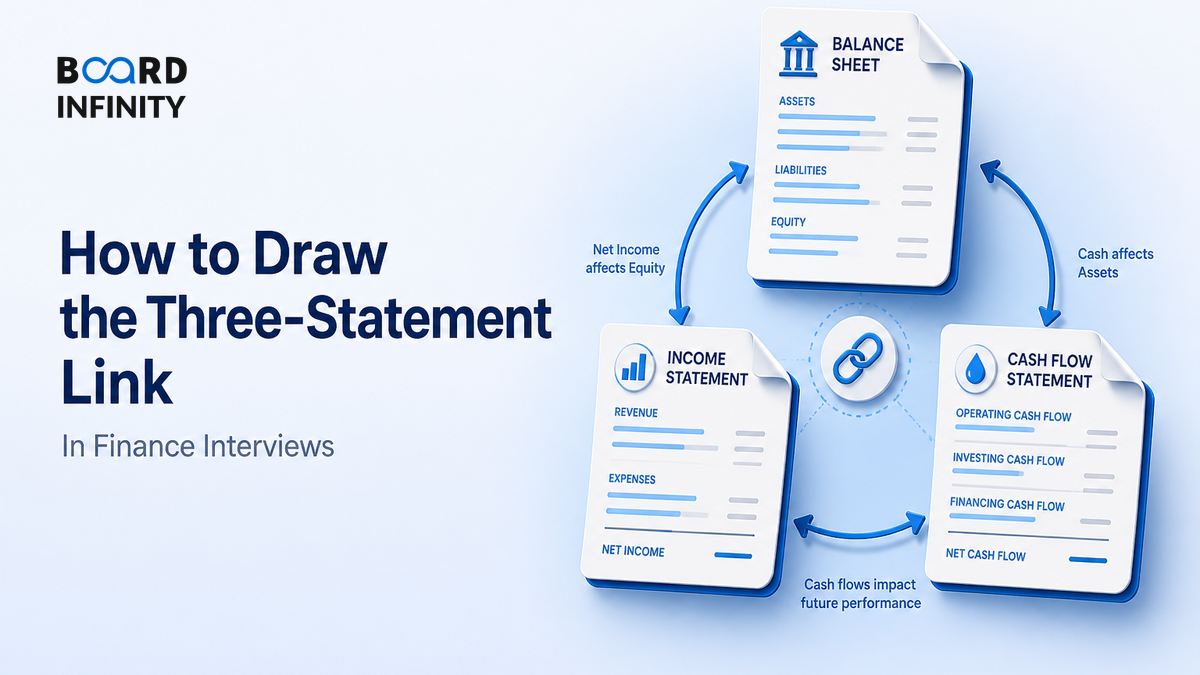
A retailer opens a new store today. Rent contracts are signed, shelves are filled, salaries begin, customers swipe cards - but the profit, cash movement, inventory, lease liability and retained earnings will appear in different places across three statements.
That is the trick. The three statements are not three reports - they are one business story told through profit, position and cash.
- Income Statement shows performance over a period: revenue minus expenses equals net income.
- Balance Sheet shows financial position on a date: assets equal liabilities plus equity.
- Cash Flow Statement explains why cash changed: operating, investing and financing cash flows.
- Net income links the income statement to equity through retained earnings.
- Ending cash links the cash flow statement to the balance sheet cash line.
- Non-cash items like depreciation reduce profit but are added back in operating cash flow.
- Working capital changes explain why profit and cash almost never match.
Big Picture: One Business, Three Lenses
Think of the three statements as a loop. The business earns profit, converts some of it into cash, invests or raises money, and ends the period with a new asset-liability-equity position. That ending position becomes the starting point for the next period.
Core Explanation: The Links You Must Be Able to Draw
The cleanest way to draw the linkage is to start with the Income Statement, move to the Cash Flow Statement, and finish by proving that the Balance Sheet balances.
The backbone is the accounting equation:
Assets = Liabilities + Equity
Every transaction must keep this equation true. If a company buys inventory on credit, inventory rises and payables rise. If it sells goods for cash, cash rises, inventory falls, revenue is recorded, profit changes equity, and taxes may become payable. One action, multiple statement effects.
The 7 Linkages Interviewers Expect
If you remember only one section, remember this table. These are the mechanical bridges between the statements.
The Profit-to-Cash Funnel
Profit is an accrual number. Cash is a bank account reality. The cash flow statement acts like a funnel that starts with accounting profit and narrows it into actual cash available to the business.
The most important insight: net income is not cash flow. A company can report profit while cash falls because customers have not paid, inventory has piled up, or capital expenditure is heavy.
A Small Worked Example: Follow One Year End to End
Assume a company starts the year with cash of ₹100, no debt and equity of ₹100. During the year:
- It earns revenue of ₹500.
- Cash operating costs are ₹350.
- Depreciation is ₹50.
- It buys new equipment for ₹80 in cash.
- Receivables increase by ₹40 because some customers have not paid yet.
- It raises debt of ₹60.
Notice the full linkage. Net income of ₹100 increases equity. Depreciation reduces profit but does not reduce cash this year. Receivables reduce operating cash because sales were booked before cash was collected. Debt increases cash and liabilities. Ending cash of ₹190 must appear on the Balance Sheet.
Definitions You Can Say in One Breath
- Income Statement: A period statement showing revenues, expenses and profit earned by the business.
- Balance Sheet: A point-in-time statement showing assets, liabilities and shareholders equity.
- Cash Flow Statement: A period statement explaining cash movement from operating, investing and financing activities.
- Asset: The IASB defines an asset as “a present economic resource controlled by the entity as a result of past events.”
- Liability: The IASB defines a liability as “a present obligation of the entity to transfer an economic resource.”
The 60-Second Drawing Sequence
When asked to explain linkage, do not start with random line items. Draw the flow in order.
Statement-Link Sanity Checks and Metrics
These measures help you test whether a company is translating accounting profit into financial strength. Always compare with peers and the companys own history, because good levels vary by sector.
Case Study: Trent - Store Expansion Through Three Statements
Trent shows how rapid retail expansion flows through revenue, inventory, leases, cash flow and the Balance Sheet - not just through reported profit.

Trent, the Tata Group retail company behind formats such as Westside and Zudio, is a useful Indian example because store-led growth is easy to see physically and financially. When a retailer expands, the business is not merely “opening stores.” It is committing to leases, stocking inventory, hiring people, building supply chains and betting that footfall will convert into profitable sales.
Situation: Indian fashion retail has a large value-conscious customer base, but success depends on store economics: right location, quick inventory turns, disciplined pricing and tight operating control.
The move: Trent expanded its retail footprint while building format-market fit, especially in value fashion. The primary driver was a proposition that matched Indian consumer demand for affordable, frequently refreshed fashion. Supporting drivers included store execution, merchandising discipline, supply chain coordination and the ability to scale formats without letting working capital run uncontrolled.
The statement linkage: New stores can lift revenue on the Income Statement. Inventory and store assets appear on the Balance Sheet. Lease obligations and right-of-use assets may appear under Ind AS 116 accounting. Cash is absorbed by inventory, store setup and operating needs before sales fully mature. Over time, if store economics work, profit improves, operating cash strengthens and retained earnings rise.
Lesson: A shallow answer says “Trent grew because it opened more stores.” A complete finance answer says growth worked only if the Income Statement growth, Balance Sheet discipline and cash conversion supported each other.
How AI Changes Three-Statement Linkage
AI does not replace the accounting logic. It makes linkage checks faster, more searchable and more scenario-driven.
- Automated variance explanation: Finance teams increasingly use AI-assisted tools to explain why cash flow differs from profit - for example, receivables build-up, inventory increases or lease payments.
- LLM-based annual report reading: Large language models can scan annual reports, management discussion sections and notes to accounts to identify where capex, leases, debt and working capital are discussed.
- Scenario modelling: AI copilots in spreadsheets can help build “what if revenue grows but receivables worsen?” cases, making statement linkage easier to stress-test.
Use NotebookLM or ChatGPT with a companys annual report. Ask: “Trace how revenue growth, working capital, capex and debt affected all three statements. Give me 5 interview questions and model answers.” Then verify every number against the report.
Interview Relevance
“Walk me through how the three financial statements are linked. Suppose depreciation increases by ₹100 - what happens across the statements?”
Use the phrase “assuming no tax for simplicity” if you want a clean depreciation answer. If taxes apply, lower profit reduces tax expense, so the net income impact is depreciation multiplied by one minus the tax rate.
Common Mistake
The mistake that costs candidates is treating the statements as separate reports. They define each one correctly but cannot show the flow. The fix: always draw net income to retained earnings, CFO adjustments to cash, capex to fixed assets, financing to debt or equity, and ending cash back to the Balance Sheet.
What to Revise Next
Now that you can draw the full linkage, revise the two analyses that interviewers naturally build on top of it.