
Quality of Earnings: Red Flags to Spot Before Blow-Ups
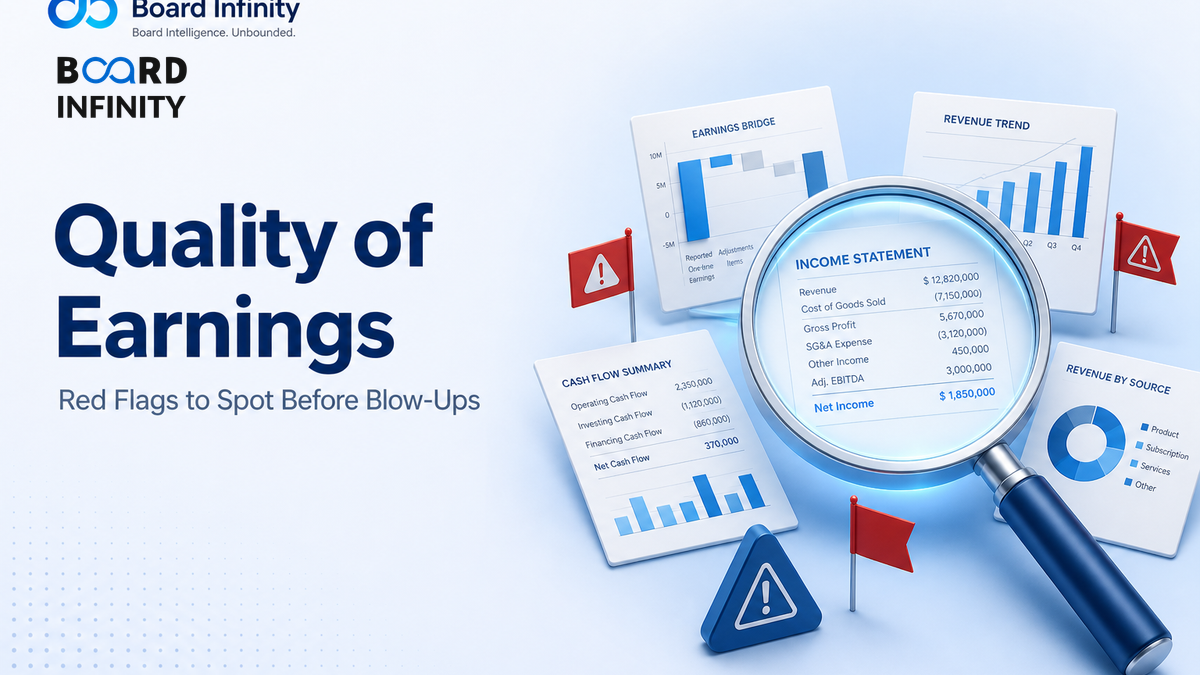
A company can report record profit and still be quietly running out of financial oxygen. The misconception is that the income statement tells you whether a business is healthy - quality of earnings asks a sharper question: how much of that profit is real, repeatable and cash-backed?
- Quality of earnings means reported profit reflects recurring core operations, not one-offs, accounting choices or working-capital stretch.
- The first test is simple: does profit turn into operating cash flow? PAT rising while CFO falls is a classic warning sign.
- Red flags cluster in five places: revenue recognition, receivables, inventory, related-party transactions and auditor or governance signals.
- A business can have high EPS growth and low earnings quality if growth is funded by credit sales, capitalization of expenses or non-recurring gains.
- Use ratios together: CFO/PAT, accrual ratio, DSO, inventory days, gross margin stability and interest coverage.
- Never call a company fraudulent from ratios alone. Say: “These are red flags that need deeper audit, notes and management discussion review.”
The big picture: quality of earnings is not about whether the company made profit on paper. It is about whether that profit is supported by cash, customer reality, conservative accounting and clean governance.
Core Explanation: What Quality of Earnings Really Tests
Quality of earnings is the degree to which reported profit reflects cash-backed, recurring, core operating performance. High-quality earnings are boring in the best way: revenue is collectible, margins are explainable, cash flow follows profit and notes do not hide surprises.
Low-quality earnings do not automatically mean fraud. They mean the number called “profit” may be fragile. The fragility usually comes from one of four sources:
The Red-Flag Loop That Often Precedes a Blow-Up
Most blow-ups do not begin with one dramatic event. They often follow a loop: growth pressure leads to aggressive accounting, cash does not arrive, financing pressure increases, and the company needs even more accounting stretch to maintain the story.
Six Practical Tests for Quality of Earnings
Use these tests in combination. A single weak ratio may be explainable; a cluster of weak ratios across cash flow, working capital and governance is where the risk becomes serious.
Worked Example: Same Profit, Very Different Quality
Suppose a company reports the following simplified numbers:
On the surface, PAT grew from ₹80 crore to ₹100 crore. But the quality tests tell a different story:
The Clean vs Risky Earnings Map
A quick way to think like an analyst is to place the company on two axes: cash conversion and accounting complexity. The best companies sit in the top-left zone: cash-backed and simple to explain.
Definitions
- Quality of earnings: The degree to which reported profit reflects cash-backed, recurring, core operating performance.
- Accruals: Revenues or expenses recognized before the related cash is received or paid.
- Operating cash flow: Cash generated or consumed by the company's normal business operations.
- Non-recurring item: A gain, loss or expense unlikely to repeat in ordinary operations.
Asian Paints is often studied for earnings quality because its profits have historically been supported by strong brands, distribution reach and disciplined working capital. The primary driver is a repeat-purchase, dealer-led paint business with pricing power, supported by supply-chain efficiency and a relatively clean balance sheet. The strategic so what: high-quality earnings usually come from business model strength, not just accounting cleanliness.
Case Study: Brightcom Group and the Cost of Trust Breakdown
Brightcom Group shows how fast reported growth can lose market trust when cash quality, disclosures, governance and regulatory comfort do not move together.

Brightcom Group, a listed Indian digital advertising and technology company, drew intense investor attention after strong reported growth and a complex business footprint across entities and geographies. For a while, the story looked attractive: digital advertising, global clients and high-growth financials.
The quality-of-earnings concern was not one isolated ratio. The primary issue was trust in the reliability of reported numbers. Supporting red flags included complexity in subsidiaries, questions around disclosures, regulatory scrutiny and governance concerns. In 2023, SEBI issued interim orders alleging irregularities relating to financial statements and preferential allotments. The legal and regulatory process matters, so the careful wording is “red flags and allegations,” not a casual declaration of fraud.
The lesson is memorable: earnings quality is not only an accounting concept. It is a market-confidence concept. Once investors doubt whether profit is collectible, recurring and governed well, valuation can compress sharply even before the final legal conclusion.
How AI Changes Quality of Earnings
AI is making quality-of-earnings analysis faster, but not magically correct. The analyst's job shifts from finding every clue manually to asking better questions and verifying the machine's output.
Practical student workflow: Load the company's annual report, latest quarterly results and exchange filings into NotebookLM. Ask: “Create a quality-of-earnings checklist covering CFO/PAT, receivables, inventory, revenue-recognition policy, auditor remarks, related-party transactions and contingent liabilities. Quote the exact page references.” Then verify the numbers manually in Excel before using them in an interview.
Interview Relevance
“A company's PAT has grown 25 percent, but operating cash flow has fallen. How would you assess the quality of earnings?”
Use this sentence: “I would not reject the company only because CFO is weak in one year, but if PAT growth, receivables, accruals and governance red flags all deteriorate together, I would treat the earnings as low quality.”
Common Mistake
The biggest mistake is treating PAT growth as proof of business strength. It costs candidates because finance interviewers expect you to reconcile profit with cash, working capital and notes. One-line fix: always say, “First I will bridge PAT to CFO, then test whether the gap is temporary, explainable and recurring.”
What to Revise Next
Move from spotting red flags to reading real documents. Next, revise Reading an Annual Report with AI: A NotebookLM Workflow so you can extract evidence quickly, then do Case Study: A Full Statement Teardown of a Listed Indian Company to practice the complete finance-interview answer.