
Reconciling Profit to Cash: Interview-Ready CFO and FCF Framework
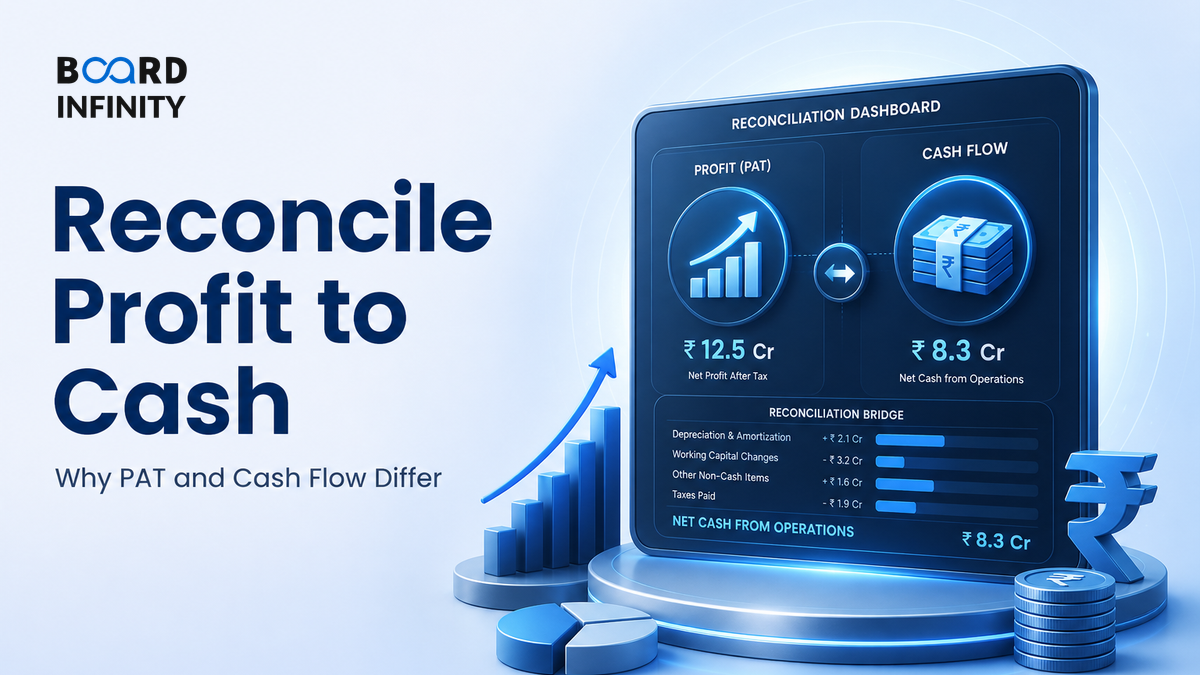
A company can announce record profits and still ask bankers for more working capital the same quarter. That is not fraud by default - it is usually accrual accounting doing its job while cash is stuck in receivables, inventory, capex or loan growth.
- Profit is not cash. Profit follows accrual accounting; cash flow follows actual receipts and payments.
- The clean bridge is: Profit + non-cash items +/- working capital = operating cash flow.
- Depreciation increases cash flow in reconciliation because it reduced profit but did not consume cash in the period.
- Receivables and inventory increases consume cash; payables increases release cash.
- Operating cash flow tells whether the core business generates cash. Free cash flow adds the reinvestment test.
- A profitable high-growth company can have weak cash flow if growth needs credit sales, stock, branches, plants or loan disbursements.
- The interview-safe answer is three layers: accrual adjustments, working-capital movements, investing/financing cash flows.
Big Picture: Profit Measures Performance, Cash Flow Measures Liquidity
Profit answers, “Did the business create accounting value this period?” Cash flow answers, “Did money actually come in or go out?” The reconciliation is a bridge from the income statement to the cash flow statement.
Core Explanation: The Bridge from Profit to Cash
The most common reconciliation starts with profit after tax and converts it into cash flow from operations using the indirect method.
The logic is simple:
Operating Cash Flow = Profit + Non-cash expenses - Non-cash gains +/- Working capital changes
Then, to understand cash available after reinvestment:
Free Cash Flow = Operating Cash Flow - Capital Expenditure
Why Profit and Cash Almost Never Match
There are four reasons profit and cash diverge. If you remember these, you can explain almost any annual report cash-flow movement.
The Three-Layer Reconciliation Framework
Use this as your mental model when reading any cash flow statement.
Worked Example: A Profitable Company with Lower Cash
Assume a company reports profit after tax of ₹100 crore. During the year, depreciation is ₹20 crore, it records a ₹5 crore gain on sale of an asset, receivables rise by ₹30 crore, inventory rises by ₹15 crore and payables rise by ₹25 crore.
The company is profitable, but free cash flow is only ₹55 crore because cash is tied up in customers, inventory and capex. That is the heart of profit-to-cash reconciliation.
Definitions You Should Be Able to Say Cleanly
- Profit: Excess of income over expenses for a reporting period under accrual accounting.
- IAS 7: Cash flows are inflows and outflows of cash and cash equivalents.
- IAS 7: Operating activities are principal revenue-producing activities and other activities not investing or financing.
- Operating cash flow: Cash generated or consumed by the company’s core business operations.
- Free cash flow: Cash left after operating needs and capital expenditure required for the business.
Metrics That Tell Whether Profit Is Becoming Cash
Do not stop at “cash flow is positive.” Analysts compare cash generation against profit, sales, working capital and debt obligations.
Always compare these with the company’s own history and peers. A grocery retailer, an NBFC and a software company will have very different “normal” cash profiles.
Mini Case Study: Bajaj Finance and the Cash Cost of Growth
Bajaj Finance shows why a company can report strong profits while cash flow needs careful interpretation, because lending growth consumes cash before it earns income over time.

Situation: Bajaj Finance is one of India’s best-known NBFCs, operating across consumer finance, SME lending, commercial lending and deposits. In a lending business, the accounting engine is different from a normal product company: interest income accrues over the loan tenure, while the cash outflow happens when the loan is disbursed.
The move: The company built a large lending franchise through distribution, data-led underwriting, cross-selling and partnerships across categories such as consumer durables, personal loans and business loans. The primary growth driver is its ability to originate and manage a large loan book; supporting drivers include risk analytics, repeat customer relationships, diversified products and access to borrowings.
The reconciliation lesson: When an NBFC grows, cash can be consumed by fresh loan disbursements even if the income statement reports profit. Provisions may reduce profit without immediate cash outflow; borrowings may increase financing cash inflow; collections from borrowers gradually convert the loan book into cash.
Outcome or lesson: In financial businesses, profit-to-cash reconciliation must be read with the balance sheet. The “so what” is powerful: strong PAT is not enough; you must ask whether loan growth, collections, provisions and funding quality support sustainable cash generation.
How AI Changes Reconciling Profit to Cash
AI does not change the accounting logic, but it changes how quickly analysts can detect cash-quality issues.
- Faster statement extraction: AI tools can pull PAT, depreciation, working capital movements, capex and borrowings from annual reports and create a first-pass reconciliation table.
- Accrual-quality screening: Models can flag patterns such as profits rising faster than CFO, receivables growing faster than revenue, or inventory building unusually versus sales.
- Scenario forecasting: Finance teams can model how a change in DSO, inventory days or capex plans affects cash runway and funding needs.
Load a company’s annual report and quarterly results into NotebookLM. Ask: “Create a profit-to-CFO bridge, identify the top three working-capital drivers, and generate five interview questions on cash-flow quality.” Then verify every number manually from the cash flow statement.
Interview Relevance
“A company has reported higher profit this year, but its cash flow from operations has fallen. How would you analyse this?”
Use the phrase “earnings quality.” Interviewers like candidates who move from mechanics to judgment: whether reported profit is converting into sustainable cash.
Common Mistake
The biggest mistake is saying, “Profit and cash differ because of depreciation,” and stopping there. That misses working capital, capex and financing - often the real drivers. One-line fix: always reconcile in three layers - non-cash adjustments, working-capital movements, then investing and financing cash flows.
What to Revise Next
Once you can reconcile profit to cash, move from one-company interpretation to comparison and disclosure reading.