
Segment Reporting: Decode a Multi-Business Company in Interviews
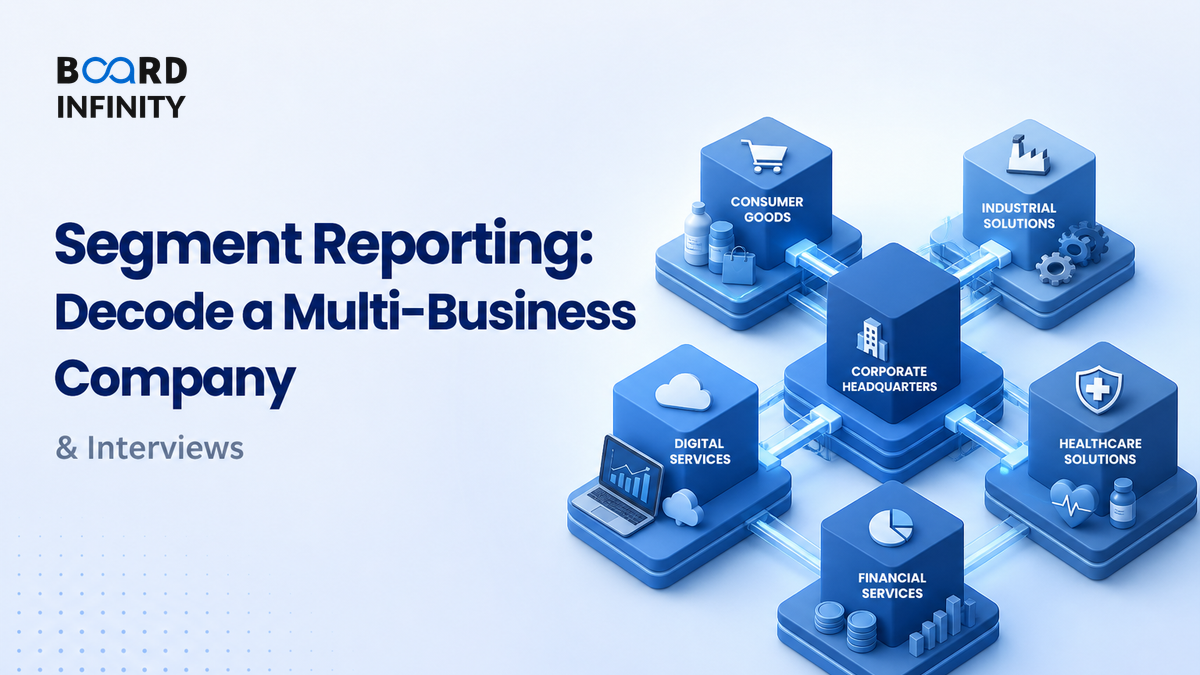
Can one company be both a high-margin technology play and a low-margin construction business at the same time? Yes - and the consolidated P&L will quietly average both into one misleading number unless you read the segment note.
- Segment reporting breaks a multi-business company into operating parts so you can see where revenue, profit, assets and risk really sit.
- Under Ind AS 108 / IFRS 8, segments follow the management approach - how the chief operating decision maker reviews the business internally.
- A segment usually becomes reportable if it crosses a 10% test on revenue, profit/loss or assets; reportable segments must cover at least 75% of external revenue.
- The best analysis compares growth, margin, capital intensity, ROCE and cyclicality - not just segment revenue share.
- For valuation, use sum-of-the-parts thinking: each segment may deserve a different multiple because its economics and risk differ.
- The trap: treating a multi-business company as one homogeneous company. Always ask, “Which segment is driving the story?”
Big Picture: One Company, Many Economic Engines
A consolidated financial statement tells you what the legal group earned. Segment reporting tells you which business model earned it. That distinction matters because a software services segment, a lending segment and an engineering projects segment may have completely different margins, asset needs, growth rates and risks inside the same listed company.
Core Explanation: The Five Questions to Ask
Do not start with “What is total revenue?” Start with “What businesses are inside the company?” A multi-business company is best read like a portfolio: each segment competes in a different market, earns a different margin and deserves a different valuation lens.
What Makes a Segment Reportable?
Indian companies following Ind AS use Ind AS 108 Operating Segments, which is aligned with IFRS 8. The key idea is the management approach: if top management reviews a component separately to allocate resources and assess performance, it may be an operating segment.
The simplified thresholds are:
- Revenue test: segment revenue, including external and inter-segment revenue, is at least 10% of combined segment revenue.
- Profit or loss test: segment profit or loss is at least 10% of the relevant combined profit/loss benchmark under the standard.
- Asset test: segment assets are at least 10% of combined segment assets.
- 75% external revenue test: reportable segments should together cover at least 75% of the entity’s external revenue.
The Metrics That Actually Matter
Segment reporting is useful only when you convert disclosure into economics. These are the numbers to calculate first.
A Quick Worked Example: Why the Average Lies
Suppose Alpha Mobility reports consolidated revenue of ₹2,500 crore and EBIT of ₹265 crore. The company looks like a 10.6% margin business. But the segment note tells a sharper story.
The conclusion changes completely: Digital Services is only 16% of revenue but about 38% of EBIT, while Manufacturing consumes most assets and earns weak returns. A good analyst would not apply one blanket multiple to all three.
The Segment Strategy Matrix
Once you calculate segment economics, place each segment on two axes: growth attractiveness and return on capital. This gives you a boardroom-style view of what management should do next.
Amazon’s segment reporting helped investors see that AWS had very different economics from the retail marketplace and logistics-heavy commerce operations. The primary driver was cloud infrastructure's higher-margin, scalable revenue model, supported by enterprise adoption, developer ecosystem depth and large-scale data-centre capabilities. The strategic so what: one consolidated margin would understate the value of a structurally different business inside the same company.
Definitions You Should Be Able to Say Cleanly
Segment reporting is disclosure of financial information by business or geography so users can assess each segment’s performance, risk and returns.
An operating segment is a component reviewed by the chief operating decision maker with discrete financial information available.
A reportable segment is an operating segment disclosed separately because it meets size thresholds or is otherwise economically important.
Sum-of-the-parts valuation values each business separately and adds them to estimate the value of a diversified company.
Case Study: Larsen & Toubro and the Value of Seeing the Parts
Larsen & Toubro shows why segment reporting matters: the same group houses project businesses, manufacturing-linked businesses and technology services with very different economics.

Situation: Larsen & Toubro is not just a construction company. It has engineering and projects businesses, manufacturing-linked businesses and significant technology services exposure through listed technology entities. A consolidated view alone can blur cyclical project execution risk with the more asset-light economics of technology services.
The move: The useful analytical move is to read L&T through segments and portfolio actions, not just total revenue. Its disclosures help separate project-heavy operations from services-led businesses. Over time, the group has also taken portfolio simplification steps, including the sale of its Electrical & Automation business to Schneider Electric and the sale of L&T Mutual Fund to HSBC, while technology services businesses have remained separately visible to public investors.
Outcome and lesson: The primary driver of clearer analysis is the separation of businesses with different margins, asset intensity and risk cycles. Supporting drivers include portfolio pruning, listed subsidiaries, stronger visibility into capital allocation and the ability to apply different valuation lenses to different businesses. The lesson is not “L&T is good because it is diversified”; the better answer is “which parts create value, which parts absorb capital and how management is reshaping the portfolio.”
How AI Changes Segment Reporting & Understanding a Multi-Business Company
AI does not replace accounting judgment, but it makes segment analysis faster and sharper when used carefully.
- Annual report extraction: LLM tools can extract segment revenue, EBIT, assets and prior-year comparatives from PDFs and convert them into a clean analysis table. The caution: always verify against the original note because segment labels and restatements can change.
- Earnings-call pattern detection: AI can scan management commentary and flag which segments are repeatedly linked to margin pressure, order wins, capex or restructuring.
- Sum-of-the-parts support: AI can help build peer sets by segment, but you must decide whether the peers are economically comparable. A wrong peer multiple gives a precise but wrong valuation.
Load the company annual report, quarterly investor presentation and transcript into NotebookLM. Ask: “Create a segment-wise table of revenue, EBIT, assets, growth drivers, risks and likely interview questions. Flag any segment reclassifications or discontinued operations.” Then verify every number in the original filings.
Interview Relevance
“You are looking at a diversified listed company. How would you use segment reporting to understand whether the company is actually creating value?”
Use this one-liner: “I would not value the company first; I would first identify which segment is driving growth, which is driving profit and which is consuming capital.”
Common Mistake
The mistake: candidates quote consolidated revenue growth and PAT, then call the whole company “strong” or “weak.” This costs marks because it ignores that one segment may be funding another, or one high-value segment may be hidden by a low-return business. Fix: always give a segment-wise sentence: “Segment A drives growth, Segment B drives margins, Segment C absorbs capital - so my conclusion is...”
What to Revise Next
Once segment reporting clicks, move to the accounting mechanics that sit behind multi-business groups and then to the red flags that reveal when reported earnings are not as clean as they look.