
Case Study Ready: Tear Down a Listed Indian Company’s Financial Statements Like an Interviewer
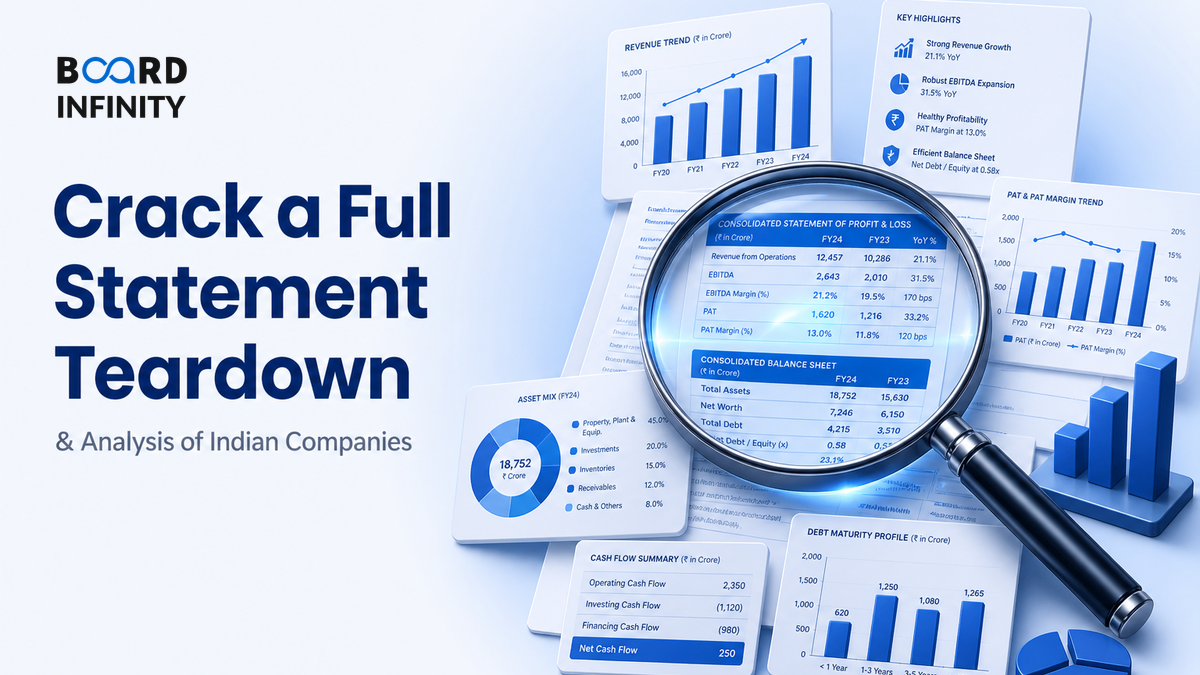
Before the teardown, a listed company’s annual report looks like a heavy PDF full of numbers. After the teardown, the same document becomes a business movie - who makes money, where cash gets stuck, what management is betting on, and whether the story is getting stronger or weaker.
- A full statement teardown connects the P&L, balance sheet, cash flow statement, notes and management commentary into one business story.
- Start with the business model, then test whether revenue, margins, assets, debt and cash flows support that model.
- Profit is not cash. Always reconcile PAT to CFO before trusting headline profitability.
- For a listed Indian company, read standalone and consolidated numbers, especially if subsidiaries, JVs or overseas entities matter.
- Track 6 core measures: revenue growth, gross margin, EBITDA margin, ROCE, inventory turns and CFO/PAT conversion.
- The best answers do not recite ratios. They explain why the ratio moved and whether that move is operational, financial or accounting-driven.
- Common red flags include rising receivables, weak operating cash flow, margin expansion without explanation, high related-party transactions and frequent exceptional items.
Big Picture: A Teardown Turns Accounting Into Business Judgment
A surface read asks, “Did revenue and profit grow?” A teardown asks, “What had to happen inside the business for those numbers to appear, and is it sustainable?” That shift is what separates a finance student from a business analyst.
Core Explanation: The Five-Lens Teardown Framework
Use the annual report like a detective file. Each statement gives one angle; the truth appears only when all angles agree.
The five-lens framework is simple enough to use in a 2-minute interview answer and deep enough for a proper case discussion.
The Statement-by-Statement Teardown
1. Profit and Loss Statement: Is the Profit Engine Improving?
The P&L tells you what the company sold, what it spent and what profit remained. But do not stop at PAT. Break the P&L into operating drivers.
2. Balance Sheet: What Resources and Risks Sit Behind the Profit?
The balance sheet shows what the company owns, owes and has funded through shareholder capital. It answers whether growth is asset-light, working-capital-heavy or debt-funded.
3. Cash Flow Statement: Did Profit Actually Become Cash?
The cash flow statement is the lie detector. A company can report accounting profit while cash is locked in receivables, inventory, capex or debt repayment.
Read cash flow in three parts:
- Cash flow from operations: cash generated by the core business after working-capital movements.
- Cash flow from investing: capex, acquisitions, investments and asset sales.
- Cash flow from financing: debt raised or repaid, equity issuance, dividends and buybacks.
Key Metrics to Track in a Full Statement Teardown
Benchmarks vary by sector, so compare against the company’s history and closest peers. For a retail or consumer-facing listed company, these are the six ratios that quickly reveal quality.
Worked Example: Turning Three Statements Into One Diagnosis
Use this as an interview practice template. These are simplified illustrative numbers, not taken from any specific company.
Diagnosis: The P&L looks excellent, but cash conversion has weakened because working capital absorbed cash. A strong answer would say: “Growth and margins improved, but I would not call it high-quality growth until I understand inventory build-up and receivable collection.”
Definitions You Should Say Clearly
- P&L statement: A statement showing revenue, expenses and profit earned over a period.
- Balance sheet: A snapshot of assets, liabilities and shareholders’ equity at a specific date.
- Cash flow statement: A statement explaining cash generated and used in operating, investing and financing activities.
- Free cash flow: Operating cash flow minus capital expenditure needed to maintain or grow the business.
- Capital employed: The long-term capital invested in the business through equity, debt and other operating funding.
Case Study: Trent Limited’s Retail Growth Seen Through the Full Statement Lens
Trent shows how a listed Indian retailer’s story becomes clearer when store expansion, margins, working capital and cash flows are read together.

Trent Limited, part of the Tata group, operates fashion and lifestyle retail formats including Westside and Zudio, along with other retail interests. In recent years, investors have closely watched Trent because its growth story has not been only about opening more stores; it has also been about format economics, private-label strength, inventory discipline and execution speed.
Situation: Indian fashion retail is highly competitive. Consumers are value-conscious, mall rentals can be expensive, inventory risk is real, and markdowns can destroy margins. A retailer can grow revenue rapidly and still damage shareholder value if it expands with poor store productivity or bloated working capital.
The move: Trent scaled a portfolio where Westside plays in curated fashion and lifestyle, while Zudio addresses value fashion with a sharper price-value proposition. The primary driver has been disciplined retail format execution - stores, merchandise, sourcing and customer proposition working together. Supporting drivers include private-label focus, store expansion, tight merchandising, brand architecture across formats and operating leverage as the revenue base scales.
The lesson: A full statement teardown prevents a shallow “revenue is growing, so the company is good” answer. For Trent, you would test whether revenue growth is accompanied by stable or better margins, controlled inventory, healthy cash conversion, sensible lease obligations and segment-level consistency.
So what: Trent is a useful interview case because it forces you to connect strategy with accounting. The financial statements are not separate from the business model; they are the proof of whether the model is scaling well.
Red Flags to Check Before You Trust the Story
A teardown is not only about appreciating performance; it is also about protecting yourself from attractive but fragile stories.
How AI Changes Full Statement Teardown
AI does not replace financial judgment, but it dramatically speeds up document reading, cross-checking and question generation.
- Annual report extraction: AI tools can summarize long annual reports, identify key accounting policies, pull management commentary and list major year-on-year changes. The analyst still verifies the source pages.
- Pattern and anomaly detection: AI can flag unusual movements such as receivables growing faster than sales, rising lease liabilities, repeated exceptional items or divergence between PAT and CFO.
- Cross-source triangulation: AI can compare annual reports, investor presentations, exchange filings, credit rating reports and earnings-call transcripts to test whether management’s story is consistent.
Upload the company’s latest annual report, investor presentation and one peer’s annual report into NotebookLM. Ask: “Create a full statement teardown covering business model, P&L, balance sheet, cash flow, key ratios, red flags and five interview questions with model answers.” Then verify every number from the original PDF before using it.
Interview Relevance
“Pick any listed Indian company you follow. Walk me through how you would analyze its annual report and decide whether the business is financially healthy.”
Use this closing line: “My view is positive only if the P&L growth is backed by cash conversion and capital efficiency; otherwise I would treat it as growth with quality risk.”
Common Mistake
The biggest mistake is giving a ratio dump - “ROE is X, margin is Y, debt-equity is Z” - without linking the ratios to the business model. It costs candidates because it sounds mechanical. Fix: always say what changed, why it changed, and whether that change improves or weakens the business.
What to Revise Next
This is the final lesson, so move from learning to performance. Pick one listed Indian company, download its latest annual report, and prepare a 3-minute teardown using the five-lens framework. Then do one capstone review: compare it with one peer and write your final investment or business-quality judgment in five sentences.