
How to Read an Income Statement Line by Line in Interviews
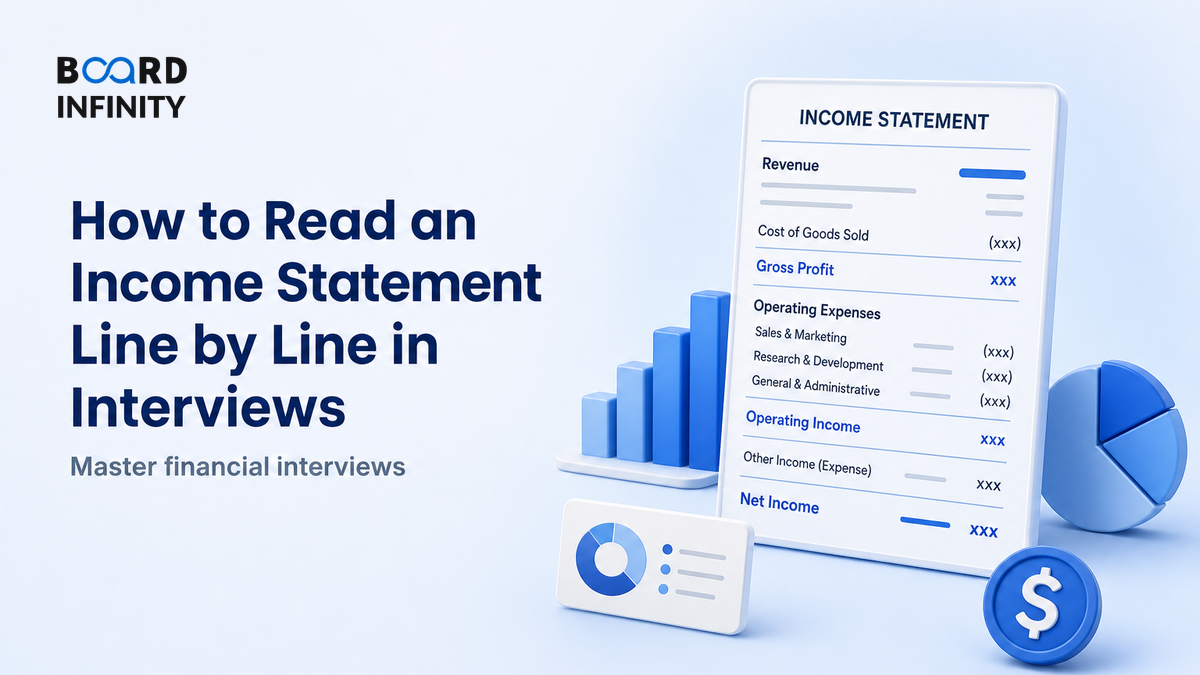
A company can look brilliant at the top and ordinary at the bottom. Revenue may be racing ahead, but after discounts, inventory costs, salaries, rent, depreciation, interest and tax, the real story may shrink to a thin line called profit.
- The income statement explains performance over a period - usually a quarter or year - not what the company owns on one date.
- Read it like a waterfall: Revenue from operations - operating costs - depreciation - interest - tax = profit after tax.
- Gross margin shows product or service economics; operating margin shows cost discipline; net margin shows what shareholders finally keep.
- Other income, exceptional items and finance costs can distort profit quality, so never stop at PAT alone.
- Compare vertically and horizontally: each line as a % of revenue, and each line versus last year or peers.
- For Indian companies, watch Revenue from Operations, Other Income, Finance Costs, Depreciation, Tax Expense, PAT and EPS under Ind AS presentation.
- Best interview answer: start with revenue growth, then margin bridge, then one-offs, then tax/interest, then EPS and profit quality.
The Big Picture
An income statement is not a random list of accounting lines. It is a performance funnel: the company starts with customer revenue, then every business claim on that revenue is deducted until only shareholder profit remains.
Core Explanation: Read the Income Statement Line by Line
The fastest way to read an income statement is to ask one question at each line: what business force is taking value away from revenue? Raw material cost, employee cost, rent, depreciation, debt, tax and dilution all tell a different story.
The Margin Ladder: The Cleanest Way to Diagnose Profitability
Margins convert rupee amounts into percentages of revenue. That makes a ₹500 crore company and a ₹50,000 crore company comparable. In interviews, the margin ladder is your strongest shorthand for explaining where performance improved or broke down.
Key Metrics to Track on an Income Statement
Do not memorise one universal “good margin.” A supermarket, bank, software firm and airline have different economics. The right benchmark is the company’s own history and its closest listed peers.
A Small Worked Example: From Revenue to EPS
Assume a hypothetical listed company has ₹1,000 crore revenue. Here is how the income statement flows line by line.
The quick diagnosis: gross margin is 40%, EBITDA margin is 18%, operating margin is 13%, net margin is 7.5% and interest coverage is 4.3x. That is a much richer answer than saying, “The company made ₹75 crore profit.”
Definitions You Must Say Cleanly
- Income statement: “The income statement presents information on the financial results of a company’s business activities over a period of time.” - CFA Institute
- Income: Increases in assets or decreases in liabilities that increase equity, other than owner contributions. - IFRS Conceptual Framework
- Expenses: Decreases in assets or increases in liabilities that decrease equity, other than distributions to owners. - IFRS Conceptual Framework
- EPS: Earnings per share equals profit attributable to ordinary shareholders divided by weighted average ordinary shares outstanding.
The Two-Sided Comparison Candidates Often Miss
The income statement is prepared on accrual accounting, not pure cash accounting. That means revenue may be recorded before cash is collected, and expenses may be recognised before or after cash is paid. This is why a company can be profitable and still face cash pressure.
A retailer may report higher profit after tax because sales rose, but if inventory also piled up and receivables increased, cash flow may not look equally strong. The strategic “so what” is simple: the income statement tells you whether the model earns profit; the cash flow statement tells you whether that profit is converting into cash.
Case Study: Trent and the Retail Income Statement
Trent shows how a retail income statement can reveal the journey from store-led revenue growth to operating leverage and profit quality.

Trent, the Tata Group retail company behind Westside and Zudio, is a useful Indian example because its income statement is not just about “sales went up.” The deeper story is how a fashion retailer converts store expansion, private-label assortment and tight merchandising into better operating economics.
Situation: Indian fashion retail is competitive, price-sensitive and operationally demanding. A company can open stores quickly and still hurt profitability if discounting rises, rent burdens grow or inventory turns slow.
The move: Trent scaled formats such as Westside and Zudio with a strong private-label orientation and disciplined store-level execution. The primary driver was a scalable retail model with clear customer propositions; supporting drivers included assortment control, store expansion, merchandising discipline and operating-cost leverage as revenue grew.
The lesson: In a retail income statement, do not stop at revenue growth. Check whether gross margin holds, employee and rent-related costs scale sensibly, depreciation reflects expansion, and PAT growth is supported by operating profit rather than only other income.
The strategic takeaway: Trent’s income statement should be read as a retail productivity story - revenue growth is the headline, but gross margin stability and operating leverage are the proof.
How AI Changes Reading an Income Statement
AI does not remove the need to understand accounting. It changes how quickly you can extract, compare and question the numbers.
Load a company’s annual report and quarterly results into NotebookLM. Ask: “Create a three-year income statement trend table, identify the top three drivers of margin change, and generate five interview questions on profit quality.” Then verify every number against the original filing.
Interview Relevance
“Pick any listed company you follow. Walk me through its income statement and tell me whether its profit growth looks healthy.”
Use one sentence like this: “Revenue growth is strong, but I would trust it only if gross margin is stable, operating costs are scaling slower than sales, and PAT is not being lifted mainly by other income or one-offs.”
Common Mistake
The mistake: saying “profit increased, so the company performed well” without checking margins, other income, finance cost, tax and EPS. Why it costs candidates: it sounds like you read only the headline, not the business. One-line fix: always explain profit growth through the margin ladder and then test whether it is core, recurring and cash-convertible.
What to Revise Next
Once you can read the income statement, complete the three-statement view. Revise these next so you can connect profitability, financial position and cash generation in one answer.