
Advertising Strategy & Creative Briefs: How to Build an Interview-Ready Campaign Logic
A chocolate bar once turned laziness into a brand asset: Cadbury 5 Star did not ask young India to hustle harder, it told them to “do nothing.” That is advertising strategy at work - not a clever line first, but a sharp business problem translated into a memorable creative direction.
- Advertising strategy decides who to influence, what belief to change, what promise to make, and how success will be measured.
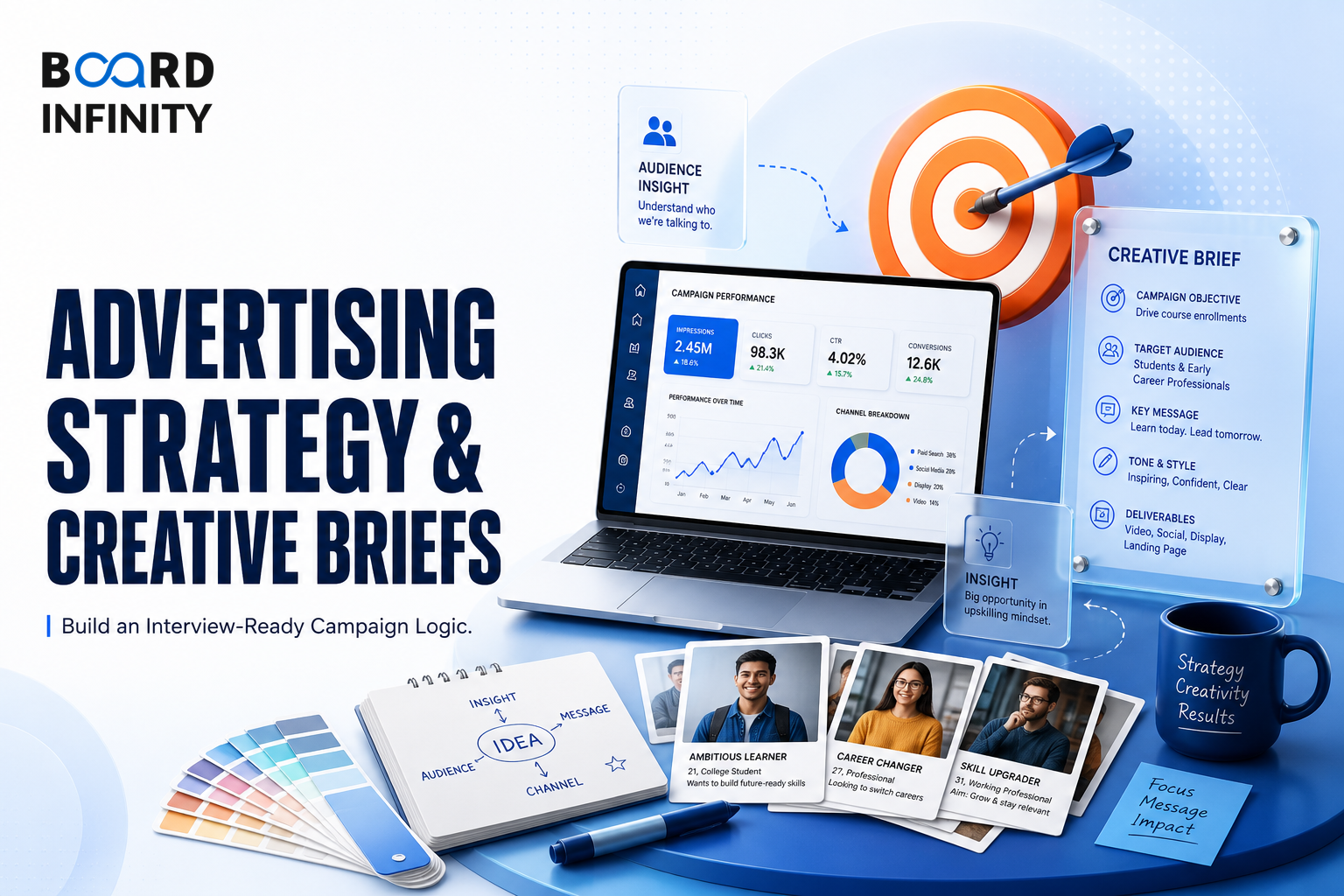
- A creative brief is the bridge between business strategy and creative execution - it turns marketing logic into a usable idea for copywriters, designers, filmmakers, and media teams.
- A strong brief is single-minded: one target, one core insight, one main proposition, one desired response.
- The best creative idea usually comes from tension: what the consumer wants, believes, fears, ignores, or secretly admits.
- Judge advertising on both brand metrics and business metrics: reach, frequency, CTR, conversion rate, ROAS, and brand lift.
- The common trap is writing a “nice ad idea” before defining the business problem and audience belief to be changed.
The Big Picture
Advertising strategy is a translation job. It converts a business objective into a consumer problem, then into a single creative promise that can be executed across film, digital, outdoor, social, retail, and performance media.
Core Explanation: From Strategy to a Winning Creative Brief
The big idea: advertising strategy is not the ad. It is the logic that makes the ad necessary, relevant, distinctive, and measurable.
A weak team says, “Let us make a funny reel.” A strong team says, “Our young working audience treats packaged snacks as boring fillers; we will make this brand feel like a small rebellion during their daily pressure moments.” The second statement gives creative people something to build on.
The Five-Step Process for Advertising Strategy
The Anatomy of a Strong Creative Brief
A creative brief should be short enough to be used and sharp enough to prevent random creativity. If a copywriter cannot tell what the one idea is, the brief has failed.
What Makes Advertising Strategy Work
Great advertising strategy balances four decisions.
Dove’s long-running Real Beauty platform worked because it addressed a real consumer tension around narrow beauty standards. The primary driver was a powerful cultural insight, supported by consistent brand behaviour, distinctive documentary-style execution, and product credibility in personal care. The strategic so what: a brand idea becomes powerful when it can guide many campaigns, not just one ad.
Advertising Metrics: What to Track and How to Read It
Advertising is creative, but it is not guesswork. Choose metrics based on the objective: awareness campaigns need reach and brand lift; performance campaigns need conversion and ROAS; full-funnel campaigns need both.
Worked example: Suppose a D2C brand spends ₹2,00,000 on ads and attributes ₹7,00,000 in revenue to the campaign. ROAS = ₹7,00,000 / ₹2,00,000 = 3.5x. If gross margin is 40 percent, break-even ROAS = 1 / 0.40 = 2.5x. Contribution after media = ₹7,00,000 × 40 percent - ₹2,00,000 = ₹80,000. So the campaign is not just generating sales - it is likely profitable before other operating costs.
Definitions You Can Say in One Breath
Advertising, per Kotler and Keller: “Any paid form of nonpersonal presentation and promotion of ideas, goods, or services by an identified sponsor.”
Cadbury 5 Star: Turning “Do Nothing” into Advertising Strategy
Cadbury 5 Star built a distinctive Indian advertising platform by making the small act of doing nothing feel funny, ownable, and culturally sharp.

Situation: The impulse chocolate and snack category is crowded. Many brands can talk about taste, energy, sharing, indulgence, or fun. Cadbury 5 Star needed a memory structure that was not just another “tasty chocolate” claim.
The move: The brand leaned into a contrarian consumer insight: young people are surrounded by pressure to be productive, responsive, and always “on.” Instead of celebrating hustle, 5 Star built its communication around the idea of doing nothing. The product’s leisurely, chewy consumption experience supported the proposition, while the deadpan humour made it distinctive.
The outcome and lesson: The “Do Nothing” platform became a recognisable brand world rather than a one-off joke. Its primary driver was the sharp opposite stance against productivity culture, supported by consistent tone, product fit, absurdist storytelling, and flexibility across cultural moments. The lesson for interviews: strong creative work usually has a strategic spine underneath it.
How AI Changes Advertising Strategy & Creative Briefs
AI is changing advertising strategy in practical ways, but it does not replace judgement. It makes research, variation, and testing faster - the strategist still chooses the sharpest human truth.
- Faster audience and insight mining: Teams can summarise reviews, social comments, Reddit threads, app-store complaints, search queries, and customer calls to detect repeated tensions. The risk is mistaking loud online comments for the full market.
- Dynamic creative optimisation: Platforms can test many headlines, visuals, CTAs, and formats, then shift spend toward better-performing combinations. This helps performance, but it can also create fragmented brand memory if no core idea guides the variants.
- Synthetic pre-testing and concept iteration: AI can help generate rough creative routes, predict likely objections, and simulate audience reactions. Use it as a sparring partner, not as final consumer truth.
Use NotebookLM or Claude to upload a brand’s annual report, recent ads, customer reviews, and competitor ads. Ask: “Create a creative brief with business problem, audience belief, insight, proposition, RTB, tone, mandatories, and metrics. Then critique it for vagueness.” Finally, rewrite the brief yourself in one page.
Interview Relevance
“Pick a brand you like and write a creative brief for its next campaign. How will you know if the campaign worked?”
In an interview, speak like a strategist before you speak like a copywriter. A line, slogan, reel idea, or film script should come only after the brief is clear.
Common Mistake
The biggest mistake is confusing creative execution with advertising strategy - jumping to “make it funny” or “use influencers” without defining the audience belief to change. Fix it in one line: first write the problem, insight, proposition, and metric; then suggest the creative route.
What to Revise Next
Once you can write a strong creative brief, move to how that idea reaches people and how the brand handles public perception beyond paid ads.