
Measuring Communication & Campaign Effectiveness: Interview-Ready Framework, Metrics and Case Study
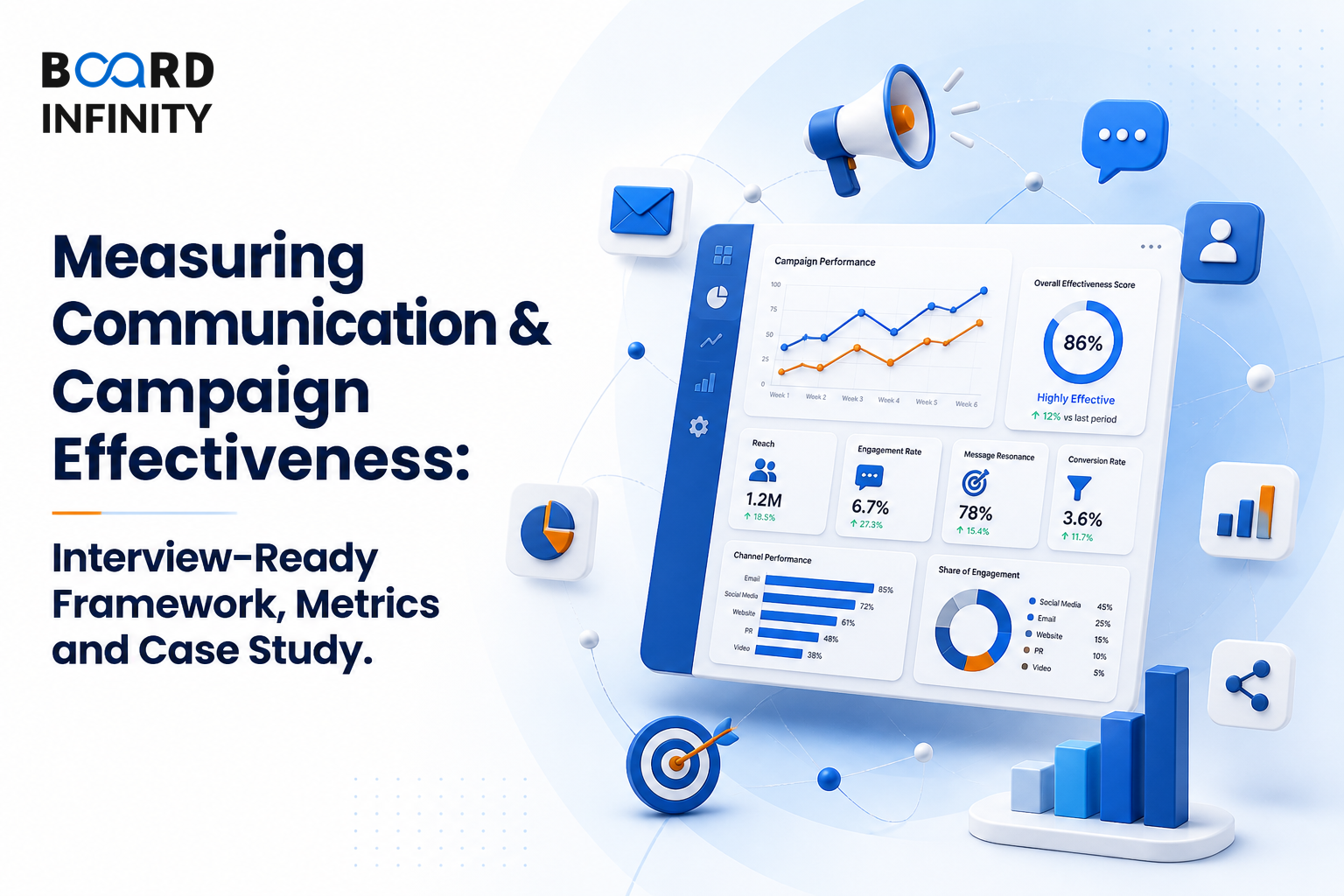
If a campaign gets millions of views but nobody remembers the brand, did it work? The uncomfortable truth is that many campaigns are celebrated for noise, while the real job is to prove whether communication changed minds, behaviour, or business outcomes.
- Campaign effectiveness means measuring whether communication achieved the objective it was designed for - awareness, preference, leads, sales, retention, or advocacy.
- Do not jump straight to sales. Good measurement follows the chain: exposure - attention - understanding - persuasion - action - business impact.
- Use different metrics for different objectives: reach and frequency for awareness, brand lift for persuasion, CTR and CVR for response, ROAS and incremental lift for business impact.
- The strongest proof is incrementality: what happened because of the campaign, not what would have happened anyway.
- Separate leading indicators like ad recall and engagement from lagging indicators like revenue, repeat purchase and market share.
- A campaign is not effective just because it is creative. It is effective when the message, media, audience and measurement design all support the same objective.
- Interview-safe answer: start with objective, map the funnel, select 4-6 metrics, compare against a baseline or control group, and end with a learning loop.
Think of campaign measurement as a logic chain, not a dashboard dump. A brand first buys or earns exposure, then tries to earn attention, create memory, shift attitude, trigger action and finally produce business value.
Core Explanation: How to Measure a Campaign Properly
The big idea is simple: effectiveness is objective-led. A launch campaign, a festive sale campaign, a brand repositioning campaign and a retention campaign cannot be judged by the same metric.
Use this five-step process.
The Metrics That Actually Matter
Campaign metrics become useful only when they are tied to the objective. A reach campaign needs sufficient frequency. A performance campaign needs cost-efficient conversions. A brand campaign needs memory and preference lift. A serious answer should name the metric, formula and interpretation.
Notice the last line carefully: attributed revenue is not the same as incremental revenue. If a customer would have bought anyway, the campaign should not take full credit.
Measurement Methods: From Weak Proof to Strong Proof
Not all measurement methods have equal credibility. A pre-post sales rise may look impressive, but it can be caused by seasonality, distribution expansion, discounts, competitor stock-outs or festival demand. Stronger methods compare the campaign-exposed group against a credible counterfactual.
A food-delivery app measuring a weekend coupon campaign may track app opens, coupon redemptions, conversion rate, cost per order and incremental orders. The same company measuring a trust campaign around hygiene or delivery reliability should add ad recall, consideration, sentiment and repeat usage over time. The strategic so what: the metric must follow the campaign objective, otherwise good work gets judged by the wrong scoreboard.
Definitions You Should Be Able to Say Clearly
Kotler and Keller: “Marketing communications are the means by which firms attempt to inform, persuade and remind consumers directly or indirectly about the products and brands they sell.”
Case Study: Ariel India and #ShareTheLoad
Ariel India turned laundry detergent communication into a long-running behaviour-change platform by measuring not just reach, but conversation, memory and relevance.
Situation: Detergent advertising in India has traditionally competed on functional promises - stain removal, whiteness, fragrance and value. Ariel, a P&G brand, needed a sharper brand meaning in a crowded category where product claims alone could be copied.
The move: Ariel launched #ShareTheLoad, a campaign platform asking why laundry is usually treated as a woman's responsibility. Instead of only showing superior cleaning, the brand connected the category to an everyday Indian household tension: unequal domestic work. The primary driver was a culturally resonant insight linked directly to the product's usage occasion. Supporting drivers included emotional storytelling, repeated multi-year execution, earned media conversation, social participation and consistency with the brand's laundry category role.

Outcome and lesson: The campaign became one of India's most recognised examples of purpose-led brand communication because it created memory around a simple behavioural question: who does the laundry? The lesson for measurement is powerful: for a campaign like this, judging only immediate sales would be too narrow. A better scorecard includes ad recall, brand association with shared responsibility, social conversation quality, consideration, purchase intent and long-term brand equity.
So what: Ariel shows that campaign effectiveness is not one metric. The campaign's primary strength was a deep category-linked cultural insight, supported by consistent execution, earned conversation and measurement across both brand and behaviour indicators.
How AI Changes Measuring Communication & Campaign Effectiveness
AI is making campaign measurement faster, but it does not remove the need for a clear objective and a valid comparison. In 2026, the strongest marketers use AI to improve measurement design, not merely to generate prettier dashboards.
Use NotebookLM or Perplexity to load a company's annual report, campaign articles and platform screenshots. Ask: “What was the likely objective, target audience, funnel metric, business metric and possible control group for this campaign?” Then convert the answer into a one-page measurement scorecard.
Interview Relevance
“Suppose a brand ran a digital campaign that got high views and engagement. How would you evaluate whether the campaign was actually effective?”
Use this sentence in interviews: “I would not call the campaign effective just because engagement was high; I would check whether the intended audience moved from exposure to the desired behaviour better than a comparable baseline or control group.”
Common Mistake
The biggest mistake is treating vanity metrics like views, likes or impressions as proof of effectiveness. They only prove exposure or interaction, not persuasion or business impact. One-line fix: always connect the metric to the campaign objective and compare it against a baseline or control.
What to Revise Next
Next, revise Case Study: Campaign Breakdowns - Cadbury, Zomato & Nike. Once you know how to measure campaign effectiveness, those breakdowns will help you see how real brands convert insight, creative idea, media choice and metrics into a complete campaign story.