
Generative AI in Advertising - Explain Creative at Scale in Interviews
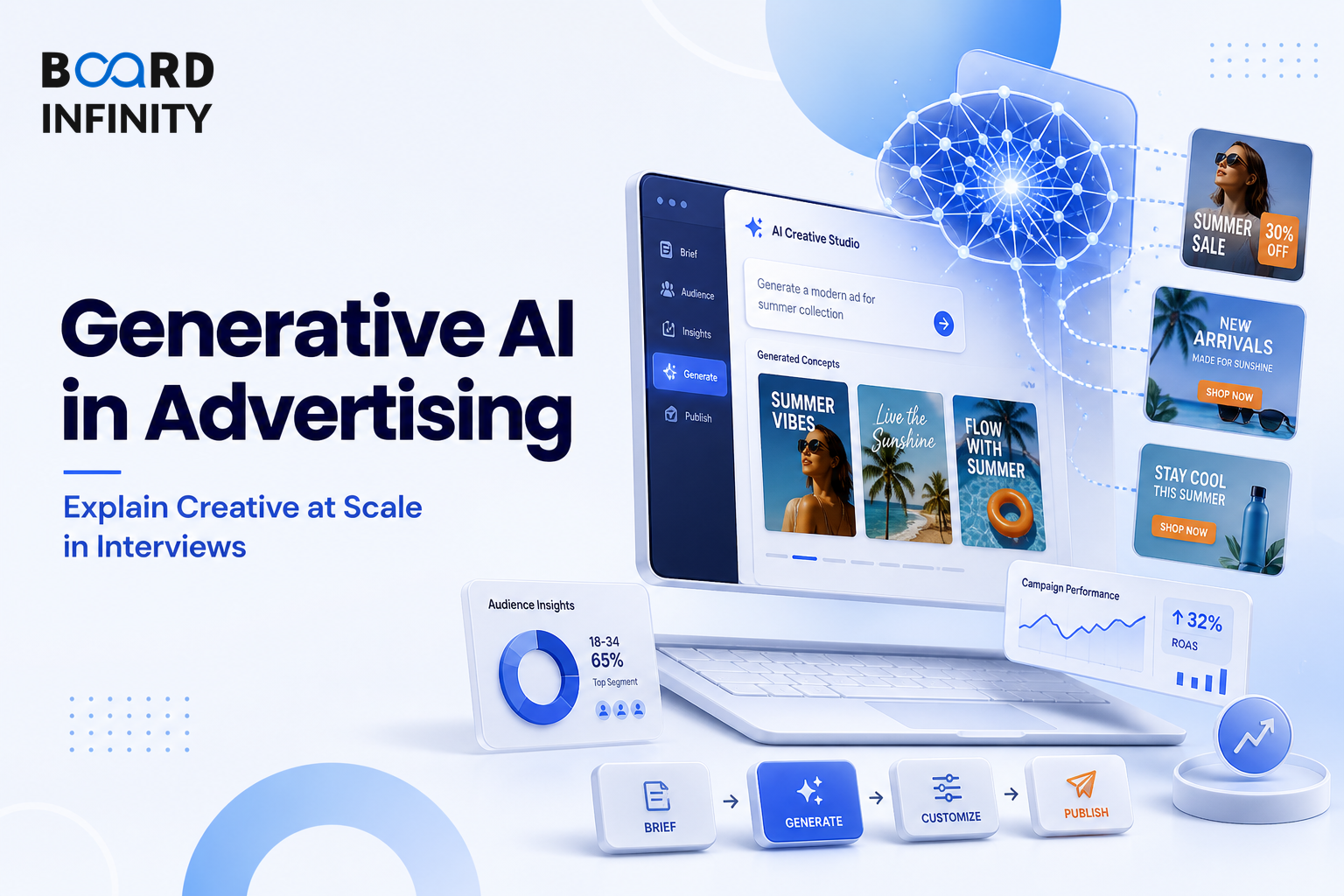
One festive campaign once meant a hero film, a print adaptation and a few banner sizes. Now the same brand idea can become hundreds of language, location, audience and offer variations - but only the good teams know which parts to automate and which parts must stay human.
- Generative AI in advertising uses AI to create copy, images, video, audio and layout variants from a human-approved brand brief.
- The strategic job is not “make more ads”; it is make more relevant ads without losing the brand idea.
- The winning model is: insight - big idea - prompt and asset system - brand/legal guardrails - test - learn - refresh.
- GenAI scales execution fastest in headlines, social posts, display ads, product copy, email subject lines, local-language adaptations and personalised video shells.
- Humans still own the consumer insight, positioning, emotional story, cultural judgement, ethics and final approval.
- Track GenAI creative using CTR, CVR, CPA, ROAS, brand lift and creative fatigue - never judge it only by “number of assets produced”.
- The biggest risk is off-brand sameness: thousands of polished assets that do not carry a distinctive memory structure.
The Big Picture
Generative AI, or GenAI, changes advertising from a linear production model to a creative operating system. The brand still needs a sharp idea; AI simply helps translate that idea into many relevant versions at lower time and coordination cost.
How Generative AI Creates Advertising at Scale
The core idea is simple: separate the campaign into what must stay consistent and what can vary. The brand promise, tone, distinctive assets, legal claims and ethical limits stay fixed. The headline, call-to-action, language, product angle, location cue, offer and format can change by audience and channel.
What actually scales
GenAI is strongest when the creative task is modular. It can generate many options for a defined pattern, but it is weaker when the task requires deep cultural originality, sensitive judgement or a new positioning decision.
Coca-Cola’s 2023 “Create Real Magic” initiative let people create AI-assisted artwork using Coca-Cola brand assets through a platform built with OpenAI and Bain. The primary driver was a participatory creative platform around iconic brand codes, supported by strong visual memory assets, technology access and moderation. So what: GenAI works best when it amplifies recognisable brand assets, not when it produces generic content from scratch.
Metrics: How to Judge GenAI Creative
Do not evaluate GenAI advertising by output volume. A team that produces 500 weak ads has not created marketing value. Measure whether variants improve efficiency, relevance and brand memory against a control.
Suppose a brand spends ₹5,00,000 testing GenAI variants against a control and earns ₹18,00,000 in attributed revenue. ROAS = ₹18,00,000 / ₹5,00,000 = 3.6x. If the control CPA is ₹250 and the best variant CPA is ₹190, the variant saves ₹60 per conversion - but you would still check brand lift and complaint signals before scaling it.
Definitions You Can Say in One Breath
Kotler and Armstrong: “Advertising is any paid form of nonpersonal presentation and promotion of ideas, goods, or services by an identified sponsor.”
- Generative AI: AI that creates new content from patterns learned in training data.
- Creative at scale: Producing many brand-safe creative variants from one strategic idea for different audiences, formats and contexts.
- Dynamic Creative Optimization: A system that assembles and serves ad elements based on audience, context and performance data.
- Prompt engineering: Writing clear instructions, examples and constraints so an AI model produces useful creative output.
Cadbury Celebrations: Personalised Festive Advertising at Local Scale
Cadbury Celebrations used AI-enabled personalisation to help local Indian retailers appear inside festive advertising, proving that scale can serve both brand memory and local relevance.

Situation: Diwali gifting is a high-emotion, high-competition moment in India. Large brands can dominate media, while neighbourhood retailers often depend on local footfall, WhatsApp sharing and personal trust. Cadbury Celebrations already had strong festive memory, but the challenge was making a national brand idea feel useful to thousands of local shopping moments.
The move: Mondelez India and its agency partners created “Not Just a Cadbury Ad”, using AI-enabled video personalisation so local retailers could generate customised versions of a Cadbury festive ad. The campaign is widely remembered for using a major Bollywood celebrity template while inserting local store references, turning a national festive platform into a local retailer support mechanism.
Outcome and lesson: The campaign became a reference point for AI-led advertising in India because it did not use personalisation as a gimmick. The primary driver was a strong modular creative system: a consistent festive brand idea plus AI-assisted local adaptation. Supporting drivers included Cadbury’s existing Diwali association, celebrity equity, retailer participation, shareable digital distribution and clear executional guardrails. The lesson for interviews: GenAI wins when it scales relevance while protecting the brand memory structure.
How AI Changes Generative AI in Advertising
By 2026, the shift is moving beyond “generate a headline” to integrated AI creative systems. Three changes matter for interviews:
- From static assets to adaptive creative systems: Brands can connect product feeds, audience segments and creative rules so AI generates and refreshes assets for different channels. The marketer’s new skill is defining the rulebook, not typing one-off prompts.
- From A/B testing to creative intelligence: AI can summarise which hooks, visuals, offers and tones are working across Meta, Google, programmatic, email and ecommerce pages. This turns campaign data into the next creative brief.
- From content generation to governance: Synthetic images, AI voice, celebrity likeness, deepfakes, copyright and data privacy create new approval needs. In India, marketers must be especially careful with consent, misleading claims, platform rules and personal data use under the DPDP Act framework.
Use NotebookLM or Claude before an interview: upload the brand’s recent campaign pages, annual report excerpts and 3 competitor ads. Ask: “Identify the brand codes, target segments, likely GenAI use cases, risks and 5 interview questions on creative at scale.” Then build one answer using the insight - idea - variants - guardrails - metrics flow.
Interview Relevance
“A D2C personal care brand wants to use generative AI to create ads at scale. How would you design the process, and how would you ensure the ads remain effective and on-brand?”
Use this sentence in answers: “GenAI should scale the executional layer, not outsource the strategic layer.” It signals that you understand both creativity and control.
Common Mistake
The costly mistake is saying, “AI will make thousands of ads, so performance will improve.” That misses strategy, brand consistency, consent, testing design and creative fatigue. One-line fix: say that GenAI creates value only when a strong human idea is converted into governed variants and measured against a control.
What to Revise Next
Revise this as a journey: first understand what makes a campaign memorable, then learn how to prove whether communication worked.