
Media Planning & Buying Fundamentals: Interview-Ready Framework, Metrics and Case Study
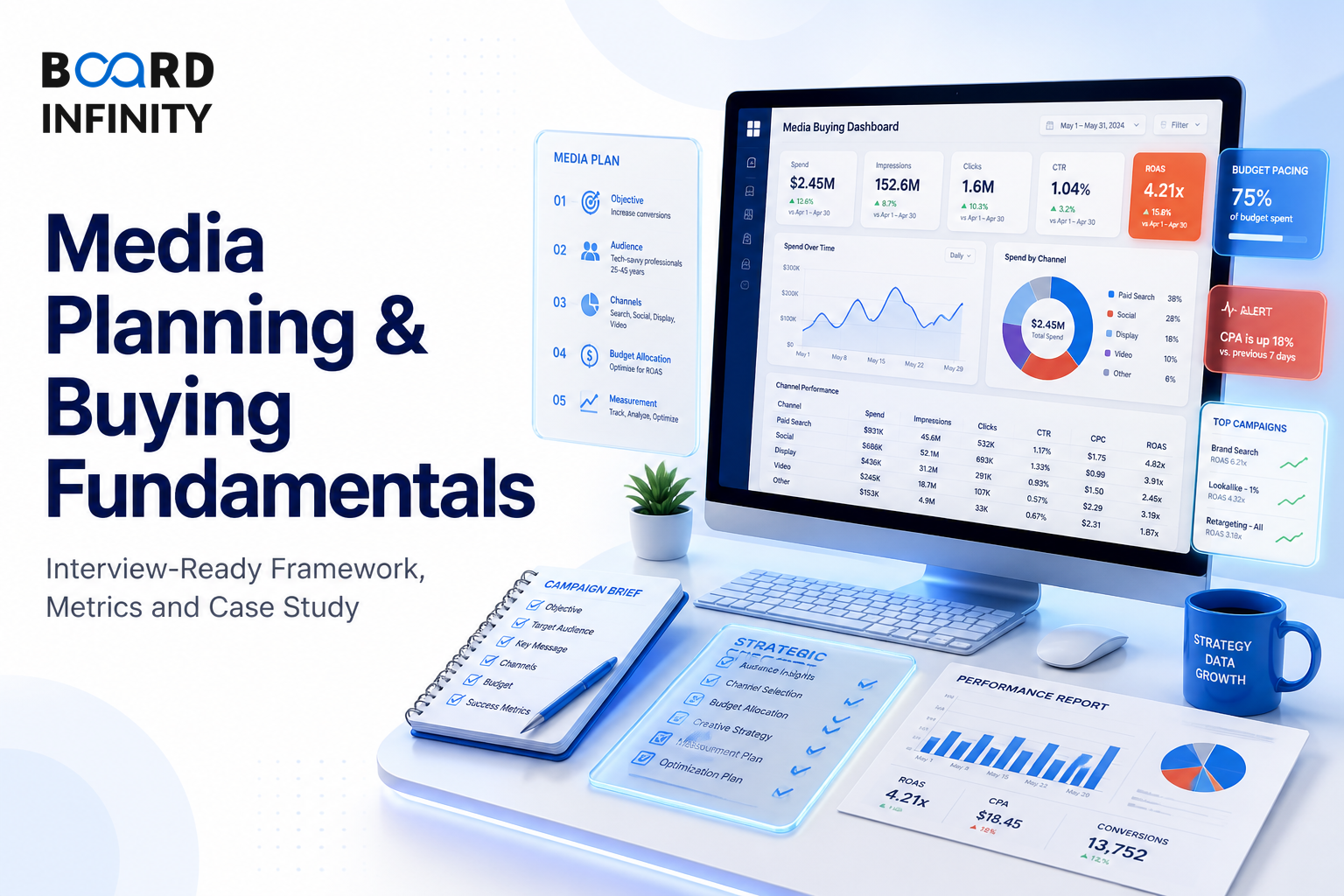
What if the most expensive ad in a campaign is not the TV spot or the front-page print ad, but the impression shown to the wrong person at the wrong moment? Media planning and buying is the discipline that prevents that waste - it decides where the message should appear, how often, at what cost, and with what proof of impact.
- Media planning decides the audience, objective, media mix, budget, schedule and success metrics.
- Media buying executes the plan by negotiating, purchasing, trafficking and optimizing media inventory.
- The core trade-off is reach versus efficiency: mass media builds memory; intent media captures demand.
- Always separate planning metrics like reach, frequency, GRP and CPM from performance metrics like CTR, CPA and ROAS.
- A strong media plan links objective - audience - channel role - budget - KPI; it never starts with “let us do Instagram.”
- In India, planners use sources such as BARC for TV, IRS for print, platform dashboards for digital, and campaign lift or MMM for effectiveness.
- The biggest interview trap is confusing media planning with creative strategy; media decides the delivery system, not the message idea.
Big Picture: Media Is the Delivery Architecture of Marketing
A great creative idea still fails if it reaches too few people, reaches them too late, or reaches them so often that money is wasted. Think of media planning and buying as a loop: choose the audience, choose the channel role, buy inventory, measure response, and shift money toward what works.
Core Explanation: How Media Planning and Buying Actually Work
The big idea is simple: planning decides the logic; buying executes the logic in the market. A media planner asks, “Where will our target audience be most receptive, and how many exposures do we need?” A media buyer asks, “How do we secure that exposure at the best price, placement and quality?”
The Five-Step Media Planning Process
Channel Choice: Match Media to the Job
Every channel has a job. TV, cinema, OOH and large video platforms help a brand become familiar fast. Search, marketplaces and retail media work when consumers already show intent. Social, influencers and short video often sit in the middle - they can create discovery and nudge consideration, but need strong targeting and creative rotation.
Buying Models You Must Know
Media buying is not just “booking ads.” It includes selecting inventory, negotiating rates, setting bids, placing pixels or tags, trafficking creatives, checking delivery, and preventing wastage from poor placements, fraud or frequency overload.
Scheduling: Flighting, Pulsing and Always-On
A media schedule answers when the campaign should appear. Flighting means short bursts of heavy activity, useful for launches and sales. Pulsing maintains a base level and adds bursts during important periods. Always-on keeps continuous presence, common in search, CRM, app remarketing and B2B lead generation.
Metrics: What to Track and What “Good” Looks Like
Good media measurement has two layers. First, did the campaign deliver the planned exposure? Second, did that exposure create business or brand impact? Never judge an awareness campaign only on clicks, and never judge a lead campaign only on impressions.
Definitions You Can Say in One Breath
- Media planning: deciding the best audience, channels, timing, budget and metrics to achieve a campaign objective.
- Media buying: purchasing, negotiating, trafficking and optimizing ad placements according to the approved media plan.
- Reach: the number or percentage of unique people exposed to a campaign at least once.
- Frequency: the average number of times reached people are exposed to the campaign.
- GRP: gross rating points, calculated as reach percentage multiplied by average frequency.
- CPM: cost per thousand impressions, used to compare the cost efficiency of exposure.
Case Study: Myntra EORS and Event-Led Media Planning
Myntra uses its End of Reason Sale as a time-bound shopping property, making media planning central to building urgency and converting fashion demand.
Situation: Fashion e-commerce faces a sharp challenge: consumers browse often, compare heavily, and postpone purchase until discounts or occasions make the decision feel urgent. Myntra’s End of Reason Sale, commonly known as EORS, solves this by turning a sale window into a recurring media event rather than a quiet discount period.
The move: The primary driver is event-led flighting - concentrated media bursts before and during the sale to create awareness, urgency and app visits. Supporting drivers include audience segmentation by shopping behavior, high-reach video and digital placements for visibility, creator and social content for fashion discovery, search and marketplace-style intent capture, and app notifications or remarketing to close the loop.

Outcome or lesson: The case shows why media planning is not merely buying cheap impressions. The strategic win comes from matching media timing to consumer urgency, supported by data-led targeting, creative consistency, retargeting and a clear sale property that consumers recognize.
How AI Changes Media Planning & Buying Fundamentals
AI is changing the speed and precision of media work, but it does not remove the need for strategy. The planner still decides the objective, audience and channel role; AI improves prediction, testing and optimization.
Student workflow: Use Perplexity or ChatGPT to compare a brand’s recent campaign touchpoints across TV, YouTube, Instagram, search and OOH. Then load the campaign notes into NotebookLM and ask: “Build a media plan critique using objective, audience, channel role, buying model, KPI and likely wastage risks.”
Interview Relevance
“You are launching a new premium ready-to-drink coffee brand in metro India with a limited budget. How would you plan and buy media for the first three months?”
In an answer, always say what each medium is supposed to do. “YouTube for reach, search for intent, quick-commerce ads for purchase proximity” sounds far stronger than listing channels randomly.
Common Mistake
The single biggest mistake is starting with channels instead of objectives: “We will do Instagram, YouTube and influencers.” It costs candidates because it shows activity thinking, not media thinking. One-line fix: start with objective - audience - channel role - KPI - optimization, then name the channels.
What to Revise Next
Next, revise Public Relations & Reputation Management to understand earned media and trust building, then Influencer & Creator Marketing in 2026 to connect paid, earned and creator-led reach into one modern communication plan.