
Integrated Marketing Communications (IMC): Interview-Ready Complete Picture
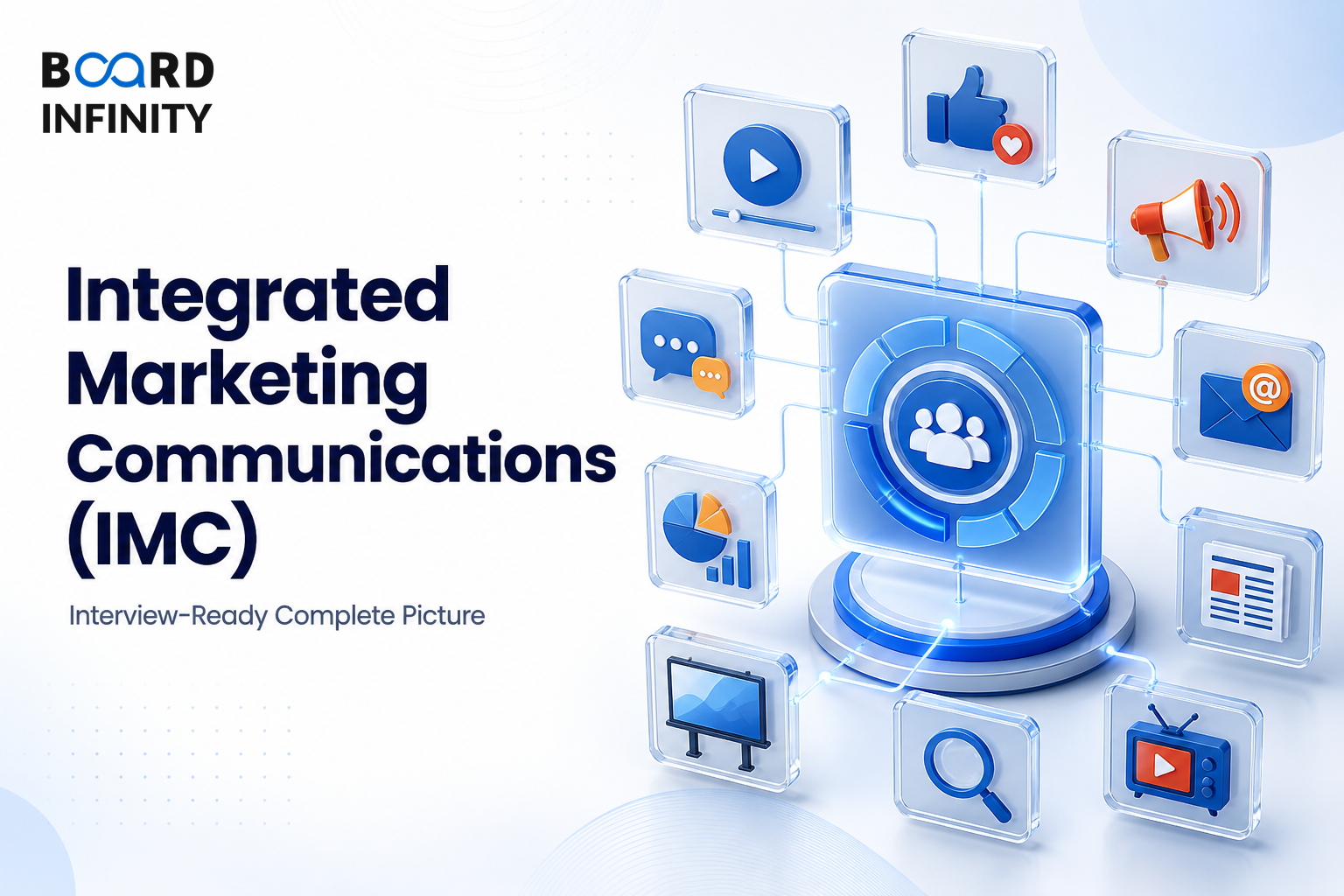
A rider sees a Royal Enfield launch film on Instagram, reads a review on a biking portal, walks into a dealership, and hears the same promise from the sales executive. If those moments feel like one connected story, the brand is doing Integrated Marketing Communications; if they feel like five different departments shouting, the brand is leaking trust.
- IMC means one brand meaning, many coordinated touchpoints. It is not simply using many media channels.
- The core job is to align message, medium, timing, audience, and measurement.
- IMC connects the promotion mix: advertising, PR, sales promotion, direct marketing, digital, events, influencer, retail and sales force communication.
- A strong IMC campaign has a single-minded proposition, then adapts execution by channel without changing the brand promise.
- Think in the order: audience insight - brand promise - message architecture - channel roles - measurement loop.
- Good IMC is measured through both brand metrics like awareness and lift, and business metrics like conversion, CAC and incremental sales.
- The common trap is saying “360-degree campaign” without explaining what is integrated and why.
The Big Picture: IMC Is Brand Orchestration, Not Media Addition
Integrated Marketing Communications works like an orchestra. Advertising may play the loudest instrument, but PR, social, retail, influencers, CRM, events and sales teams must play the same tune for the same audience at the right moment.
What IMC Really Means
Integrated Marketing Communications is the disciplined coordination of paid, owned, earned and shared messages to deliver one clear brand meaning.
The keyword is coordination. A brand may run a TV ad, an influencer reel, a retail display, a WhatsApp offer, a PR story and a salesperson script. IMC asks: do all these contacts reinforce the same positioning, or do they confuse the customer?
Kotler and Keller define marketing communications as “the means by which firms attempt to inform, persuade, and remind consumers - directly or indirectly - about the products and brands they sell.”
So, IMC is not a separate tool. It is the management system that makes every communication tool work together.
The Five Building Blocks of IMC
Use this as your interview framework. A good IMC answer is not “advertising plus digital plus PR.” It explains how the pieces fit.
The Promotion Mix Inside IMC
IMC pulls together all promotion tools, but each tool has a different job. A campaign becomes integrated when the tools are sequenced and assigned roles instead of being run as disconnected activities.
Amul's topical advertising is a strong Indian example of consistent brand voice across changing contexts. The subjects change almost daily, but the tone - witty, timely, Indian and culturally observant - remains unmistakable. The strategic lesson is that IMC consistency does not mean repeating the same sentence everywhere; it means preserving the same brand personality across moments.
The IMC Response Ladder: What Communication Must Move
IMC should move the customer from not knowing to knowing, liking, choosing, buying and eventually recommending. This is why the same message cannot be pushed in the same format at every stage.
How to Measure IMC
IMC measurement must connect communication outcomes with business outcomes. A campaign that has high engagement but no recall, no search lift, no qualified leads and no sales movement is not automatically successful.
For interviews, say clearly that there is no single universal “good” number for most IMC metrics. The right benchmark depends on category, brand maturity, channel, objective and previous campaign baseline.
Definitions You Should Be Able to Say Cleanly
- Integrated Marketing Communications: coordinated brand communication across touchpoints to deliver one clear message and measurable customer response.
- Touchpoint: any moment where a customer encounters the brand, message, product, service, employee or experience.
- Message architecture: the hierarchy of core promise, support points, proof and tone used across channels.
- Media synergy: the incremental effect created when channels reinforce each other instead of operating independently.
Case Study: Royal Enfield Hunter 350 and the IMC of a Younger Riding Culture
Royal Enfield used the Hunter 350 to make motorcycling feel more urban, accessible and youthful while keeping the brand's riding-community DNA intact.

Situation. Royal Enfield had a powerful association with classic, long-distance and heritage motorcycling. With the Hunter 350, the challenge was to attract a younger, city-first rider without making the brand feel like it had abandoned its core identity.
The move. The brand did not rely only on product advertising. It connected the idea of accessible, city-friendly motorcycling through launch communication, social content, creator and review ecosystems, dealership experience, test rides and the broader Royal Enfield riding community. The primary driver was a clear positioning bridge: younger and more urban, but still recognisably Royal Enfield. Supporting drivers included the product design, community credibility, retail experience, earned reviews and consistent visual tone across touchpoints.
Outcome and lesson. The lesson is not that one campaign line created success. The IMC strength came from aligning product truth, brand heritage, city-rider insight, media content, community and retail experience. In interviews, this is exactly the difference between a shallow “360-degree campaign” answer and a complete IMC answer.
How AI Changes Integrated Marketing Communications (IMC)
AI does not replace the need for a sharp brand idea. It changes how quickly marketers can understand audiences, adapt content and measure integrated impact.
- AI-powered audience intelligence: Social listening and review analysis can detect emerging language, pain points and cultural cues across platforms. The risk is overfitting to noisy online chatter, so human judgement is still needed.
- Dynamic creative adaptation: AI can help generate multiple channel-specific versions of a core message for search, email, short video, display and CRM. The IMC discipline is to keep the same promise while adapting format and tone.
- Better measurement and attribution: Machine learning supports marketing mix modelling, incrementality testing and journey analysis across fragmented channels. This is especially useful when last-click attribution undervalues PR, TV, influencers or upper-funnel media.
Use Perplexity or NotebookLM to study any brand before an interview: collect recent ads, social posts, PR articles and app or website communication, then ask, “What is the central brand promise, which touchpoints support it, and where is the message inconsistent?”
Interview Relevance
“Explain Integrated Marketing Communications. Pick any Indian brand and show how you would design or evaluate its IMC campaign.”
If asked for an example, do not only list media channels. Say, “The integrated part is that the same proposition is reinforced through advertising, earned media, retail experience and CRM, while each channel plays a different role in the customer journey.”
Common Mistake
The biggest mistake is equating IMC with “being present everywhere.” That sounds energetic but not strategic, because it ignores audience, message consistency, channel roles and measurement. The fix: always answer IMC as one brand promise + coordinated touchpoints + measurable response.
What to Revise Next
Now move from the integration layer to the actual communication tools. Revise The Promotion Mix: Advertising, PR, Sales Promotion, Direct and Digital, then study Advertising Strategy and Writing a Winning Creative Brief. That sequence will help you move from “how the system fits” to “how a campaign is actually built.”