
Bond Basics for Interviews: Price, Coupon, YTM & Accrued Interest Made Practical
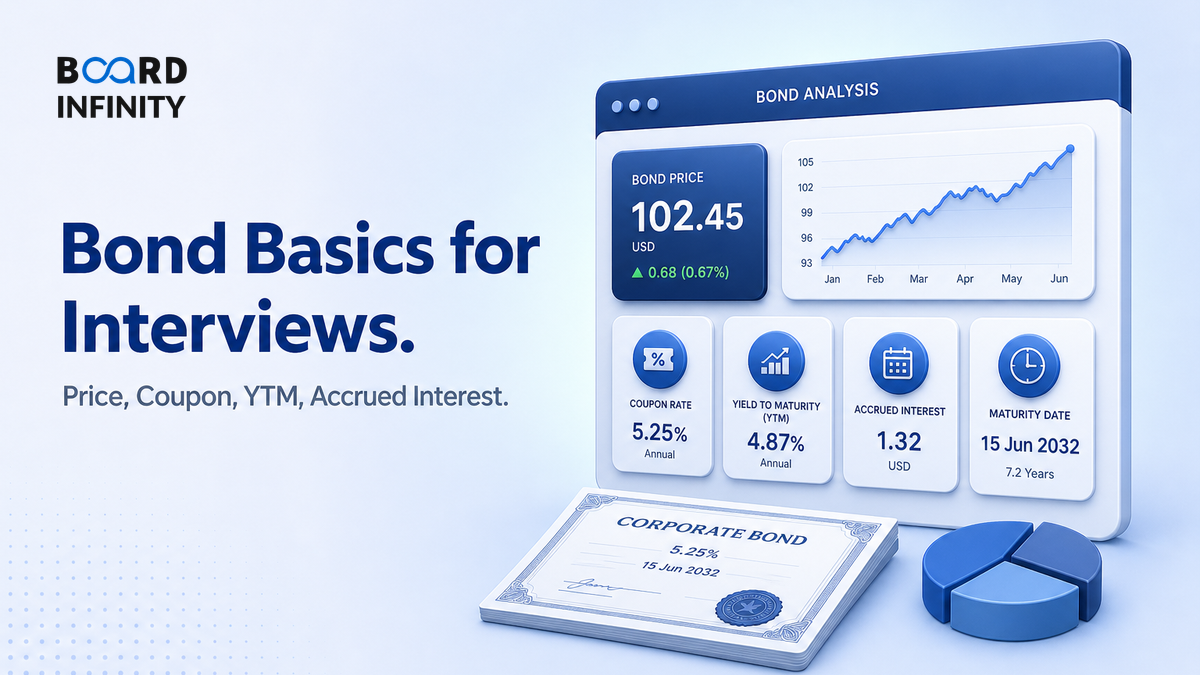
Why would an 8% coupon bond sell below face value when it is still paying exactly what it promised? Because in bonds, the coupon is history, the price is today, and yield is the market's demand for tomorrow.
- Coupon is the fixed interest promised on face value; it does not change when market rates change.
- Bond price is the present value of future coupon payments plus principal repayment.
- Yield to maturity is the annualized return if you buy today, hold to maturity, and all promised cash flows are paid.
- When market yield rises, bond price falls; when market yield falls, bond price rises.
- Coupon rate > YTM usually means the bond trades at a premium; coupon rate < YTM usually means it trades at a discount.
- Clean price excludes accrued interest; dirty price is the actual invoice price paid on settlement.
- Accrued interest compensates the seller for coupon earned since the last coupon date.
Big Picture: A Bond Is a Cash-Flow Contract, Not a Fixed-Return Product
A bond starts simple: an issuer borrows money, promises periodic coupons, and repays principal at maturity. The complexity enters because investors do not value those future cash flows at yesterday's coupon rate - they discount them at today's required yield.
Core Explanation: The Four Ideas You Must Not Mix Up
1. Face Value and Coupon
Face value, also called par value, is the principal amount on which coupon is calculated and usually repaid at maturity. If a bond has face value ₹1,000 and an 8% annual coupon, it promises ₹80 interest per year.
The coupon rate is fixed at issue for a plain fixed-rate bond. Once issued, the bond's market price can move every day, but the promised coupon rupee amount remains the same unless the bond's terms say otherwise.
2. Price: Present Value of Future Cash Flows
A bond's price is the present value of all promised future coupons and principal, discounted at the investor's required yield. The basic pricing equation is:
Bond price = PV of coupons + PV of principal repayment
If the market demands a higher yield than the coupon, the old coupon stream becomes less attractive, so the bond must sell at a discount. If the market accepts a lower yield than the coupon, the bond becomes attractive, so it sells at a premium.
3. Yield to Maturity: The Market's Implied Return
Yield to maturity, or YTM, is the discount rate that makes the present value of future bond cash flows equal to today's price. It is not the same as coupon.
YTM assumes three things: you buy at the current price, the issuer pays all promised coupons and principal, and you hold the bond until maturity. For callable, default-risky or illiquid bonds, YTM is still useful, but it is not a guarantee.
4. Accrued Interest: Why the Invoice Price Is Not the Quoted Price
Coupons are earned day by day, but paid only on coupon dates. If a seller sells the bond between coupon dates, the buyer pays the seller the interest earned from the last coupon date to the settlement date. That amount is accrued interest.
This creates two prices:
- Clean price - the quoted bond price excluding accrued interest.
- Dirty price - clean price plus accrued interest; this is the settlement amount before transaction charges and taxes.
Bond Metrics and Formulas You Should Know
Use these measures together. A high coupon can be irrelevant if the bond is overpriced, and a high YTM can be a warning if it reflects credit or liquidity risk.
Worked Example: Price, YTM Logic and Accrued Interest
Assume a plain annual coupon bond with face value ₹1,000, coupon rate 8%, and 3 years to maturity. The market requires 10% YTM for this risk and tenor.
Step 1: Identify cash flows. Coupon = 8% of ₹1,000 = ₹80 per year. Final year cash flow = ₹80 coupon + ₹1,000 principal = ₹1,080.
Step 2: Discount at market yield.
Price = ₹80 / 1.10 + ₹80 / 1.10² + ₹1,080 / 1.10³
Price = ₹72.73 + ₹66.12 + ₹811.42 = ₹950.27 approximately
The bond trades below face value because its 8% coupon is lower than the 10% return now demanded by the market.
Step 3: Add accrued interest for settlement. Suppose 90 days have passed since the last coupon date, using a simplified 365-day convention.
Accrued interest = ₹80 x 90 / 365 = ₹19.73 approximately
Dirty price = Clean price + Accrued interest = ₹950.27 + ₹19.73 = ₹970.00 approximately
Actual markets use the day-count convention specified in the bond terms. In India, always read the information memorandum or term sheet before computing accrued interest.
Definitions: Say These Cleanly
“The value of an asset is the present value of the expected cash flows on that asset.” This is the core logic behind bond pricing.
Case Study: Muthoot Finance NCDs and the Difference Between Coupon and Return
Muthoot Finance has used listed non-convertible debentures to raise debt from investors, making it a useful Indian example of coupons, yields and accrued interest in action.

Situation. Muthoot Finance, a large Indian gold-loan NBFC, periodically raises funds through secured and unsecured non-convertible debentures, or NCDs. These instruments appeal to investors looking for fixed-income cash flows, but the coupon printed in the prospectus is only one part of the return story.
The move. The company offers NCD series with different tenors and interest payout options, such as periodic interest or cumulative redemption structures, subject to the terms of each issue. Listing on exchanges gives investors a secondary-market route, where the bond may trade above or below face value depending on interest rates, credit perception and liquidity.
Outcome and lesson. The primary driver of investor interest is the need for predictable fixed-income cash flows backed by disclosed, regulated debt terms. Supporting drivers include the familiarity of the gold-loan business, credit rating disclosures, exchange listing, multiple payout choices and SEBI-regulated offer documentation. The lesson is sharp: an investor comparing two NCDs must compare YTM and risk, not just the highest coupon.
So what: Muthoot Finance shows why bond analysis is not “pick the highest coupon.” A complete answer links coupon, price, yield, accrued interest and credit risk into one return-and-risk view.
How AI Changes Bond Basics
AI does not change the formulas. It changes how quickly analysts can read bond documents, compare securities and spot errors.
Student workflow: Use NotebookLM or ChatGPT with three inputs - the bond term sheet, the latest exchange quote, and the issuer's annual report. Ask: “Extract the coupon schedule, compute accrued interest for a sample settlement date, explain whether the bond trades at premium or discount, and generate five interview questions on credit and yield risk.”
Interview Relevance
A bond has face value ₹1,000, coupon 8%, and 3 years to maturity. If the market yield is 10%, will it trade at premium or discount? How will accrued interest affect the amount paid by the buyer?
If you can say “coupon is promised cash flow, YTM is implied return, clean price is quote, dirty price is settlement,” you sound immediately structured.
Common Mistake
The costly mistake is treating the coupon rate as the investor's return and ignoring accrued interest. This fails because return depends on purchase price and settlement cash flow, not just the printed coupon. Fix: always answer in this order - coupon cash flows, market YTM, clean price, accrued interest, dirty price.
What to Revise Next
Now that the basic bond vocabulary is clear, move from “what is a bond worth?” to “why does that worth move?” Revise these next as a journey: