
Price-Yield Relationship: Explain Why Bond Prices Move Inversely in Interviews
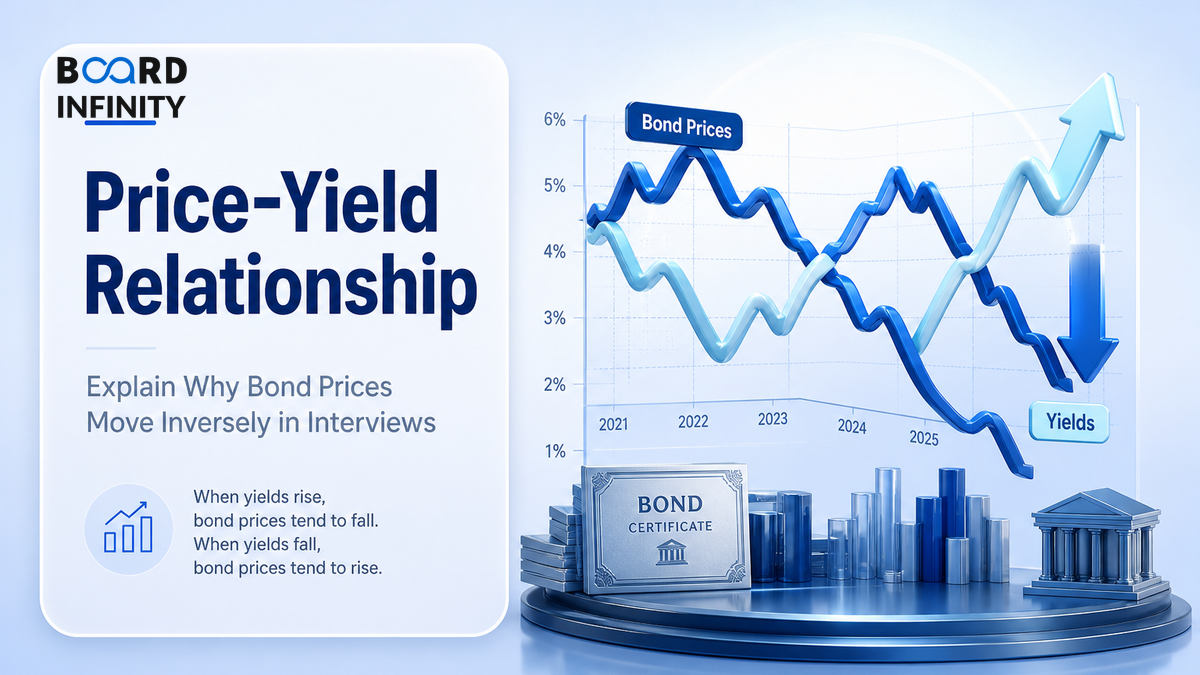
On a trading screen, a government bond can lose value even though the issuer has not missed a single payment. Nothing happened to the coupon, the face value, or the maturity date - only the market’s required yield moved, and the bond price had to adjust.
- Bond price is the present value of future coupons and principal, discounted at the market yield.
- Price and yield move inversely: when required yield rises, each future cash flow is discounted more heavily, so price falls.
- Coupon is fixed for a plain fixed-rate bond; price changes because the market demands a different return.
- At par: coupon rate equals yield. At discount: yield is above coupon. At premium: yield is below coupon.
- Longer maturity and lower coupon bonds are usually more sensitive to yield changes because more value sits in distant cash flows.
- YTM is an IRR: the single discount rate that equates today’s price with promised future cash flows.
- Interview one-liner: yields rise, discount rates rise, present values fall - therefore bond prices fall.
The Big Picture
A fixed-rate bond is a package of promised cash flows. The market asks, “What return do I now require for this risk and maturity?” That required return becomes the discount rate. Change the discount rate, and the present value - the bond price - changes in the opposite direction.
Core Explanation: Why the Inverse Relationship Exists
Start with the valuation equation for a plain fixed-rate bond:
Bond Price = PV of coupons + PV of face value
For an annual coupon bond, the formula is:
Price = C / (1 + y)1 + C / (1 + y)2 + ... + (C + Face Value) / (1 + y)n
Here, C is the coupon payment, y is the market yield or required return, and n is the number of periods to maturity. If y goes up, the denominator for every future cash flow becomes larger. A larger denominator means a smaller present value. That is the whole logic.
The Three Price States: Par, Premium and Discount
Every fixed-rate bond can be read using one simple comparison: coupon rate versus market yield.
Example: if a bond pays an 8% coupon but new comparable bonds yield 10%, nobody will pay full price for the old 8% bond. Its price must fall until the total return to a new buyer is around 10%.
Worked Example: Same Bond, Different Yields
Take a 3-year bond with face value ₹1,000, annual coupon 8%, and annual coupon payment ₹80.
Notice what did not change: the ₹80 coupon and ₹1,000 principal. Only the market yield changed. The price moved to make the old bond competitive with new market returns.
The Funnel: How a Rate Shock Becomes a Price Move
Bond prices do not fall merely because “rates are up” in the abstract. The rate news passes through a chain: policy expectations, required yield, discount rate, present value, and finally market price.
What Determines How Much the Price Moves?
Two bonds can face the same yield shock and show very different price movements. The sensitivity depends mainly on timing and size of cash flows.
Key Bond Measures You Should Know
If you discuss bond prices in an interview, move beyond “price goes down.” Name the measure that captures the movement.
Definitions
- Bond price: the present value of promised coupons and principal discounted at the market required yield.
- Yield to maturity: the internal rate of return that equates a bond’s price with its promised cash flows.
- Coupon rate: the fixed annual coupon as a percentage of the bond’s face value.
- Face value: the principal amount repaid to the bondholder at maturity.
- Brealey, Myers and Allen valuation principle: the value of an asset is the present value of its expected future cash flows.
Case Study: Edelweiss Bharat Bond ETF and the Lesson of Target Maturity
Edelweiss Mutual Fund’s Bharat Bond ETF made the price-yield relationship visible to Indian retail investors through a low-cost, target-maturity corporate bond portfolio.
Bharat Bond ETF, managed by Edelweiss Mutual Fund, invests in AAA-rated public sector company bonds and follows a target-maturity structure. That means the ETF holds bonds that mature around a stated year, and over time the portfolio naturally “rolls down” toward maturity.
The situation became especially teachable during India’s 2022-23 rate-hiking cycle. The RBI raised the repo rate from 4.00% to 6.50% between May 2022 and February 2023. As market yields rose, existing fixed-rate bonds inside debt portfolios faced downward price pressure. Investors looking at daily NAVs could see the inverse relationship at work: higher required yields meant lower present values.
The strategic move was not to pretend the inverse relationship did not exist. The product design helped investors understand it: if you buy a target-maturity bond ETF and hold it close to maturity, the interim mark-to-market swings matter less than the portfolio yield locked in at purchase, assuming no credit default and reasonable tracking. The primary driver was the target-maturity structure. Supporting drivers were high-quality public sector bond exposure, transparency of portfolio maturity, exchange-traded access and low-cost passive management.

The takeaway: bond price risk is not automatically “bad.” It is a timing problem. A trader feels yield changes immediately through price. A hold-to-maturity investor focuses more on yield locked in, credit quality and whether cash flows arrive as promised.
How AI Changes the Price-Yield Relationship
AI does not change the mathematics of bond pricing. It changes how quickly analysts detect yield drivers, simulate scenarios and explain portfolio risk.
- Faster rate-signal extraction: LLMs can summarize RBI MPC statements, Fed commentary, inflation reports and bond-market commentary to identify whether the market is repricing growth, inflation or liquidity risk.
- Scenario analytics at scale: AI-assisted tools can run “what if yields rise by 50 bps or 100 bps” across hundreds of bonds and rank the portfolio by duration exposure, credit spread risk and maturity bucket.
- Natural-language portfolio explanation: Instead of only showing duration tables, AI can generate plain-English explanations of why a debt fund NAV moved - rates, credit spreads, roll-down or liquidity.
Load an RBI MPC statement, a debt fund factsheet and this lesson into NotebookLM. Ask: “Explain how a 100 bps rise in market yield would affect this fund’s NAV, using duration, YTM and maturity profile.” Then convert the answer into a 60-second interview response.
Interview Relevance
“Why do bond prices fall when interest rates rise? Explain with an example.”
If the interviewer pushes deeper, say: “The relationship is inverse but not linear. Duration gives the first approximation; convexity improves the estimate for larger yield moves.”
Common Mistake
Mistake: saying bond prices fall because the coupon falls. For a plain fixed-rate bond, the coupon does not change - the market required yield changes, and price adjusts to make the old fixed cash flows competitive. Fix: always say “coupon fixed, discount rate changed, present value changed.”
What to Revise Next
Now that the inverse relationship is clear, revise the two tools that make it interview-grade: Duration, Modified Duration & Convexity Made Practical to quantify price sensitivity, then The Yield Curve: Shapes, Drivers & the Signals It Sends to understand why yields move differently across maturities.