
Types of Bonds in India - Answer Government, State, Corporate and Short-Term Paper Confidently
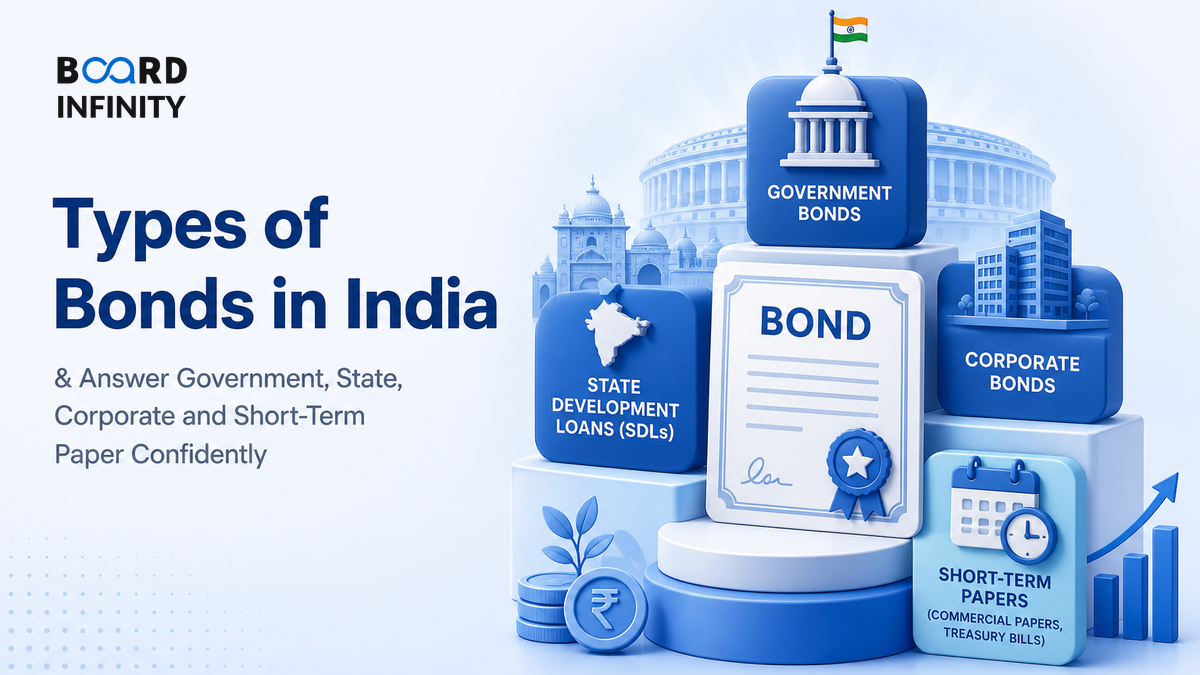
On one screen, the Government of India is borrowing for ten years through a G-Sec. On another, a state is raising money through an SDL, a company is issuing an NCD, and a treasury desk is parking cash for 91 days in a T-bill. They are all “bonds” in everyday language, but they do very different jobs in India’s financial system.
- Central Government securities are the benchmark debt instruments in India - lowest credit risk, high institutional participation, and key reference rates for pricing.
- State Development Loans are bonds issued by state governments; they usually trade at a spread over comparable Central Government securities.
- Corporate bonds or NCDs are debt issued by companies or financial institutions; credit rating, covenants, security cover and liquidity matter most.
- Short-term paper includes Treasury Bills, Commercial Paper and Certificates of Deposit - mainly used for cash management and working-capital funding.
- Risk rises as you move from sovereign to corporate issuers, so investors demand a credit spread over the risk-free government curve.
- Do not compare only coupon rates. Compare yield to maturity, duration, credit spread, rating, security and liquidity together.
- Interview answer structure: classify by issuer, maturity, risk, return and use-case - then give one Indian example for each.
Big Picture: The Indian Bond Shelf
Think of India’s bond market as a shelf arranged by two questions: who is borrowing and for how long. The borrower decides credit risk; the maturity decides interest-rate risk and investor use-case.
Core Explanation: The Main Types of Bonds in India
The Indian debt market is easier when you stop memorising product names and start asking: who issues it, why they issue it, how long it runs, and what risk the investor takes.
1. Central Government Securities: The Benchmark Borrowing Instruments
Government Securities, often called G-Secs, are issued by the Government of India through the Reserve Bank of India’s auction system. They finance the fiscal needs of the central government and form the reference curve for much of India’s debt pricing.
They come mainly in two forms:
- Treasury Bills: short-term, zero-coupon instruments issued at a discount and redeemed at face value.
- Dated Government Securities: longer-maturity instruments that usually pay periodic coupon interest.
So what: If you understand the G-Sec yield curve, you understand the “risk-free” starting point from which many other Indian rupee bonds are priced.
2. State Development Loans: State Government Borrowing
State Development Loans, or SDLs, are bonds issued by Indian state governments. Like G-Secs, they are auctioned through the RBI platform, but the borrower is a state government rather than the Centre.
SDLs typically offer a spread over comparable Central Government securities because investors consider state-level fiscal strength, liquidity and market demand. An SDL from a fiscally stronger or more liquid state may be viewed differently from one with weaker fiscal metrics, even if both are government-linked.
So what: SDLs teach an important bond-market idea - not all “government” borrowing is priced identically.
3. Corporate Bonds and NCDs: Company Borrowing
Corporate bonds, often issued in India as Non-Convertible Debentures, are debt instruments issued by companies, NBFCs, public-sector undertakings and financial institutions. The investor earns interest, but takes company-specific credit risk.
In corporate bonds, the checklist is richer:
So what: A higher coupon is not automatically better; it may simply be compensation for credit risk, illiquidity or weaker structure.
4. Short-Term Paper: Cash Management Instruments
Short-term paper sits at the money-market end of the bond universe. These instruments are usually used for liquidity management, temporary funding and treasury operations.
- Treasury Bills: short-term sovereign paper issued by the Government of India.
- Commercial Paper: unsecured short-term promissory notes issued by eligible companies and financial institutions.
- Certificates of Deposit: negotiable money-market instruments issued by banks and eligible financial institutions.
So what: Short-term instruments are more about liquidity, rollover risk and treasury timing than long-term capital structure.
Comparison Table: Government, State, Corporate and Short-Term Paper
How to Evaluate a Bond: Six Measures You Must Know
Bond analysis is not “which coupon is highest?” A placement-ready answer compares yield, risk, time and liquidity together.
Worked Example: Why Coupon Alone Misleads
Suppose a corporate bond has face value ₹1,000, annual coupon 8%, current market price ₹960, and 4 years left to maturity.
- Annual coupon = 8% × ₹1,000 = ₹80
- Current yield = ₹80 ÷ ₹960 = 8.33%
- Annual capital gain if held to maturity = (₹1,000 - ₹960) ÷ 4 = ₹10
- Approximate YTM = (₹80 + ₹10) ÷ [(₹1,000 + ₹960) ÷ 2] = ₹90 ÷ ₹980 = 9.18%
The bond’s coupon is 8%, but the approximate yield to maturity is higher because the investor is buying below face value. The next question is not “is 9.18% good?” It is: is 9.18% enough for this issuer’s credit risk, maturity and liquidity?
Definitions You Can Say in One Breath
- RBI - Government Security: “A Government Security is a tradeable instrument issued by the Central Government or the State Governments.”
- RBI - Commercial Paper: “Commercial Paper is an unsecured money market instrument issued in the form of a promissory note.”
- Bond: A bond is a debt instrument where the issuer borrows money and promises interest and principal repayment.
- Yield to Maturity: YTM is the discount rate that makes a bond’s future cash flows equal its current price.
- Credit Spread: Credit spread is the extra yield over a comparable government bond for taking issuer credit risk.
Case Study: Power Finance Corporation and the Logic of Corporate Bonds
Power Finance Corporation shows why large Indian infrastructure financiers use bonds to match long-term lending with long-term funding.
Situation: Power Finance Corporation, a government-owned infrastructure finance company, lends heavily to India’s power sector. Its assets are long-duration loans, so funding them only with short-term borrowings would create refinancing risk.
The move: PFC regularly uses the domestic bond market, including listed non-convertible debt securities, to raise rupee funding from institutional investors. The primary driver is asset-liability matching - long-term bonds help fund long-term power-sector loans. Supporting drivers include PFC’s established issuer profile, credit ratings, access to institutional demand, and the broader Indian need for infrastructure financing.
Outcome or lesson: The lesson is not simply “PFC issues bonds because it needs money.” The deeper answer is that bond markets help convert investor savings into long-term infrastructure credit, while investors evaluate issuer strength, government ownership, rating, maturity and liquidity before accepting the yield.

Strategic takeaway: A good corporate bond answer always connects the instrument to the issuer’s business model. In PFC’s case, bonds are not just a financing product; they are a balance-sheet tool for funding long-horizon infrastructure assets.
How AI Changes Types of Bonds in India
AI is not changing the legal nature of a G-Sec, SDL or NCD. It is changing how analysts screen, compare and monitor them.
- Faster document reading: LLMs can summarise offer documents, debenture trust deeds, rating rationales and financial statements, making it easier to identify covenants, security cover and repayment terms.
- Credit surveillance: AI models can track news, filings, rating actions, interest-coverage movement and sector stress signals to flag possible credit deterioration earlier.
- Relative-value analysis: Quant tools can compare yields across maturity, rating, issuer group and liquidity buckets to highlight bonds that look rich or cheap versus peers.
Load an issuer’s annual report, latest rating rationale and bond term sheet into NotebookLM. Ask: “Classify this instrument, list key risks, compare it with a similar-maturity G-Sec, and generate five interview questions on why an investor would or would not buy it.” Then verify every factual output from the original documents.
Interview Relevance
“Explain the main types of bonds in India. How would you compare a Government security, an SDL, a corporate bond and commercial paper?”
If the interviewer pushes deeper, move from “types” to “pricing”: every non-sovereign rupee bond should be discussed as a spread over the comparable Government security.
Common Mistake
The single biggest mistake is ranking bonds only by coupon rate. It costs candidates because a high coupon may reflect lower credit quality, poor liquidity, longer duration or weaker covenants. One-line fix: always compare yield, rating, maturity, security and liquidity together.
What to Revise Next
Now that you can classify the instruments, move one level deeper into the market structure and the analyst workflow.