
Credit Ratings in India: Answer Scales, Agencies and Rating Migration with Confidence
A common misconception: a credit rating is a stamp on a company. It is not. In India, a rating is closer to a live risk signal on a specific debt instrument - and that signal can migrate quietly for months or fall sharply when liquidity breaks.
- Credit rating is an independent opinion on timely debt servicing risk, not a guarantee and not an equity recommendation.
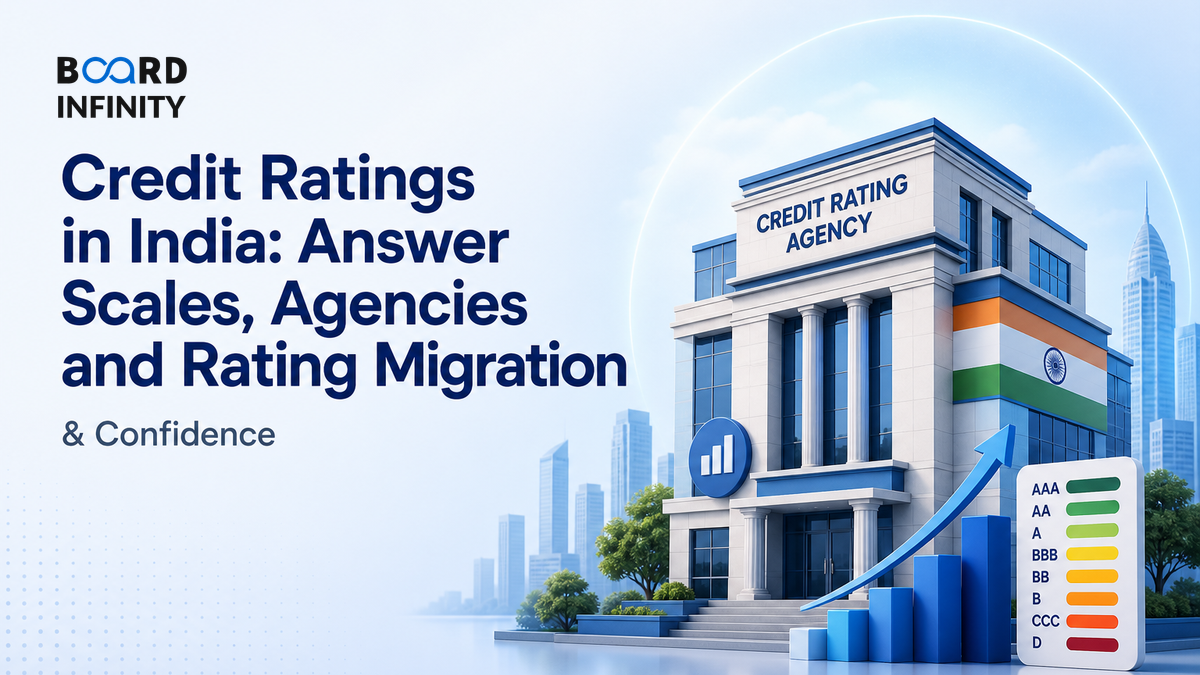
- Indian long-term ratings usually run from AAA at the top to D for default; BBB and above is investment grade.
- Major Indian credit rating agencies include CRISIL, ICRA, CARE Ratings, India Ratings, Acuité and Infomerics, all operating under SEBI regulation.
- Ratings are usually instrument-specific: the same company can have different ratings for bank loans, NCDs, commercial paper or securitised pools.
- Rating outlook signals medium-term direction; rating watch signals a sharper event-driven possibility.
- Rating migration means movement across rating grades - upgrade, downgrade, default or withdrawal - during surveillance.
- The smartest interview answer links rating migration to cash flow, leverage, liquidity, refinancing risk, governance and sector cycle.
Big Picture: A Rating Is a Living Risk Opinion
Think of credit rating as a five-part system: a borrower raises debt, an agency assesses default risk, investors and banks price the debt, the company is monitored continuously, and the rating migrates when risk changes.
Core Explanation: How Credit Ratings Work in India
A credit rating answers one central question: How likely is timely servicing of interest and principal on this specific obligation? Agencies do not merely ask whether the company is famous or profitable. They test whether the borrower can generate cash, refinance debt, survive stress and honour payment dates.
In India, credit rating agencies are regulated by SEBI. Their ratings are used by bond investors, mutual funds, insurers, banks, NBFCs and companies issuing instruments such as non-convertible debentures, commercial paper, bank loans and structured finance securities.
The Indian Long-Term Rating Scale
The long-term scale is easiest to remember as a ladder. The top rungs mean very high safety; the middle rungs mean adequate safety; the lower rungs mean speculative credit risk; D means default or expected default.
Long-Term, Short-Term, Outlook and Watch
Do not mix these four terms. A long-term rating assesses debt with longer maturity. A short-term rating assesses instruments such as commercial paper. An outlook indicates likely direction over a medium-term horizon. A rating watch indicates a sharper event risk, such as merger, refinancing, regulatory action, litigation or sudden liquidity stress.
What Agencies Actually Analyse
A rating committee usually looks at five buckets. The first two - business risk and financial risk - carry the story. The last three explain whether the story is reliable under stress.
An Indian manufacturing company may have one rating for long-term bank facilities and another for commercial paper. The long-term facility depends on overall cash generation and security structure; the commercial paper rating depends heavily on short-term liquidity and rollover risk. So what: never say “the company is rated AA” without naming the instrument or facility.
Rating Migration: The Part Interviewers Really Care About
Rating migration is the movement of a rating from one grade to another during surveillance. Migration matters because credit risk is dynamic. A company can move from A to AA after deleveraging, from BBB to BB after weak cash flows, or directly to D if it misses payment.
What to Track in Rating Migration
If you are analysing a loan book, bond portfolio or sector, do not just count ratings. Track how ratings move.
Worked Example: A Simple Migration Calculation
Suppose a debt fund starts the year with 100 rated corporate bond exposures. During the year, 8 are upgraded, 12 are downgraded, 2 move to D, and 78 remain unchanged.
The portfolio looks weak because downgrades exceed upgrades and there are defaults. A better answer would next ask: Were downgrades concentrated in one sector, one promoter group or one rating band such as BBB?
Definitions You Should Be Able to Say Cleanly
- Credit rating: an independent opinion on relative credit risk and timely servicing of a specific debt obligation.
- Credit rating agency: a SEBI-registered institution that assigns and monitors ratings on debt instruments and related obligations.
- Rating migration: movement of a rating up, down, to default, or to withdrawal during surveillance.
- Rating outlook: a medium-term directional signal on whether a rating may move up, down or remain stable.
- Rating watch: a short-term signal that a specific event may cause a rating change.
- Default: failure to service principal or interest as promised under the instrument terms.
Case Study: Go First and the Cliff Effect in Rating Migration
Go First showed how a rating can migrate sharply when operating disruption turns into liquidity stress and then insolvency-driven default risk.
Situation: Go First, an Indian low-cost airline, faced severe operational disruption before filing for voluntary insolvency resolution in May 2023. Airlines are especially sensitive to liquidity because aircraft leases, fuel, airport charges, maintenance and salaries create heavy fixed cash commitments.
The move: Once insolvency proceedings began and payment risk became immediate, credit rating actions moved sharply toward default categories for affected obligations. The primary driver was not simply “aviation is risky.” The primary driver was near-term debt servicing stress, supported by grounded capacity, cash burn, weak refinancing flexibility and creditor uncertainty.
Outcome or lesson: Go First is a useful migration case because it shows that credit ratings often move gradually during weakening phases, but can become a cliff when liquidity breaks. The rating process ultimately punishes missed or highly uncertain debt servicing, not just poor profitability.

Strategic so what: In credit analysis, the question is not “Is this company well-known?” The question is “Will cash arrive before obligations fall due, and what happens if refinancing closes?”
How AI Changes Credit Ratings in India
AI does not replace rating judgement, but it is changing how credit risk is monitored before a formal rating action appears.
Student workflow: Use NotebookLM to upload one company annual report, two rating rationales and recent exchange filings. Ask it to create a table of leverage, liquidity, refinancing risk, management actions and likely rating triggers. Then use Perplexity to verify recent rating actions from agency and exchange sources.
Interview Relevance
“Explain credit ratings in India. How do rating scales work, and what does rating migration tell an investor?”
If asked to analyse a downgrade, structure your answer as: trigger - cash flow impact - liquidity impact - refinancing impact - rating action - market consequence.
Common Mistake
Treating a rating as a permanent company score. This costs candidates because it ignores instrument specificity, surveillance and migration. Fix: always say “rating of a specific obligation, monitored over time, and revised when credit risk changes.”
What to Revise Next
Now move from rating labels to the instruments and loss models behind them. Revise Securitisation & Structured Finance Explained to understand how pools and tranches are rated, then Expected Credit Loss: Default Probability, Loss Severity & Provisioning to connect ratings with PD, LGD and provisions.