
Distressed Debt & Recovery: How to Explain What Happens When Credit Goes Bad
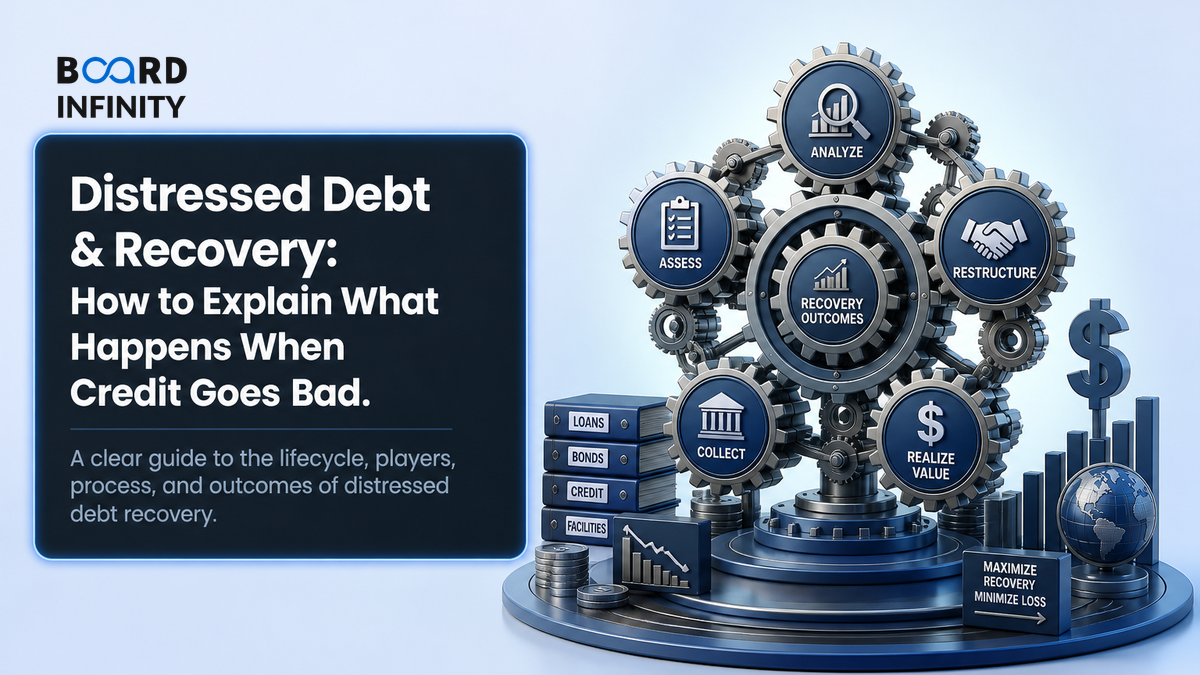
A loan does not die on the day the borrower misses interest. It changes species: from a promise to pay into a fight over cash flows, collateral, priority and time. When the RBI superseded the boards of Srei group companies in 2021, lenders were no longer asking only “will it pay?” - they were asking “what can we recover, who gets paid first, and how long will it take?”
- Distressed debt is debt trading or being managed as if default, restructuring or deep recovery risk is likely.
- Credit going bad moves through a sequence: early warning signals, missed payment, default or NPA, resolution route, recovery or write-off.
- Recovery depends on three hard facts: enterprise value, claim priority and execution time.
- Do not say “default means loss.” A lender may recover through restructuring, collateral sale, IBC resolution, ARC sale or liquidation.
- The key calculation is Recovery Rate = Amount Recovered / Admitted Claim; haircut is the opposite.
- In India, the IBC gives creditors a structured resolution route, but delays, litigation and asset-quality uncertainty can reduce recoveries.
- The best interview answer separates business viability from security value - a sick company can still have recoverable assets, and a viable company may need restructuring.
Big Picture: Distress Is a Recovery Process, Not a Panic Event
Think of distressed debt as a controlled shift in the lender’s objective. In normal credit, the question is “Can the borrower repay as scheduled?” In distress, the question becomes “Which route maximizes present recovery after legal costs, delay and priority claims?”
Core Explanation: What Actually Happens When Credit Goes Bad
Distressed debt is debt whose full and timely repayment is doubtful because default, restructuring or insolvency is likely. It can be held by banks, mutual funds, NBFCs, ARCs, private credit funds or bond investors.
The shift from normal credit to distressed recovery has four practical changes:
- From borrower promise to evidence: lenders stop relying on projections and verify cash, collateral, receivables and legal enforceability.
- From accounting value to market value: a factory, brand or inventory is worth only what can be realized under distress conditions.
- From individual lender to creditor class: banks, bondholders, suppliers, employees and tax authorities may compete for the same value.
- From full repayment to best recovery: the goal is the highest risk-adjusted, time-adjusted recovery, not emotional punishment of the borrower.
The Recovery Waterfall: Who Gets Paid First
Recovery is not distributed equally. A distressed company may have value left, but the order of claims decides who captures it. This is the recovery waterfall.
Recovery Routes: The Five Choices a Lender Has
Once stress is visible, lenders do not have only one path. The right route depends on whether the business is viable and whether collateral is strong.
Key Metrics: How to Measure Distress and Recovery
In interviews, distressed debt becomes credible only when you attach it to numbers. These six measures cover borrower stress, collateral cover and recovery economics.
Worked Example: Recovery Waterfall in 90 Seconds
Suppose a bank has a ₹100 crore senior secured loan to a stressed manufacturer. After valuation and sale process, the business is expected to realize ₹72 crore. Resolution costs are ₹4 crore. There are no higher-priority claims in this simplified example.
The interview-worthy point: a ₹100 crore default is not automatically a ₹100 crore loss. The expected loss depends on realizable value, seniority, costs and time.
Definitions You Should Be Able to Say Cleanly
- Distressed debt: Debt whose full and timely repayment is doubtful because default, restructuring or insolvency risk is high.
- Default: Failure to meet a contractual debt obligation, such as interest, principal, covenant or maturity payment.
- NPA: In Indian lending, a loan generally becomes non-performing when payment remains overdue beyond 90 days.
- Recovery rate: Amount recovered by creditors divided by their admitted claim.
- Haircut: The portion of a creditor’s claim not recovered through resolution, settlement or liquidation.
- Restructuring: Changing debt terms to improve repayment likelihood while preserving more value than immediate enforcement.
India’s Insolvency and Bankruptcy Code gives creditors a formal route to resolve corporate default through a committee of creditors, resolution professional and tribunal approval. The strategic “so what” is that recovery becomes a structured auction and negotiation process, not just bilateral pressure by one bank. Its success depends primarily on credible bidders and asset value, supported by creditor coordination, legal enforceability and speed.
Case Study: Srei Group and the Reality of Recovery
Srei Infrastructure Finance and Srei Equipment Finance show how distressed recovery in India moves from regulatory intervention to IBC-led resolution when a financial borrower itself becomes stressed.

Situation: Srei was a major infrastructure and equipment finance group. Stress built up in its lending book, and in 2021 the Reserve Bank of India superseded the boards of Srei Infrastructure Finance and Srei Equipment Finance. That was a clear signal that this was no longer normal credit monitoring - it had become a systemic recovery problem involving many creditors.
The move: The companies entered insolvency resolution. Creditors had to evaluate competing recovery routes: keeping the platform alive under a resolution applicant, selling assets, or accepting a plan from a distressed-asset buyer. The National Asset Reconstruction Company Ltd, India’s government-backed bad bank platform, emerged as the successful resolution applicant, and the plan received tribunal approval.
Outcome or lesson: The exact economics depended on the approved plan and realization over time, but the lesson is clean: in distressed finance, recovery is driven primarily by the quality and realizability of underlying assets. Supporting drivers were creditor coordination under IBC, regulatory oversight, legal transferability of claims, and the ability of a specialized resolution buyer to manage collections over time.
The memorable takeaway: distressed debt is not just “bad loans.” It is a value-recovery problem where the winning party understands assets, law, priority and time better than the market does.
How AI Changes Distressed Debt & Recovery
AI does not remove credit risk. It changes how early distress is detected, how recovery documents are analyzed, and how scenarios are priced.
- Earlier warning signals: ML models can combine repayment delays, GST-style business signals where available, bank-statement patterns, bureau behavior, news, litigation data and sector stress indicators to flag borrowers before formal default.
- Faster document review: LLMs can summarize loan agreements, security documents, guarantees, covenants, inter-creditor agreements and tribunal filings, helping teams spot priority and enforceability issues faster.
- Better recovery scenarios: AI-assisted valuation models can stress-test enterprise value under multiple assumptions - asset sale, going-concern sale, restructuring, liquidation and delayed recovery.
Use NotebookLM for a live company prep drill: upload the company annual report, rating-rationale note, recent lender disclosures and any tribunal order, then ask: “List the top five distress signals, likely recovery routes, and three interview questions a credit analyst may ask.” Cross-check any numbers with the original documents before using them.
Interview Relevance
“A borrower has missed interest payments for two quarters. Walk me through how a lender should evaluate whether to restructure, enforce security, sell the loan, or take it to insolvency.”
Use the phrase “time-adjusted recovery.” It signals maturity because ₹60 crore recovered quickly may be better than ₹75 crore after years of litigation and asset decay.
The biggest mistake is treating default as a binary event - “company defaulted, so lender loses money.” That sounds naïve because recovery depends on collateral, priority, viability and time. One-line fix: always answer with a recovery waterfall and compare at least two resolution routes.
What to Revise Next
Now move from theory to judgment. Revise Case Study: Would You Lend? A Full Credit Decision Walkthrough so you can connect credit appraisal, warning signals, covenants, recovery routes and final lending recommendation in one complete answer.