
Would You Lend? Full Credit Decision Walkthrough for Interviews
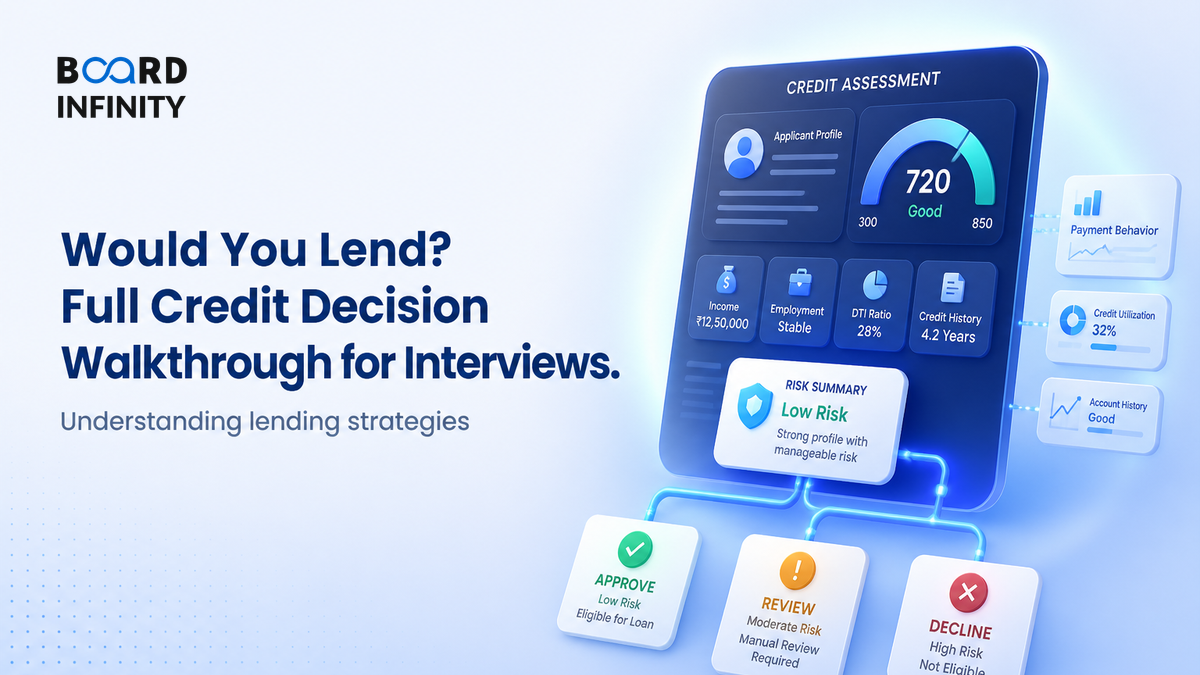
Would you lend ₹20 lakh to a profitable business that has weak bank balances, delayed customer payments, and no hard collateral? That is the uncomfortable heart of credit decisions: a borrower can look successful on paper and still be dangerous to lend to.
- A credit decision is not “good borrower or bad borrower.” It is “can this borrower repay, and can we survive if they do not?”
- Start with cash flow, not collateral. Collateral reduces loss after default; cash flow prevents default.
- The core lens is capacity, character, capital, collateral and conditions. These are the classic 5 Cs of credit.
- Expected Loss = PD x LGD x EAD. PD is probability of default, LGD is loss given default, EAD is exposure at default.
- Strong files triangulate data. Financial statements, bank statements, GST or invoices, bureau record, site visit and management discussion should tell the same story.
- The best answer is often “approve with mitigants,” such as lower ticket size, shorter tenor, escrow, covenants, collateral, guarantees or monitoring triggers.
- The biggest interview trap: approving because the business is profitable without testing debt service ability.
The Big Picture: Credit Is a Repayment Story, Not a Sales Story
A lender is not buying the borrower’s growth dream. A lender is underwriting a stream of future repayments under uncertainty. Your job is to convert borrower information into a structured recommendation: approve, reject, or approve with conditions.
Core Explanation: The Full Credit Decision Walkthrough
Think like a credit committee. You are not trying to be optimistic or pessimistic. You are trying to be evidence-based. Every approval must answer three questions:
Step 1: Understand the Borrower and the Loan Purpose
Credit starts with purpose. A ₹20 lakh loan for inventory before festival season is different from a ₹20 lakh loan to repay overdue creditors. Same amount, different risk.
Step 2: Apply the 5 Cs of Credit
The 5 Cs are a practical checklist for converting a messy borrower story into a credit view.
Interview-grade insight: Capacity is usually the anchor. Character, collateral and conditions modify the decision, but weak repayment capacity should not be hidden behind a strong asset or a confident promoter.
Step 3: Measure the Credit File With Real Ratios
Ratios are not decorative. They force discipline. Use them to test whether the borrower can repay under normal conditions and under stress.
Important: “Good” ranges vary by product, borrower segment, industry and lender policy. In an answer, say the range, then adapt it to the case facts.
Worked Example: Should You Lend ₹20 Lakh?
Assume a small electronics distributor asks for a ₹20 lakh working capital loan. The borrower claims the loan is needed to stock inventory before a high-sales season.
Now calculate the two most important ratios:
- DSCR = EBITDA / Total debt service = ₹14.4 lakh / (₹4.0 lakh + ₹5.3 lakh) = 1.55x. This is comfortable because operating cash flow covers debt service with a cushion.
- Current Ratio = Current assets / Current liabilities = ₹30 lakh / ₹20 lakh = 1.5x. This suggests acceptable short-term liquidity, assuming receivables are collectible.
Decision: likely approve, but not blindly. The file is positive because DSCR is healthy, current ratio is acceptable and conduct is clean. The approval should still include mitigants: verify GST or invoice consistency, check bank statement credits, cap exposure to demonstrated sales, monitor receivables ageing and restrict end-use diversion.
Step 4: Convert Risk Into PD, LGD and EAD
A complete credit decision separates default risk from recovery risk. Two borrowers may have the same probability of default but very different loss outcomes because collateral and guarantees differ.
Use this formula to explain the logic of terms:
- Higher interest rate compensates for risk but does not reduce default by itself.
- Collateral, guarantees and escrow reduce LGD or improve control over cash flows.
- Lower ticket size and shorter tenor reduce EAD and uncertainty.
- Covenants and monitoring triggers help detect stress before default.
Definitions You Can Say in One Breath
- Basel Committee: “Credit risk is most simply defined as the potential that a bank borrower or counterparty will fail to meet its obligations in accordance with agreed terms.”
- Underwriting: The process of assessing borrower risk and setting loan amount, pricing, security and conditions.
- Default: Failure to meet contractual repayment obligations as agreed.
- Expected Loss: The statistically expected credit loss, calculated as PD x LGD x EAD.
- Covenant: A loan condition requiring the borrower to maintain or avoid specified financial or operating actions.
Case Study: Kinara Capital and MSME Cash-Flow Lending
Kinara Capital, an Indian NBFC, shows how a lender can serve small businesses by underwriting cash flows, not just traditional collateral.

Situation: Many Indian MSMEs need formal credit for inventory, machinery or working capital, but they may lack large collateral, audited depth or long formal banking histories. A conventional collateral-first approach can reject viable businesses simply because their documentation looks thin.
The move: Kinara Capital built its lending proposition around collateral-free MSME loans, supported by digital application flows, business data, field understanding and portfolio monitoring. The important point is not “technology approves loans.” The primary driver is cash-flow based underwriting for small businesses. Supporting drivers include digital data capture, sector or cluster understanding, borrower verification, repeat customer history and ongoing repayment monitoring.
Outcome and lesson: The model illustrates a modern credit principle: access can expand when lenders improve information quality and monitoring, not when they ignore risk. In an interview, use this case to show that inclusive lending still needs disciplined repayment logic.
So what: Kinara Capital is a reminder that the answer to “Would you lend?” is not always “only if there is collateral.” A sharper answer is: “I would lend if verified cash flows support repayment and the structure reduces PD, LGD or EAD enough for the risk.”
How AI Changes Credit Decision Walkthroughs
AI is reshaping credit decisions in 2026, but it does not remove credit judgment. It changes the speed, signals and monitoring discipline of underwriting.
- AI expands borrower signals. Lenders can analyze bank statement patterns, invoice flows, GST-style business signals, device or application data and repayment behavior to assess thin-file borrowers. The risk is model bias, weak explainability and over-reliance on proxy variables.
- AI improves early warning systems. Machine learning models can flag stress from falling account credits, rising bounced payments, delayed receivables, declining transaction frequency or sudden utilization spikes before a borrower misses an EMI.
- AI speeds credit memo preparation. LLMs can summarize financial statements, extract covenant breaches, compare borrower performance with industry patterns and generate first-draft risk notes. Human review remains essential because loan decisions need accountability and explainability.
Use NotebookLM for practice: upload a company annual report, a sample loan proposal and your credit-ratio notes. Ask it to generate a one-page credit memo with borrower profile, 5 Cs, DSCR, risks, mitigants and final recommendation. Then challenge the memo by asking: “What facts would make this loan a reject?”
Interview Relevance
“A small business owner asks for a ₹20 lakh loan. Sales are growing, profits are positive, but bank balances are volatile and receivables are delayed. Would you lend? Walk me through your decision.”
Do not rush to a yes or no. Say: “I would first separate repayment capacity from recovery protection. If cash flows pass and conduct is clean, I would approve with risk-based terms.” That sounds like a credit professional.
Common Mistake
The mistake: approving because the borrower is profitable or has collateral. Profit is accounting performance; repayment needs cash on time. Collateral helps after default, but it does not pay EMIs. One-line fix: always anchor the decision on cash-flow coverage first, then use collateral, pricing and covenants as mitigants.
What to Revise Next
This is the natural capstone for credit decisioning. Now revise by doing one full mock credit memo: choose any listed lender or NBFC, read its annual report risk section, and write a one-page recommendation for a hypothetical borrower using the 5 Cs, key ratios, PD-LGD-EAD logic and final terms.