
Securitisation & Structured Finance Explained for MBA Interviews
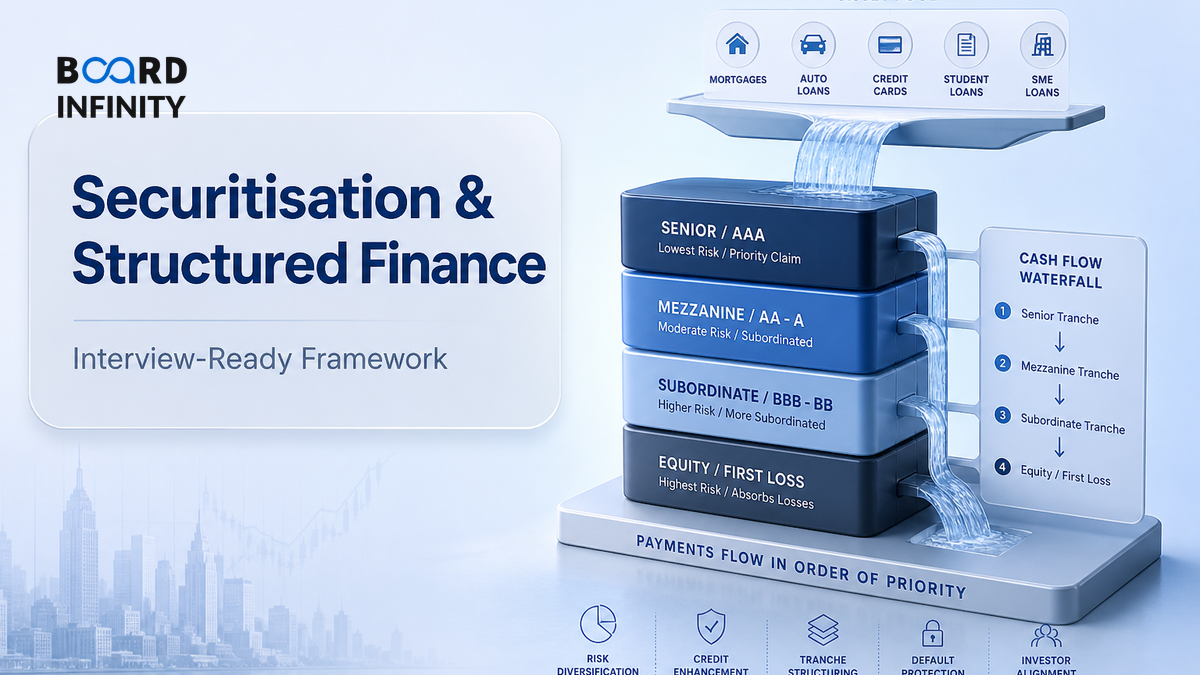
A bank has thousands of small loan repayments arriving every month, but investors want clean, rated instruments with predictable cash flows. Securitisation is the bridge - it turns messy loan books into structured securities, and if the bridge is badly built, credit risk quietly travels to places that do not understand it.
- Securitisation pools cash-flow-generating assets and issues securities backed mainly by those cash flows.
- The usual structure is: originator sells assets to a bankruptcy-remote SPV, which issues securities to investors.
- Tranching splits the same pool into senior, mezzanine and equity pieces with different risk-return profiles.
- The waterfall decides payment priority - senior investors get paid first, equity absorbs losses first.
- Credit enhancement protects investors through subordination, overcollateralisation, cash collateral, guarantees or excess spread.
- Good interview answers connect structure to economics: funding, risk transfer, capital relief, investor appetite and regulation.
- The biggest trap is saying securitisation is “just selling loans” - the real idea is cash-flow engineering plus risk allocation.
Think of securitisation as a financial assembly line. The raw material is a pool of loans or receivables; the finished product is a set of securities designed for investors with different risk appetites.
Core Explanation: How Securitisation Actually Works
The big idea is simple: cash flows can be separated from the company that originated them. A bank, NBFC, housing finance company or fintech may have loans on its balance sheet. Instead of waiting years for repayment, it can pool those loans, transfer them to a special purpose vehicle and raise money from investors.
The assets could be home loans, vehicle loans, microfinance loans, credit card receivables, lease rentals, toll-road receivables or trade receivables. What matters is not the label; what matters is whether the pool produces predictable cash flows that can be legally isolated and analysed.
The Structured Finance Ladder: Same Pool, Different Risk
Structured finance is broader than securitisation. It includes securitisation, project finance, leveraged finance, asset-backed loans and bespoke financing structures. The common thread is contract design: legal isolation, priority rules, triggers, covenants and credit enhancement are used to reshape risk.
Securitisation vs Structured Finance
Use this distinction in interviews: all securitisation is structured finance, but not all structured finance is securitisation.
The Waterfall: Where the Economics Become Real
The waterfall is the contract’s payment algorithm. It is why two investors in the same loan pool can have very different risk. In a simple monthly waterfall, collections first pay servicing costs, then senior interest, senior principal, mezzanine dues and finally residual cash to the equity holder.
Definitions You Should Be Able to Say Cleanly
Securitisation: pooling cash-flow-generating assets and issuing securities backed mainly by those cash flows.
Structured finance: financing that uses legal, contractual and cash-flow structuring to allocate risk and return among different parties.
CFA Institute framing: securitisation pools financial assets and sells claims to the cash flows from the pool.
RBI regulatory essence: securitisation redistributes credit risk of a pool through tranches whose payments depend on pool performance.
Key Metrics Interviewers Expect You to Track
Structured finance is not just vocabulary. You must be able to test whether the structure is safe enough for the promised rating and yield.
Worked Example: A Simple Tranching Case
Assume an NBFC securitises a ₹100 crore vehicle-loan pool. The pool yield is 14%. The structure issues a ₹80 crore senior tranche at 9%, a ₹10 crore mezzanine tranche at 13% and retains a ₹10 crore equity tranche.
The interview takeaway: tranching does not remove credit risk; it reallocates it. Senior notes look safe because junior capital, excess spread and waterfall priority stand below them.
Case Study: Northern Arc Capital and Indian Securitisation
Northern Arc Capital has used structured debt and securitisation-style platforms to connect originators serving retail borrowers with institutional capital.

Situation: Many Indian lenders that serve microfinance, vehicle finance, small business and affordable housing customers need repeatable funding. Their borrowers repay in small instalments, while investors such as banks, mutual funds and institutions prefer analysed, structured exposures with defined protections.
The move: Northern Arc built a business around connecting originators and investors through structured debt transactions. In such transactions, the economic logic is classic securitisation: analyse granular loan pools, structure priorities, add credit enhancement, monitor repayment performance and make the risk understandable to institutional capital providers.
Why this is a good case: It is not a glamorous consumer-brand example. It shows the real Indian mechanics - granular retail loans, NBFC and MFI originators, investor due diligence, rating comfort, pass-through structures, direct assignment routes and RBI-regulated securitisation principles.
Outcome and lesson: The primary driver is not “financial engineering” alone. The model works when pool analytics and legal structuring are supported by strong originator selection, credit enhancement, investor transparency and post-transaction surveillance. The strategic so what: securitisation can expand credit access, but only if risk is measured and allocated honestly.
How AI Changes Securitisation & Structured Finance
1. Better pool analytics: AI models can examine loan-level repayment patterns, bureau variables, geography, vintage behaviour and collection history to improve default and prepayment estimates. The value is not a magical rating upgrade; it is sharper segmentation of pool risk.
2. Faster document and covenant review: LLMs can summarise term sheets, servicing reports, rating rationales, trustee reports and legal covenants. This is useful because structured finance risk often hides in definitions - trigger events, early amortisation clauses, reserve account rules and servicing standards.
3. Continuous surveillance: AI can flag abnormal delinquency movement, concentration risk, fraud signals, servicer deterioration and macro stress sensitivity. The caution: model outputs must be explainable because investors, rating agencies and regulators cannot rely on a black box for credit decisions.
Use NotebookLM: upload the RBI securitisation directions, one NBFC annual report and a rating rationale for any securitised pool. Ask it to generate: “What are the asset risks, structural protections, waterfall priorities and likely interview questions?” Then verify the answers against the documents.
Interview Relevance
“Explain securitisation to me. Why would a bank or NBFC securitise loans, and what can go wrong?”
If you have 30 seconds, say: “Securitisation is not risk elimination. It is risk transformation - from originator balance sheet risk into investor tranche risk governed by an SPV, waterfall and credit enhancement.”
Common Mistake
Mistake: Calling securitisation “selling loans to investors” and stopping there. That loses marks because it ignores the SPV, tranching, waterfall, credit enhancement and continuing performance risk. Fix: Always answer in this order - asset pool, SPV, securities, waterfall, credit enhancement, risks.
What to Revise Next
Next, move from structure to credit loss. Revise Expected Credit Loss: Default Probability, Loss Severity & Provisioning to understand how pool losses are estimated, then study Distressed Debt & Recovery: What Happens When Credit Goes Bad to see what happens when the waterfall is not enough.