
Credit Analysis Interview Guide: Five Cs and the Real Analyst Workflow
If a borrower offers a factory, a house, or a pile of receivables as security, is the loan safe - or only easier to recover after it has already gone wrong? Credit analysis starts with that uncomfortable distinction: a good loan is repaid by cash flow, not by auctioning collateral.
- Credit analysis asks three questions: can the borrower repay, will the borrower repay, and what protects the lender if repayment weakens?
- The Five Cs are Capacity, Capital, Collateral, Conditions and Character. Capacity is the first C because operating cash flow is the primary repayment source.
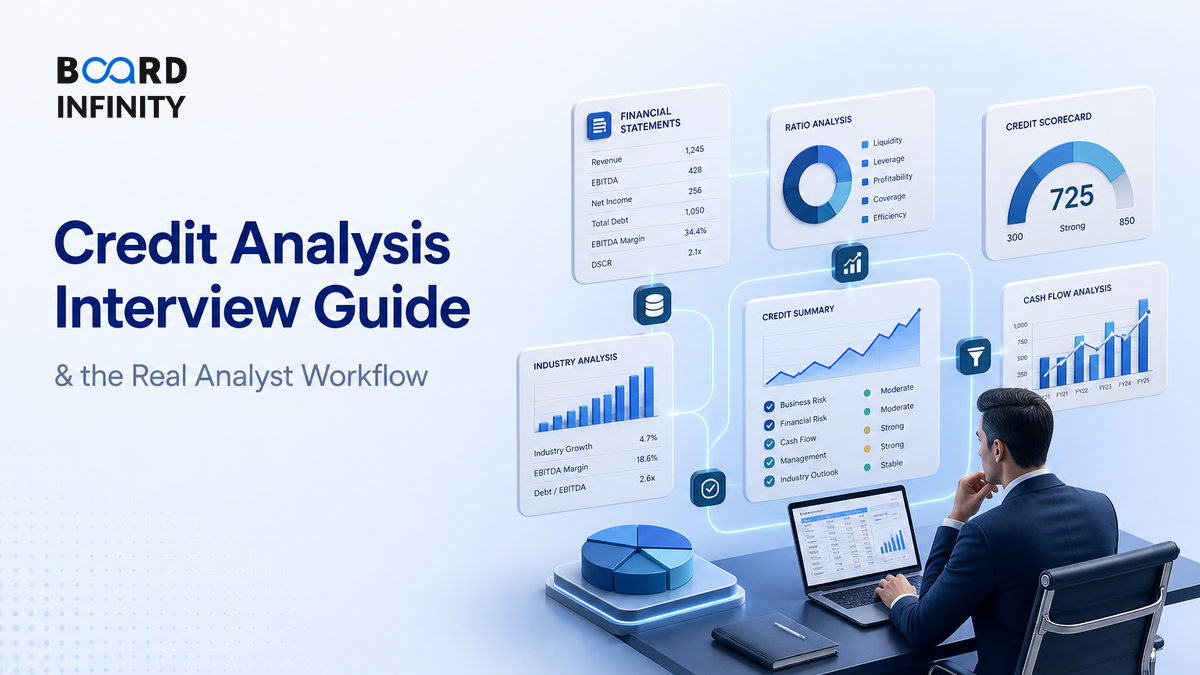
- The analyst workflow is not a checklist. It moves from data collection to financial spreading, business risk, ratio analysis, facility structuring, covenants and credit note writing.
- Key ratios: DSCR, interest coverage, net debt/EBITDA, current ratio, CFO/debt and working-capital days.
- Collateral reduces loss given default. It does not automatically reduce probability of default; weak capacity plus strong collateral is still risky.
- A strong credit answer links risk to structure: tenor, amount, margin, security, covenants, monitoring and exit triggers.
- Common trap: reciting the Five Cs without taking a credit call - approve, reject, or approve with conditions.
Big Picture: Credit Analysis Is a Repayment Story
Think of credit analysis as converting messy borrower information into a clear lending decision. The analyst does not merely calculate ratios; they build a defensible view on repayment ability, repayment intent and downside protection.
The Five Cs of Credit Analysis
The Five Cs are five lenses used to judge borrower creditworthiness. They are simple to remember, but powerful only when you connect them to the loan decision.
Capacity is the anchor. If the borrower cannot produce cash, collateral only changes the recovery story. Capital shows skin in the game. Collateral protects downside. Conditions explain external pressure. Character tells you whether numbers can be trusted.
The Analyst's Actual Workflow
In a bank, NBFC, rating agency or corporate credit team, the work is sequential. The Five Cs sit inside this workflow; they do not replace it.
Key Credit Ratios and What Good Looks Like
Ratios are not universal pass-fail rules. A toll road, SaaS company, steel manufacturer and FMCG distributor have different risk profiles. Still, these ranges give you a practical interview-ready benchmark for plain-vanilla corporate lending.
A Small Worked Example
Assume a mid-sized manufacturer asks for a ₹20 crore term loan. The analyst estimates annual EBITDA of ₹12 crore, cash taxes of ₹1.5 crore and maintenance capex of ₹1 crore. So cash flow available for debt service, or CFADS, is ₹9.5 crore.
Annual interest plus scheduled principal repayment is ₹8 crore. Therefore, DSCR = ₹9.5 crore / ₹8 crore = 1.19x. Interest expense alone is ₹3 crore, so interest coverage = ₹12 crore / ₹3 crore = 4.0x. If net debt after the loan is ₹30 crore, then net debt/EBITDA = ₹30 crore / ₹12 crore = 2.5x.
The judgment: interest coverage and leverage look acceptable, but DSCR is tight. A sensible analyst may not reject immediately; they may reduce the loan amount, extend tenor, add a cash sweep, take receivables escrow, require promoter contribution, or set a minimum DSCR covenant.
Definitions You Should Be Able to Say Cleanly
- Credit risk - Basel Committee: “the potential that a bank borrower or counterparty will fail to meet its obligations in accordance with agreed terms.”
- Credit analysis: A structured assessment of a borrower's ability and willingness to repay debt on promised terms.
- Five Cs: Capacity, capital, collateral, conditions and character - five lenses used to judge borrower creditworthiness.
- DSCR: Cash available for debt service divided by scheduled principal plus interest due.
Apple has issued bonds despite having a highly cash-generative business. A credit analyst would still examine recurring free cash flow, cash balances, product concentration, supply-chain dependence, shareholder payouts and debt maturity profile. The so what: even a powerful brand is not analysed by reputation alone; capacity remains primary, supported by liquidity, market position and governance.
Case Study: Aavas Financiers and Credit Analysis for Informal Income Borrowers
Aavas Financiers shows how credit analysis can work when borrowers may not have neat salary slips, but still have assessable cash flows and mortgageable homes.

Situation. Affordable housing finance in India often serves salaried and self-employed borrowers whose income may be partly informal, seasonal or documented through bank deposits, business records and field verification rather than a single clean Form 16. A shallow analyst might reject such borrowers because documentation is imperfect.
The move. Aavas Financiers, a listed Indian housing finance company, built its model around granular borrower assessment for low and middle-income housing customers. The primary driver is field-based cash-flow underwriting - understanding household income, business stability and repayment behaviour close to the borrower. Supporting drivers include mortgage-backed security, legal and technical property checks, conservative loan structuring, local market knowledge, collection discipline and diversified funding access.
The lesson. The company demonstrates that creditworthiness is not the same as perfect paperwork. A good credit process triangulates evidence: capacity from cash flows, collateral from property, character from repayment behaviour, capital from borrower contribution and conditions from local income stability.
Strategic takeaway: strong credit analysis adapts evidence to the borrower segment. The win is not simply “secured lending”; it is cash-flow-first underwriting, supported by collateral discipline, field verification and monitoring.
How AI Changes Credit Analysis
AI is changing credit analysis in practical, observable ways - especially in data-heavy retail, MSME and corporate lending.
- Faster document intelligence: AI can extract figures from bank statements, GST returns, invoices, annual reports, ageing schedules and sanction letters, then flag inconsistencies for the analyst to verify.
- Early-warning systems: machine learning models can monitor payment delays, bureau changes, bank balance volatility, GST decline, covenant breaches and news sentiment to identify stress earlier.
- NLP for credit monitoring: LLMs can summarize earnings calls, auditor qualifications, management commentary, rating rationales and court filings, making qualitative risk review faster.
Student workflow: before a credit interview, load a company annual report, rating rationale and latest quarterly investor presentation into NotebookLM. Ask it to produce: “top repayment risks, key credit ratios to calculate, likely covenants, and five interviewer questions on this borrower.” Then verify the numbers yourself in Excel.
Never outsource the credit call to AI. Use it to extract, summarize and challenge; the analyst remains responsible for assumptions, ratio accuracy, regulatory context and final judgment.
Interview Relevance
“A mid-sized company approaches your bank for a term loan. Walk me through how you would assess the credit proposal using the Five Cs.”
Use the phrase “primary repayment source” when discussing capacity and “secondary repayment source” when discussing collateral. It instantly signals credit maturity.
Common Mistake
The biggest mistake is treating collateral as proof that the borrower is creditworthy. It costs candidates because lenders do not want recovery proceedings; they want timely repayment. One-line fix: start with cash-flow capacity, then use collateral only as downside protection.
What to Revise Next
Now move from concept to execution. First revise Spreading Financials & Building a Credit Assessment Note so you can convert statements into a lender-ready memo. Then revise Credit Ratings in India: Scales, Agencies & Rating Migration to understand how CRISIL, ICRA, CARE Ratings and India Ratings communicate credit risk over time.