
Key Players and the Competitive Map in Agriculture & Food
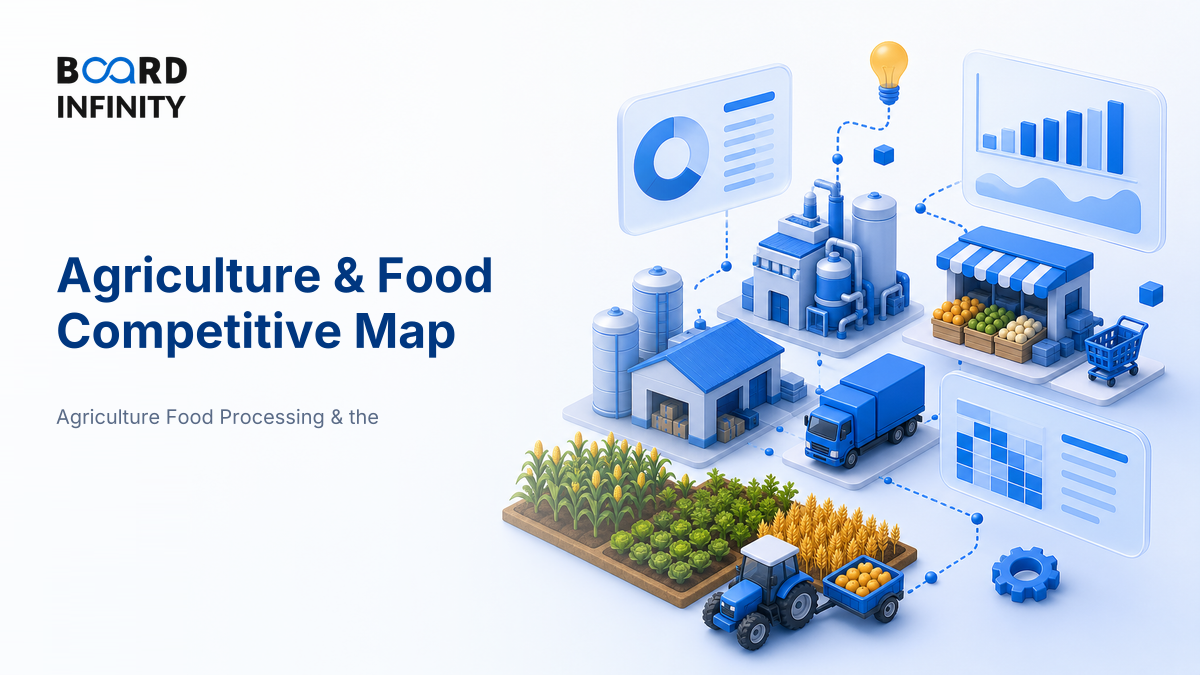
A tomato can leave a farm at dawn as a ₹20 crate commodity and reappear by evening as sauce, soup, pizza topping, or a premium ready meal. Same crop, very different economics. Agriculture & Food is not one market - it is a chain of battles, where the winner changes depending on who controls seeds, sourcing, cold chain, processing, brand, shelf space, or data.
- Agriculture & Food is a value chain, not a single sector: inputs, farming, aggregation, logistics, processing, brands, retail, foodservice, and exports each have different economics.
- Key players differ by profit pool: input companies win on science and distribution; processors win on scale and procurement; food brands win on consumer trust and shelf access.
- The central competitive question: who controls the scarce constraint - farmer relationship, perishability, processing capacity, brand, data, or route-to-market?
- Indian market nuance: fragmented farms, mandi systems, FPOs, cold-chain gaps, food-safety regulation, and regional tastes shape competition.
- Do not map only famous brands: many powerful players are invisible B2B firms in seeds, fertilisers, crop protection, milling, warehousing, and logistics.
- Best interview answer: map the value chain, name player types, compare profit pools, identify moats, then give one Indian example.
Big Picture: Agriculture & Food Is a Farm-to-Fork Competitive System
The sector starts before the seed is planted and ends long after food reaches the shelf. A strong answer shows the whole system first, then zooms into the profit pool being discussed. The same value-chain thinking used in aviation and logistics value chains is useful here because physical flow, time, capacity, and service levels decide who captures value.
The Competitive Map: Who Plays Where and Why They Win
The Agriculture & Food map has two very different halves. Upstream players sell to farmers and farms; downstream players sell food to consumers, restaurants, retailers, or exporters. The closer you move to the consumer, the more brand, packaging, distribution, and repeat purchase matter. The closer you move to the farm, the more agronomy, credit, trust, local salesforce, and yield improvement matter.
1. Agri-input players include seed, fertiliser, crop protection, animal feed, irrigation, and farm machinery companies. Examples include UPL, Bayer CropScience, Coromandel International, IFFCO, Mahindra Farm Equipment, and Jain Irrigation. Their moat is built through product efficacy, dealer networks, farmer education, credit linkages, and regulatory approvals.
2. Farm production and farmer organisations include individual farmers, Farmer Producer Organisations, cooperatives, contract farming networks, and large plantations. They usually have weak pricing power individually, but gain strength when they aggregate volume, standardise quality, or connect directly with processors and retailers.
3. Aggregators, traders, and digital platforms sit between farm output and buyers. Traditional mandis, commission agents, procurement companies, and platforms such as Ninjacart or DeHaat solve discovery, quality, credit, and logistics problems. India’s electronic National Agriculture Market is a government-backed digital trading platform for agricultural commodities (eNAM).
4. Processors and packers convert raw agricultural output into higher-value products: rice into branded packs, milk into curd and ice cream, wheat into flour and biscuits, fruits into juices or pulp, and spices into mixes. Their economics depend on procurement scale, plant utilisation, wastage control, food safety, and consistent quality.
5. Food brands and FMCG companies win through consumer trust, habit, retail reach, pricing architecture, and category innovation. Examples include Britannia, Nestle India, ITC Foods, HUL Foods, Amul, Tata Consumer, LT Foods, and Marico in selected food categories.
6. Retail, quick commerce, foodservice, and exports are the demand engines. Reliance Retail, DMart, BigBasket, Zepto, Swiggy Instamart, restaurant chains, QSRs, hotels, and exporters influence assortment, pricing, packaging, and delivery expectations. Export-facing players must also handle certification, traceability, and destination-market compliance through bodies such as APEDA, which promotes scheduled agricultural and processed food exports from India (APEDA).
The 2x2 Map Interviewers Expect You to See
Most candidates list companies. Strong candidates classify them by value-chain control and brand control. This reveals why two firms in the same crop can have completely different economics.
Low value-chain control, low brand control: pure traders and brokers can move volume but often face thin margins and high working-capital pressure.
High value-chain control, low brand control: bulk processors, millers, ingredient suppliers, and cold-chain operators can be operationally strong but may depend on large buyers.
Low value-chain control, high brand control: asset-light food brands can scale fast, but supply shocks, quality inconsistency, or manufacturing dependence can hurt them.
High value-chain control, high brand control: integrated dairy, rice, poultry, fresh food, and QSR ecosystems are harder to copy because they control both supply reliability and demand pull.
Definitions You Should Be Able to Say Clearly
Competitive map: a structured view of who competes where, how they make money, and what advantages protect returns.
Porter’s Five Forces: a framework analyzing competition through rivalry, entrants, substitutes, supplier power, and buyer power (Harvard Business School Institute for Strategy & Competitiveness).
Food value chain: the linked activities that move agricultural output from input supply to processing, distribution, consumption, and waste recovery.
How to Evaluate Players: Six Metrics That Reveal Competitive Strength
Use these metrics to avoid vague statements like “strong distribution” or “good supply chain.” In Agriculture & Food, a good number is category-specific, so compare against the same crop, region, channel, and business model rather than against the whole sector.
For interviews, connect each metric to the business model. A dairy player needs wastage control and cold-chain discipline. A seed company needs distribution productivity and farmer repeat purchase. A packaged snack company needs gross margin, brand salience, and outlet reach.
Case Study: Hatsun Agro Product and the Power of Cold-Chain Control
Hatsun Agro Product shows how an Indian food company can compete by controlling perishability, procurement density, and branded demand in dairy.
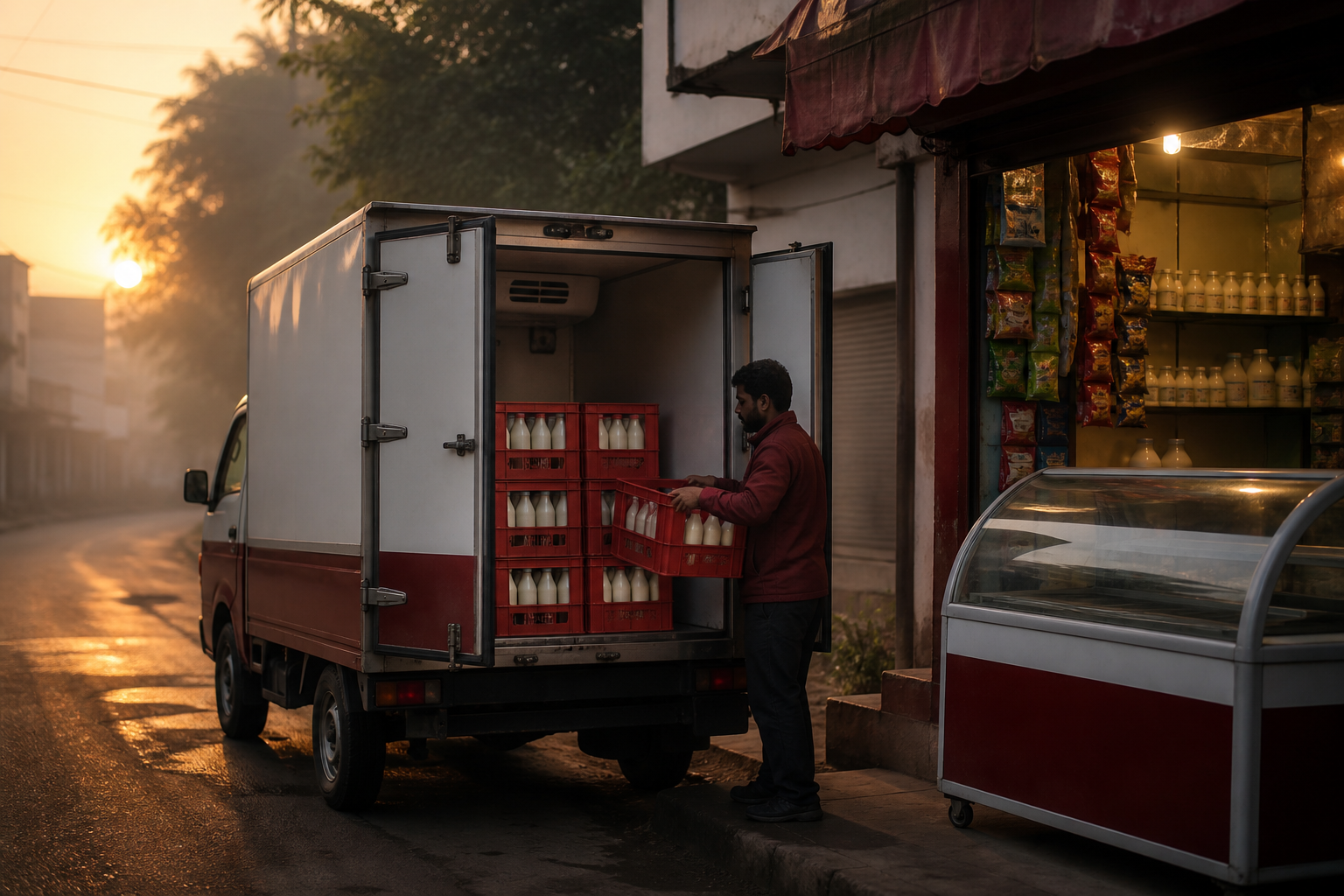
Hatsun Agro Product operates in a category where the product is perishable, sourcing is fragmented, and quality failure is immediately visible to the consumer. Its portfolio includes dairy and ice-cream brands such as Arun Icecreams, Arokya Milk, and Hatsun Curd, which makes it a useful example because it is not only a packaged-food brand - it is also a procurement, processing, chilling, routing, and retail execution system.
Situation: Dairy competition in India is structurally difficult. Milk must be collected frequently, chilled quickly, tested for quality, processed safely, and distributed before shelf life deteriorates. Small operational failures can destroy margin and trust.
The move: Hatsun’s strategic logic is vertical discipline. It builds farmer-side procurement access, processing capability, cold-chain movement, and consumer-facing brands together. The primary driver is control over perishability through sourcing and cold-chain execution. Supporting drivers include a multi-brand portfolio, regional depth, retail freezer presence, SKU variety, and route-level discipline.
Outcome and lesson: The case teaches a powerful competitive-map idea: in perishable food, brand equity alone is not enough. The player that controls the time-temperature-quality chain can defend both supply reliability and consumer trust.
How AI Changes Agriculture & Food
1. AI improves demand forecasting for perishables. Food players can combine sales history, weather, festivals, local events, promotions, and shelf life to forecast outlet-level demand. This matters because a forecast error in fresh food becomes either a stockout or wastage, not just a delayed sale.
2. AI upgrades grading, quality control, and traceability. Computer vision can help grade fruits, grains, or vegetables by size, colour, defects, and ripeness. IoT plus machine-learning alerts can flag cold-chain temperature deviations before a consignment becomes unsaleable.
3. AI changes farmer engagement and credit underwriting. Agritech platforms can use satellite imagery, transaction history, soil data, and crop advisory data to improve recommendations, input planning, and risk assessment. The caution: models must avoid excluding farmers simply because their data is sparse or historically under-recorded.
Use NotebookLM for revision: upload a company annual report, FSSAI or APEDA notes, and your sector notes, then ask: “Map this company across the Agriculture & Food value chain, identify its moat, key risks, and five interview questions.”
Interview Relevance
“Map the key players in Agriculture & Food in India. Where do you think the strongest competitive advantage lies - farm inputs, processing, brands, or retail?”
If you are asked “who has power,” answer by category. In seeds it may be R&D and farmer trust; in dairy it may be cold chain; in staples it may be procurement and milling efficiency; in snacks it may be brand and distribution.
Common Mistake
The mistake: candidates name only consumer brands like Amul, Britannia, Nestle, or ITC and ignore upstream and B2B players. Why it costs marks: it makes the answer look like FMCG revision, not Agriculture & Food sector understanding. One-line fix: always map farm inputs, production, aggregation, processing, brands, channels, and regulation before naming companies.