
How the Agriculture & Food Value Chain Works
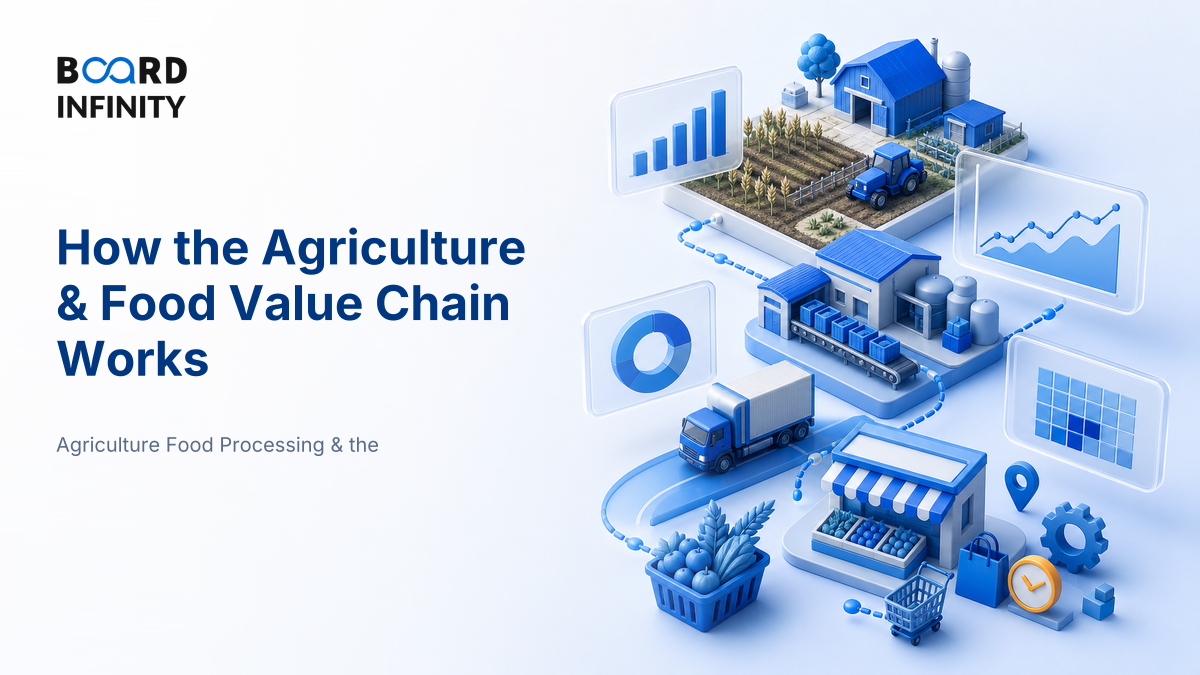
Most people think agriculture is a simple story: farmers grow food, companies sell it, consumers buy it. The real value chain is messier and more interesting - the tomato on a supermarket shelf has passed through decisions on seed, credit, weather risk, grading, cold storage, logistics, processing, pricing and retail power before it reaches you.
- The agriculture and food value chain converts biological production into market-ready food through inputs, farming, aggregation, processing, distribution and consumption.
- The biggest difference from many industries is perishability: time, temperature and handling can destroy value quickly.
- Power shifts by category: seeds and crop protection may favour input players; milk and staples favour scale processors; fresh produce often depends on sourcing and logistics control.
- Value is created by four levers: yield improvement, loss reduction, quality standardisation and market access.
- In India, the chain is highly fragmented at the farm end and increasingly organised at the processing, retail and platform end.
- Key metrics include farmgate share, post-harvest loss rate, fill rate, inventory days, gross margin per kg and OTIF delivery.
- The best interview answer shows both flows: physical product flow forward and information, money and demand signals backward.
Big Picture: Food Is a Value Chain, Not a Straight Line
The agriculture and food system is a chain of specialised players. Each stage either improves the product, reduces risk, creates convenience, or brings the product closer to a paying consumer. The trick is to see both the visible flow of food and the invisible flow of finance, quality data, demand signals and regulation.
Core Explanation: The Six Links in the Agriculture and Food Chain
Agriculture and food value chain means the connected activities that move food from farm inputs to final consumption while adding utility, reducing risk and capturing margin.
Think of it as six links. If one link fails, the whole chain suffers: high-yield seed is wasted without market access; great processing capacity is useless without consistent raw material; premium retail cannot survive poor cold-chain execution.
If you already understand logistics nodes, compare this with how the aviation and logistics value chain works - agriculture adds biological risk, perishability and quality variation on top of movement and warehousing.
The Loop That Many Candidates Miss
A food chain is not just “farm to fork.” It is a loop. Demand forecasts affect sowing decisions. Weather affects output. Output affects prices. Prices influence farmer behaviour in the next season. Consumer complaints change grading, packaging and sourcing norms.
Where Value Is Created - and Where It Leaks
Every player in the chain tries to answer one question: Can I improve reliability, quality, speed or market access enough to capture margin?
For MBA interviews, this is the “so what”: agri-food companies do not win only by buying cheap and selling high. They win by controlling uncertainty - quality uncertainty, supply uncertainty, price uncertainty and demand uncertainty.
Four Business Archetypes in the Chain
Different companies sit in different parts of the chain. The same tomato can create revenue for a seed company, a farmer, an aggregator, a processor, a cold-chain operator, a retailer and a food delivery restaurant.
For plant-heavy categories, the logic starts resembling industrial economics: utilisation, throughput, quality and working capital matter. If you want a cross-industry comparison, the applied chemicals, metals and industrials teardown is a useful way to see how capacity and input-cost thinking transfers.
Definitions You Should Be Able to Say in One Breath
- Value chain: The linked activities that add utility and margin as a product moves from inputs to final consumer.
- Farmgate price: The price received by the farmer before downstream transport, processing, wholesale or retail markups.
- Aggregation: Combining fragmented farm output into standardised lots that buyers can efficiently purchase, grade and move.
- Post-harvest loss: Quantity or value lost after harvest because of damage, spoilage, poor handling or inefficient storage.
- Cold chain: Temperature-controlled storage and transport that preserves quality for perishable products such as dairy, meat and fresh produce.
Metrics That Show Whether the Chain Is Working
There is no single universal benchmark because onion, milk, poultry, basmati rice and frozen snacks have different biology and economics. In interviews, use these metrics and say you would compare them by crop, season, geography and channel.
Mini Case Study: DeHaat and the Full-Stack Agri Platform
DeHaat is a useful Indian example because it tries to sit across multiple links of the chain - farmer advisory, inputs, financial access and output market linkage - rather than solving only one isolated problem.
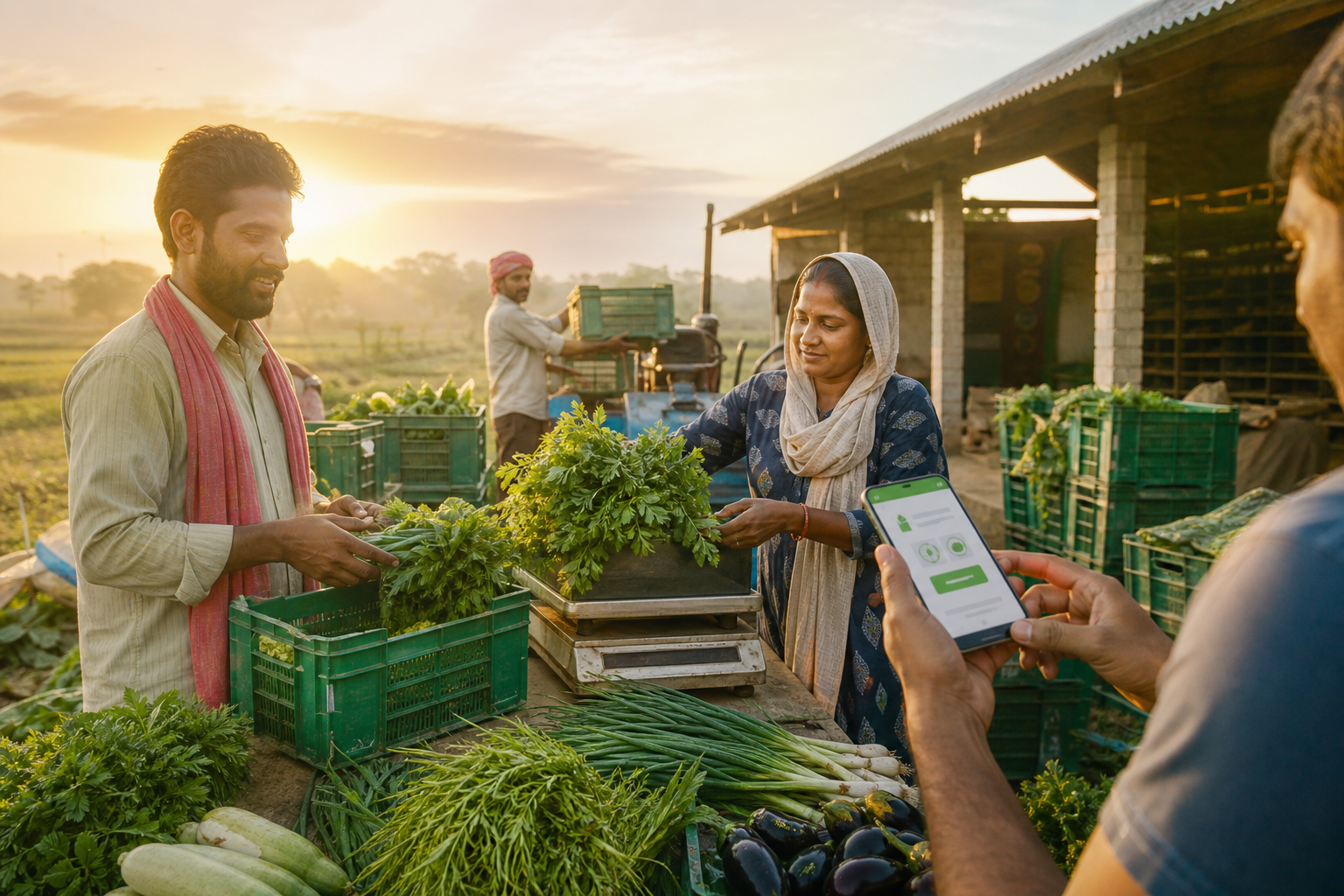
Situation. Indian agriculture has a structural coordination problem. The farm end is fragmented, farmers often need trusted advice and working capital before harvest, and organised buyers need consistent quality and supply after harvest. A pure app-only solution struggles because the crop is physical, local and seasonal.
The move. DeHaat positions itself as a full-stack agritech platform, combining advisory, input access, financial linkages and output market connections through a phygital model. Its website describes services across crop advisory, agri-inputs, financial services and market linkages (DeHaat). The primary driver is orchestration across the chain: helping the farmer before production and connecting output to buyers after production. Supporting drivers include local trust networks, crop data, collection infrastructure and buyer relationships.
The lesson. The strategic insight is not “remove the middleman.” In agri-food, many intermediaries perform real functions: credit, aggregation, grading, transport, risk absorption and local trust. The stronger model is to replace inefficient intermediation with coordinated, data-backed intermediation.
How AI Changes Agriculture and Food Value Chains
AI matters in agriculture only when it improves a real operating decision. The best use cases are specific, local and measurable.
Student workflow: before an interview with an agritech, FMCG, dairy or food retail company, load its annual report or website pages into NotebookLM and ask: “Map this company onto the agriculture and food value chain. Identify where it captures margin, where it faces perishability risk, and what metrics I should mention in an interview.” Then use ChatGPT or Claude to turn that into a 60-second answer.
Interview Relevance
“Explain the agriculture and food value chain. Where does a company actually make money, and where are the biggest risks?”
If the interviewer asks about India, emphasise fragmentation at the farm end, rising organised demand downstream, the role of FPOs and aggregators, and the importance of cold chain for perishables.
Common Mistake
The mistake: saying “agriculture has too many middlemen, so the solution is to remove them.” That sounds simplistic because intermediaries often provide credit, aggregation, grading, storage, risk-taking and local trust. The fix: say the goal is to remove inefficient friction while preserving the functions that make the chain work.