
Applied: A Full Agriculture & Food Teardown
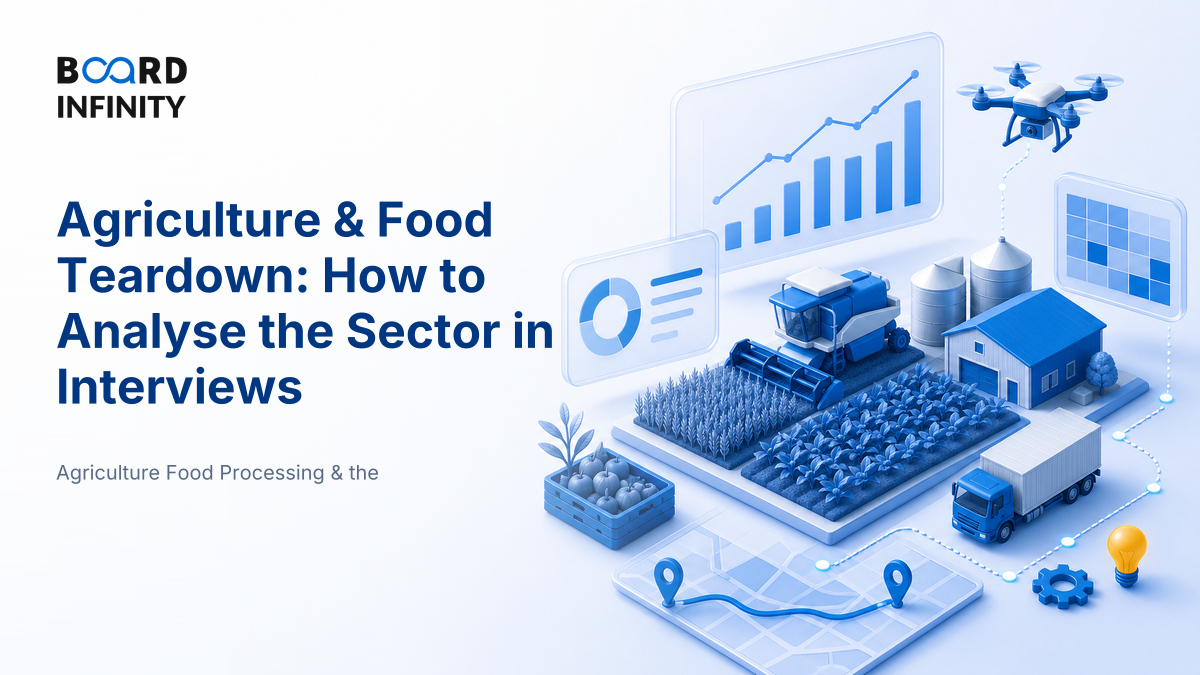
At 5:30 a.m., a truck of tomatoes reaches a city mandi: one crate is bought by a wholesaler, another is rejected for bruising, and a third eventually becomes packaged puree on a supermarket shelf. Same crop, same morning - but three completely different economics. Agriculture and food is not one business; it is a chain of fragile handoffs where value, risk and margin keep moving.
- Agriculture and food is a system, not a sector: inputs, farming, aggregation, processing, logistics, retail and consumption are interdependent.
- The core constraint is perishability plus fragmentation: small producers, volatile prices, weather risk and weak cold-chain discipline shape the economics.
- Profit pools shift downstream: branded food, processing, distribution control and consumer access usually capture more predictable margins than commodity farming.
- Interview-ready teardown: map the value chain, identify bottlenecks, locate profit pools, test business models, then discuss regulation and AI.
- Key KPIs: farm-gate realization, shrink, inventory turns, OTIF, gross margin per kg and working-capital cycle.
- Winning models reduce uncertainty: better demand visibility, quality grading, farmer trust, logistics reliability and financing are usually more important than a flashy app.
Big Picture: Agriculture & Food Is a Chain of Risk Transfer
Every player in agriculture and food is answering the same question: who will carry uncertainty? The farmer carries weather and yield risk, the trader carries price and quality risk, the processor carries utilization risk, the distributor carries inventory risk, and the brand carries demand risk. A good teardown follows that risk as it moves from farm to fork.
Core Explanation: How to Tear Down Agriculture & Food
Use a simple five-lens teardown. It works for dairy, staples, fresh fruits and vegetables, packaged foods, agri-inputs, food delivery, quick commerce and B2B supply-chain startups.
The fastest way to sound sharp is to separate commodity economics from brand economics. Commodity businesses win on procurement, scale, yield and logistics. Branded food businesses win on trust, distribution, repeat purchase and pricing power.
The Four Business Models You Must Recognise
Most agriculture and food companies combine one or more of these models. Do not force every company into the same bucket.
For adjacent input industries such as fertilisers, agrochemicals and industrial processing, compare this with business models in chemicals, metals and industrials - the overlap is especially visible in agri-inputs and food processing equipment.
Definitions You Can Say in One Breath
An agrifood system is the network of activities and actors that produce, process, distribute, consume and dispose of food, consistent with the FAO agrifood systems lens.
Farm-gate price is the price received by the farmer before transport, commissions, processing, retail margins and taxes are added.
Food loss happens before retail or consumption; food waste happens at retail, food service or consumer level.
Key Metrics: What a Good Agriculture & Food Answer Tracks
Metrics in this sector must respect category reality. Fresh fish, basmati rice, milk, edible oil and packaged snacks do not share the same benchmark. In interviews, state the formula, then compare it against category peers, seasonality and the company’s own trend.
Worked Example: Why Gross Margin Can Disappear After Shrink
Assume a B2B fresh-produce company buys 1,000 kg of tomatoes at ₹20 per kg. Transport, sorting and packaging add ₹4 per kg, so landed cost is ₹24 per kg on the procured quantity. It plans to sell at ₹30 per kg.
On paper, the margin looked like ₹6 per kg. After 10% shrink, the realized margin is only ₹3.33 per sellable kg. That is why agriculture and food interviews reward candidates who adjust for physical loss, not just price spread.
Indian Market Nuances: What Makes This Sector Different Here
India’s agriculture and food market is shaped by fragmentation, regulation, infrastructure gaps and trust. The winning answer is never “digitize the farmer” in isolation. It is “digitize only where it reduces a real transaction cost.”
DeHaat: The Full Framework in One Business
DeHaat shows how an agritech company can attack farmer fragmentation by bundling inputs, advisory, financing support and output market linkages into one operating system.
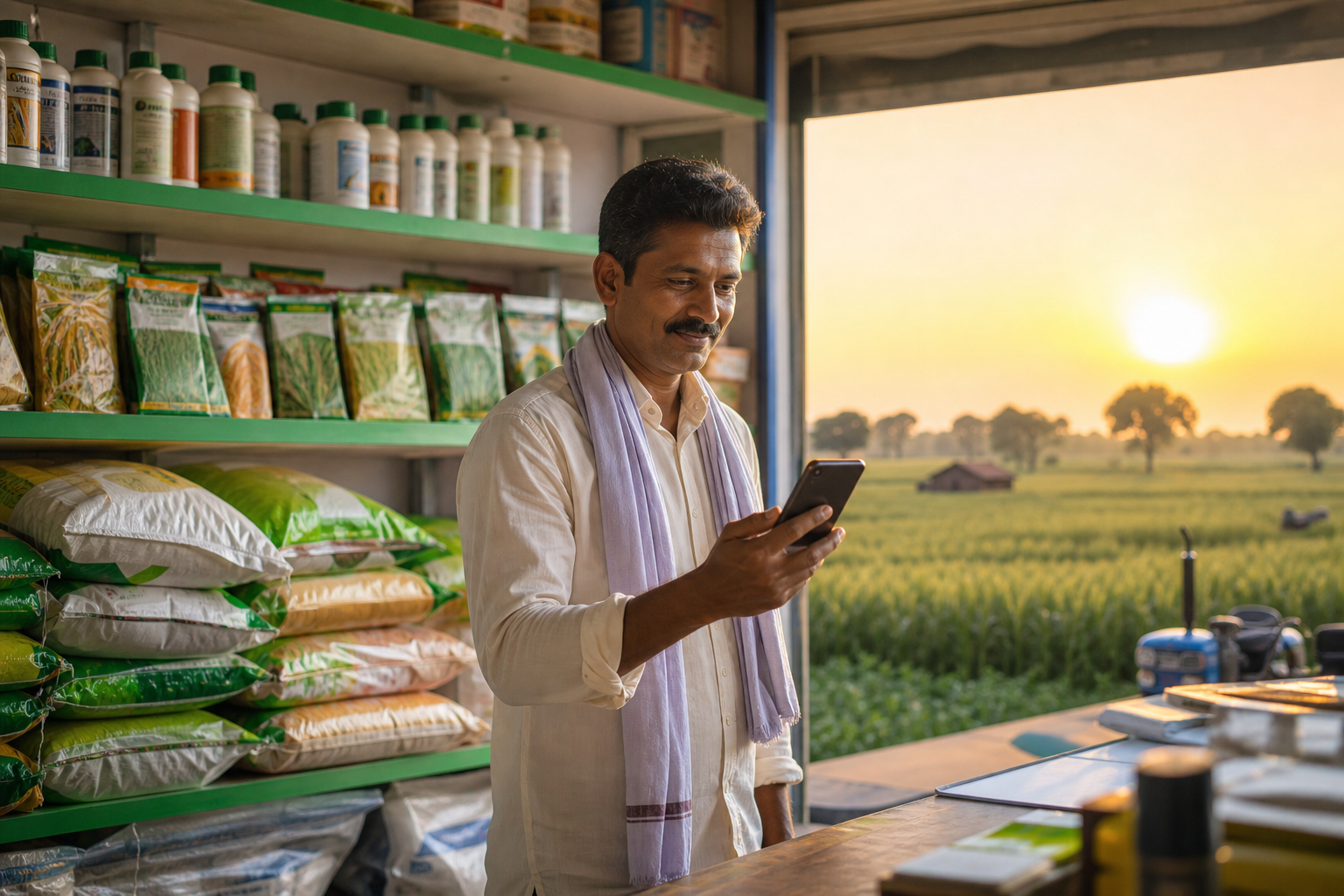
DeHaat is useful because it is not just an app story. The company presents itself as a full-stack agriculture platform connecting farmers with input access, crop advisory, financial services and market linkage through its network and technology layer on the DeHaat official platform.
Situation: Indian farmers often face fragmented access to quality inputs, local advice, credit and assured buyers. Each missing link raises transaction cost and uncertainty. A standalone advisory app would not solve the whole problem if the farmer still cannot buy the right input or sell output reliably.
The move: DeHaat’s primary driver is an integrated operating model: it tries to solve multiple farmer jobs in one relationship. Supporting drivers include local network presence, crop-level data, input distribution, advisory, buyer linkages and financing partnerships. The power is in bundling: each transaction deepens data and trust for the next one.
Outcome or lesson: The strategic lesson is not “agritech wins because farmers use apps.” The stronger answer is: full-stack agritech can work when the primary driver is trust-led transaction bundling, supported by local execution, financing, data and reliable market access. If any one of those supports is weak, the model becomes expensive to scale.
How AI Changes Agriculture & Food
AI is not replacing the farmer or the food manager. It is improving prediction, grading and matching in a system where small errors become spoilage, stockouts or price crashes.
Use NotebookLM: upload this lesson, one annual report of a listed food company, and FSSAI or APEDA pages relevant to that category. Ask it to generate a one-page sector teardown with value chain, profit pools, risks, KPIs and five likely interview questions.
Interview Relevance
“Pick any agriculture or food company and give me a full business teardown. Where does it make money, what are the risks, and what would you track?”
If you get stuck, say: “I will analyse this as a perishable supply-chain business with demand uncertainty.” That single sentence usually puts your answer on the right track.
Common Mistake
The biggest mistake is treating agriculture and food as a generic “large market” story. That costs candidates because it ignores the real economics: perishability, quality variation, working capital and trust. The fix: always anchor your answer in one category, one value chain and one measurable bottleneck.