
Where AI Is Landing in Agriculture & Food
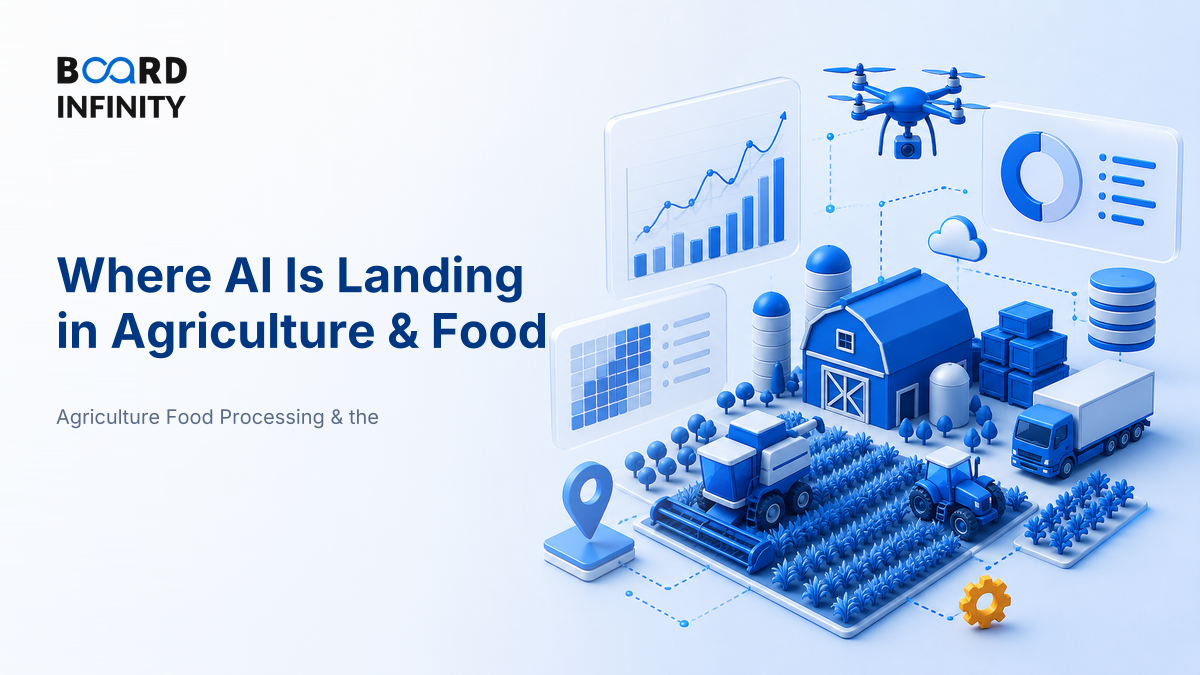
A farmer once decided irrigation by looking at the sky, squeezing soil in his palm and trusting last season’s memory. Now the same decision can be nudged by satellite imagery, soil sensors, weather forecasts and a model that says, “water this plot, not that one.”
That contrast is the real story of AI in agriculture and food: not robots everywhere, but better decisions at the exact points where uncertainty is expensive.
- AI in agriculture and food is a decision layer - it predicts, recommends or automates choices across farms, processors, distributors and retailers.
- The best use cases sit where data is frequent and decisions repeat: disease detection, yield estimation, grading, demand forecasting, route planning and traceability.
- India’s biggest adoption barrier is not model quality alone - it is farm fragmentation, low digital records, trust, language, connectivity and unit economics.
- Upstream AI improves crop planning, input use and risk sensing; downstream AI improves quality, inventory, cold chain and food waste reduction.
- ROI must be measured operationally: forecast error, yield variance, rejection rate, wastage, service level and cost per decision.
- The winning model is hybrid: AI recommendations plus agronomists, field agents, FPOs, retailers or enterprise workflows.
- Interview answer line: “AI lands where variability is high, data is available, and the decision can be changed in time.”
Big Picture: AI Is a Decision Layer, Not a Tractor Replacement
Think of the agriculture and food system as a chain of uncertain decisions: what to plant, when to irrigate, whether disease is spreading, how to grade produce, where to route inventory, and how much demand to expect tomorrow. AI creates value when it reduces that uncertainty before the cost becomes irreversible.
Where AI Actually Lands Across Agriculture and Food
The mistake is to say “AI in farming” as if the farm is the only arena. Agriculture and food is a full system: inputs, farming, aggregation, processing, logistics, retail and consumption. Each stage has different data, buyers and ROI logic.
Food-side AI often touches cold-chain routing, capacity and service levels; if that piece feels weak, revise how the aviation and logistics value chain works before discussing perishables.
At the input end, AI changes demand sensing for seed, fertilizer and crop-protection companies; the economics are easier to explain if you understand chemicals, metals and industrials business models.
The Four Landing Zones That Matter Most
For interviews, do not list twenty random use cases. Cluster them into four zones. This shows business judgement.
1. Productivity: Better decisions per acre
AI helps farmers, agronomists and agri-enterprises decide when and where to act: irrigation, fertilizer, pesticide, harvesting and labour deployment. The primary driver is site-specific recommendation, supported by satellite imagery, local weather, field images and agronomic rules.
2. Quality: Standardizing what humans judge inconsistently
Fresh produce and food processing involve subjective quality checks: colour, size, bruising, defects, ripeness and contamination risk. Computer vision can make grading more consistent, especially when paired with human supervisors and clear buyer standards.
Indian company Intello Labs applies computer vision to fresh produce quality assessment. The strategic point is not “AI sees fruit”; it is that buyers, aggregators and processors can standardize quality conversations in a market where manual grading can vary widely.
3. Risk: Seeing stress before it becomes loss
AI models can flag pest pressure, water stress, crop health anomalies, credit risk or supply disruption. The primary driver is early warning, supported by remote sensing, weather feeds, historical farm performance and local field validation.
4. Market linkage: Matching supply to demand
In perishable categories, value disappears quickly. AI helps forecast demand, plan procurement, allocate stock, route vehicles and reduce waste. The primary driver is better matching of uncertain supply with uncertain demand; supporting drivers include cold-chain discipline, retailer data and faster replenishment decisions.
Metrics: How to Prove AI Is Working
Good candidates do not stop at “AI improves efficiency.” They name the metric, show the formula and connect it to a business decision. Benchmarks vary by crop, geography and category, so the strongest answer compares AI performance against the company’s own pre-AI baseline.
Definitions You Must Say Cleanly
- AI system: A machine-based system that infers predictions, recommendations or decisions from inputs, based on the OECD AI Principles.
- Precision agriculture: Site-specific crop or livestock management using data to vary decisions by location, timing or biological condition.
- Traceability: The ability to follow food through specified production, processing and distribution stages.
- Computer vision: AI that interprets images or video to classify, detect or measure objects and defects.
- Decision intelligence: The use of data, models and workflows to improve repeated business decisions.
Cropin: AI as a Decision Layer for Farming Enterprises
Cropin shows how AI in agriculture becomes valuable when it is embedded into enterprise decisions, not sold as a standalone prediction.
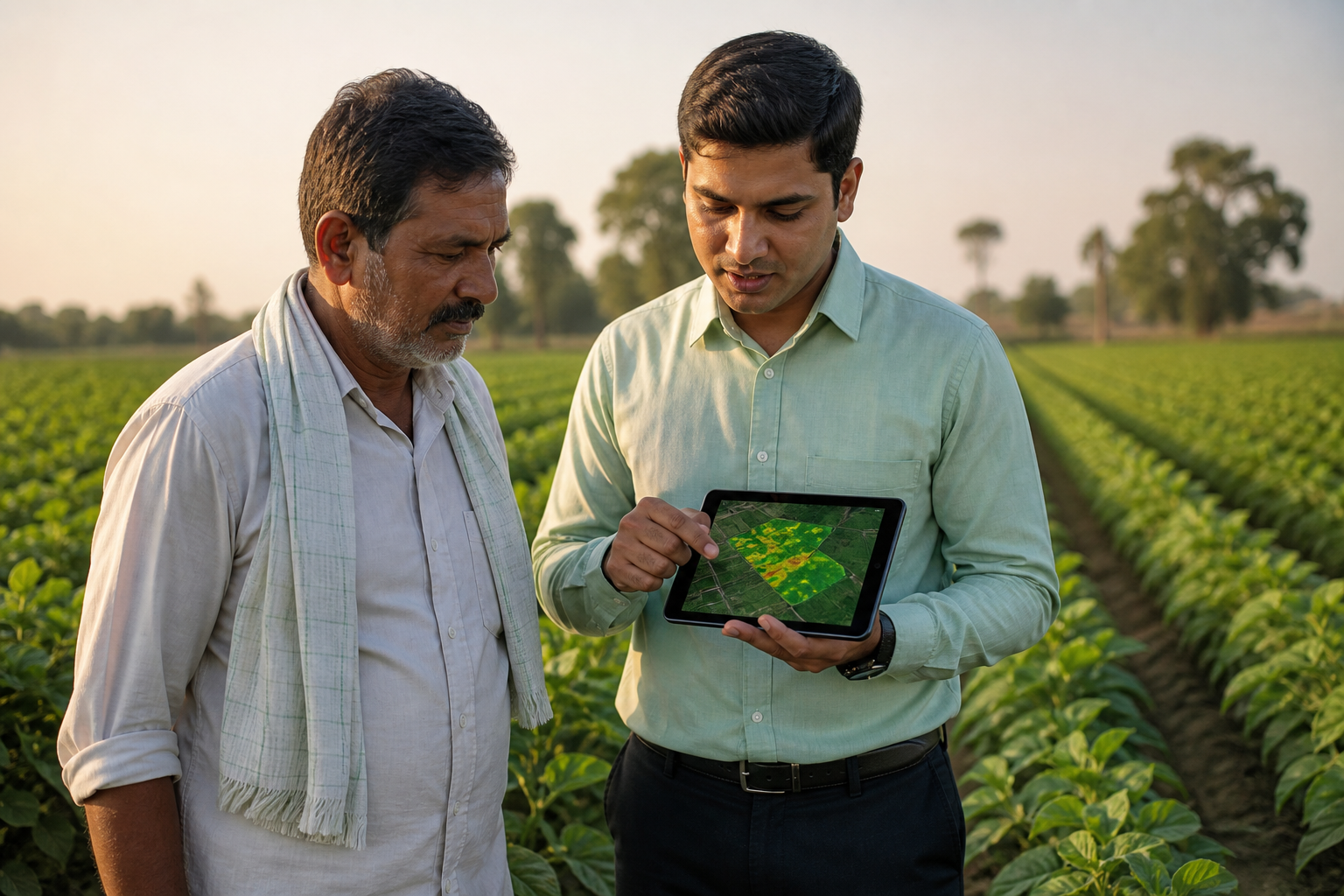
Cropin is an Indian agritech company that works on farm digitization, intelligence and traceability for agribusinesses. Its relevance is simple: large agri-enterprises do not manage one farm. They manage thousands of plots, farmers, crops, suppliers, field agents and buyers. That creates a decision problem before it creates a technology problem.
Situation: Agribusinesses need visibility across fragmented farms. Field teams may collect data manually; managers need to estimate crop progress, monitor compliance, plan procurement, manage quality and respond to weather or disease risk.
The move: Cropin’s model turns farm, field and remote data into a more structured intelligence layer. Instead of relying only on end-of-season reports, an enterprise can digitize plots, monitor crop conditions, guide field teams and support traceability. AI is useful because it converts messy agricultural signals into decisions that a manager can act on.
Outcome and lesson: The lesson is not that “AI alone improves yields.” The primary driver is workflow integration: the prediction reaches the person who can change a decision. Supporting drivers include field data capture, remote sensing, agronomic context, enterprise dashboards and adoption by field teams. That is the complete answer interviewers respect.
How AI Changes Agriculture & Food
AI is changing agriculture and food in three concrete ways in 2026.
Practical student workflow: Use Perplexity or NotebookLM to study one agri-food company. Load its website, annual report or product pages, then ask: “Where in this company’s value chain could AI reduce forecast error, rejection rate, wastage or working capital?” Convert the answer into a four-zone map: productivity, quality, risk and market linkage.
Interview Relevance
“Where do you see AI creating real ROI in agriculture and food, especially in India? What would stop adoption?”
Use this sentence if you freeze: “In agri-food, AI succeeds when the prediction changes an operational decision before crop quality, freshness or working capital is lost.”
Common Mistake
The single biggest mistake is giving a “cool tech” answer - drones, sensors, robots, apps - without explaining who pays, what decision changes, and which metric improves. The fix: always tie every AI use case to one buyer, one decision and one KPI.