
Customs, Documentation & Cross-Border Trade Compliance
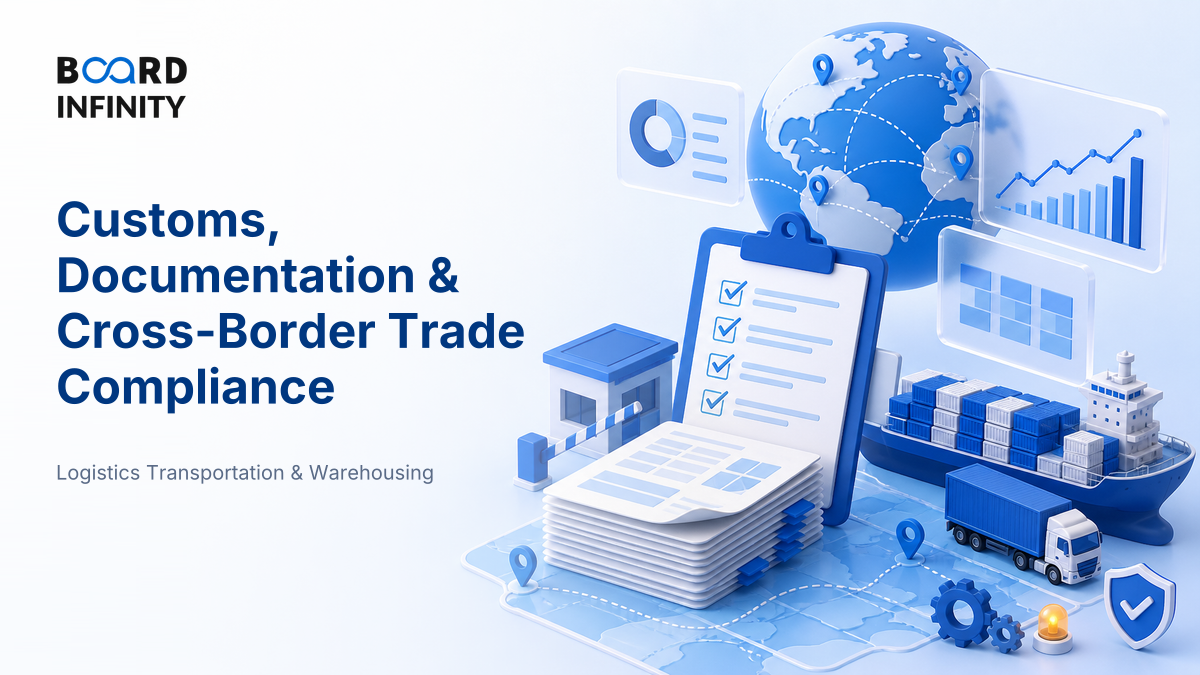
A container can reach Nhava Sheva on time, the buyer can be waiting, the truck can be booked - and one wrong HS code or missing certificate can still freeze the shipment at the port. Cross-border trade is not just moving goods across borders; it is moving proof across authorities.
- Customs compliance means declaring, documenting and paying correctly so goods can legally enter or leave a country.
- The three control points are classification - HS code, valuation - assessable value, and origin - where the product legally comes from.
- The document pack usually includes commercial invoice, packing list, transport document, shipping bill or bill of entry, certificate of origin and product-specific certificates.
- Incoterms decide buyer-seller responsibility for freight, insurance, risk transfer and import or export clearance - they do not replace customs law.
- Compliance starts before shipment: supplier data, purchase contract, product specs and restricted-party checks must be clean.
- Best interview answer: explain the shipment flow, name the documents, identify risk points, then show how you would monitor clearance KPIs.
Big Picture: Customs Compliance Is a Proof System, Not Paperwork
Think of customs as a gate where the government asks five questions: What is this product? What is it worth? Where did it originate? Is it allowed? Have duties, taxes and filings been done correctly?
The biggest lesson: customs documentation is not an afterthought handled by a freight forwarder. It is a cross-functional process involving procurement, logistics, finance, tax, legal, quality and sales. If you understand this, you sound like a supply-chain manager - not a clerk.
Core Explanation: The Cross-Border Shipment in Five Control Points
A cross-border shipment moves through a sequence. At every stage, a different document or compliance check proves that the shipment is legal, correctly valued and traceable.
The Document Pack: What Each Paper Proves
Documentation becomes easy when you stop memorising document names and ask: “What does this document prove?”
In India, an importer or exporter needs an Importer Exporter Code from the Directorate General of Foreign Trade; DGFT describes IEC services on its Importer Exporter Code portal. Operationally, exporters and importers file customs declarations through ICEGATE, Indian Customs Electronic Gateway.
If an Indian manufacturer imports a specialised component, procurement cannot stop at price and lead time. It must collect supplier declarations, product specifications, country of origin and compliance certificates before shipment. This is where what procurement owns in supplier data and value creation directly affects customs clearance.
The Three Technical Pillars: Classification, Valuation and Origin
Most customs disputes sit inside three boxes. If you can explain these three, you can handle most interview questions on trade compliance.
The World Customs Organization explains the Harmonized System as an international nomenclature for classifying products. In plain interview language: the HS code is the product’s customs identity.
Incoterms sit beside these pillars, not above them. The ICC Incoterms rules define buyer-seller responsibilities for cost, risk and delivery obligations in international sales. They help decide who arranges freight, insurance and clearance, but customs law still decides what is payable and what documents are required.
Risk Matrix: Where Trade Compliance Fails
Not every shipment needs the same control intensity. A low-value repeat shipment of standard parts is not the same as a first-time export of regulated chemicals to a new market.
This is also why supplier compliance is not separate from trade compliance. A supplier that cannot provide origin evidence, product declarations or audit-ready documents becomes a customs risk; the natural next topic is supplier risk, compliance and responsible sourcing.
Metrics: How a Manager Tracks Customs Performance
In operations interviews, do not say “we will ensure compliance.” Say what you will measure. Strong trade teams track speed, accuracy, cost and risk.
Definitions You Can Say in One Breath
- Customs compliance: The discipline of declaring, documenting, valuing and clearing goods according to import-export laws.
- HS code: A standardized product classification code used by customs authorities to apply duties, restrictions and statistics.
- Trade facilitation: The WTO describes it as “the simplification, modernization and harmonization of export and import processes” on its trade facilitation page.
- Incoterms: ICC Incoterms rules are globally recognised terms that allocate buyer-seller responsibilities in international sale of goods.
- Certificate of origin: A document proving the country where goods legally originate for tariff or regulatory purposes.
Case Study: Bajaj Auto and the Discipline Behind Export Scale
Bajaj Auto shows why export success in manufacturing depends not only on product-market fit, but also on repeatable documentation, classification and market-specific compliance.
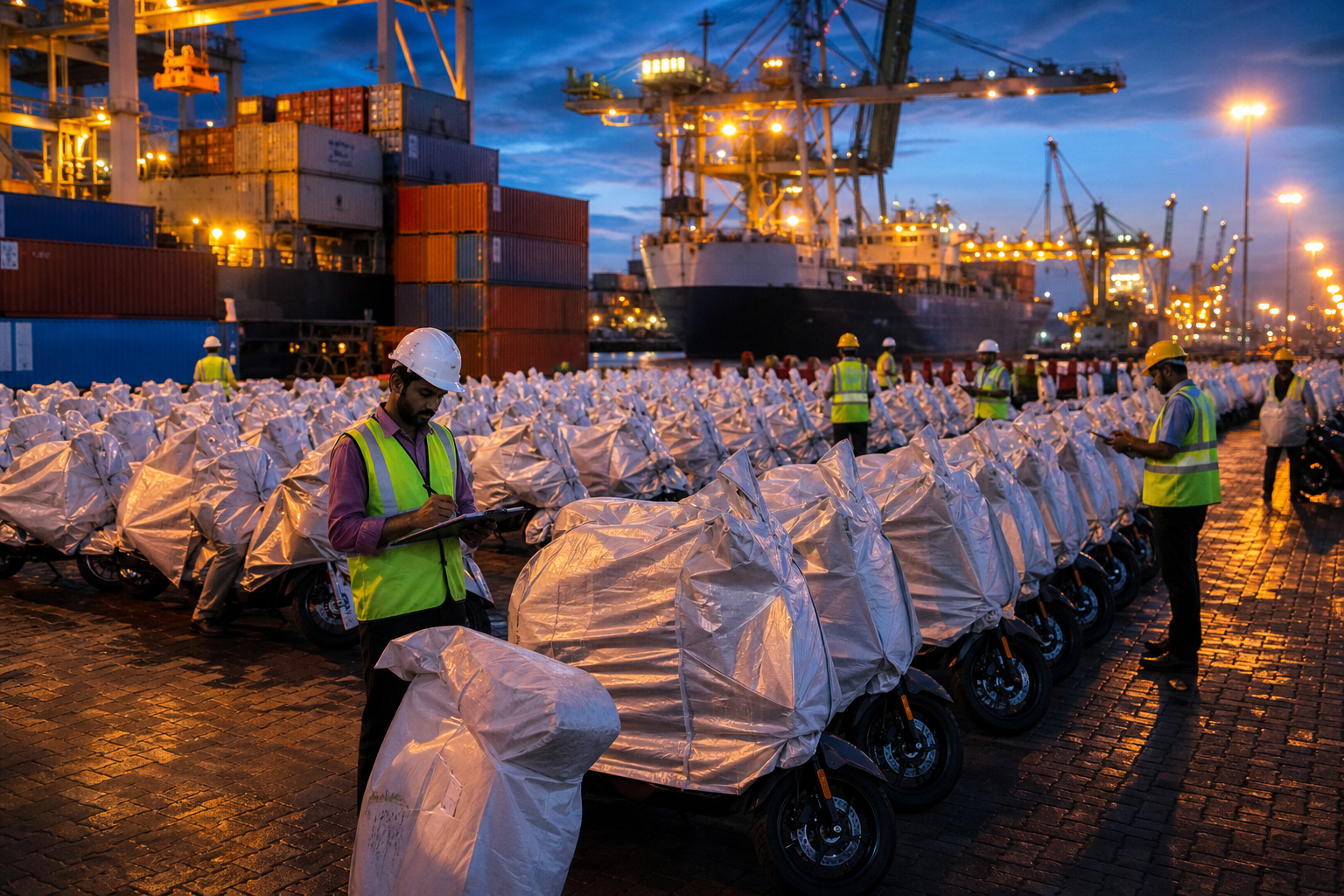
Bajaj Auto is widely known as an Indian two-wheeler and three-wheeler manufacturer with a large international business; its investor communications and annual reports discuss exports as a major part of the business on the company’s annual reports page. The interesting lesson for a supply-chain student is not “Bajaj exports vehicles.” The lesson is that vehicle exports require repeatable compliance across many destination rules.
Situation: A motorcycle or three-wheeler export is not just a finished product leaving a factory. Each destination may need correct HS classification, invoice and packing accuracy, transport documents, certificate of origin, homologation or regulatory approvals, and spare-parts documentation. If the product is shipped as a complete unit, CKD kit or spare-part consignment, classification and documentation logic can change.
The move: A company operating at this scale must standardise product master data, map documentation requirements by destination, coordinate logistics with finance and tax teams, and keep brokers and freight forwarders working from controlled data rather than ad hoc shipment descriptions. The primary driver is repeatable compliance architecture - supported by product standardisation, experienced export operations, destination-market knowledge and disciplined partner coordination.
Outcome and lesson: Export competitiveness is not only manufacturing cost or brand demand. It is the ability to deliver reliably across borders without avoidable holds, rework, duty disputes or document gaps. In interview terms, Bajaj Auto helps you say: “Cross-border capability is a supply-chain capability, not a paperwork activity.”
How AI Changes Customs, Documentation & Cross-Border Trade Compliance
AI does not remove customs responsibility, but it changes how fast teams can detect risk before goods reach the border.
A practical student workflow: load a company annual report, one sample commercial invoice template and the target country’s import requirements into NotebookLM, then ask it to generate “top customs risks, missing documents and likely interviewer questions.” For procurement-heavy roles, connect this to using AI in spend analysis, sourcing and contract review, because supplier contracts increasingly need compliance-data clauses.
Never present AI-suggested HS codes, sanctions results or licence requirements as final legal advice. In trade compliance, AI is a risk scanner; accountability stays with the importer, exporter and authorised experts.
Interview Relevance
“Suppose your company imports electronic components from China and exports finished goods to Europe. What customs documents and compliance checks would you put in place?”
A strong answer links customs to business impact: delays hurt customer service, demurrage hits cost, wrong classification creates duty exposure, and weak origin proof can destroy tariff benefits.
Common Mistake
The mistake is treating customs as “the CHA or forwarder’s job.” It costs candidates because it ignores the company’s legal responsibility for correct data, documents and declarations. One-line fix: say, “The broker files, but the business owns classification, value, origin, documents and controls.”