
Warehouse Automation, Robotics & Picking Technology
What if the fastest warehouse is not the one with the most robots, but the one where a picker takes the fewest wrong steps? That is the core tension in warehouse automation: technology looks glamorous, but the real prize is flow - fewer touches, shorter travel, better accuracy, and predictable dispatch.
- Warehouse automation uses software, machines and robotics to reduce manual movement, decisions and errors inside a warehouse.
- The biggest cost lever in picking is usually travel time, not the physical act of picking the item.
- Do not choose technology first. Start with order profile, SKU velocity, space constraint, labour availability, service promise and ROI.
- Person-to-goods systems make workers walk to inventory; goods-to-person systems bring inventory to workers.
- AMRs, AS/RS, pick-to-light, voice picking, conveyors and sorters solve different problems - they are not interchangeable.
- Key metrics: pick rate, order accuracy, dock-to-stock time, cost per order, space utilisation and automation uptime.
- The interview-winning answer is: map the process, identify bottlenecks, match the technology, pilot, measure, then scale.
Big Picture: Automation Is a Flow Problem, Not a Robot Problem
A warehouse converts inbound inventory into accurate outbound orders. Automation improves that conversion by attacking three wastes: movement, waiting and errors. Robotics is only one layer; the real system includes WMS logic, slotting, picking method, material-handling equipment and people design.
Core Explanation: The Technologies and When to Use Them
Think of warehouse automation in four layers. The first layer is software control, usually a warehouse management system or WMS. The second is process design, such as batching, zoning, wave picking and slotting. The third is material movement, such as conveyors, sorters, AMRs and AS/RS. The fourth is human enablement, such as pick-to-light, voice picking and ergonomic workstations.
The decision is not “manual versus automated.” The decision is which activity deserves automation. A slow-moving spare-parts warehouse may need better slotting and scanning, not robots. A high-volume e-commerce fulfilment centre may justify AMRs, sorters or goods-to-person systems because travel and sorting become the bottleneck.
The 2x2 Fit Matrix: Which Automation Fits Your Warehouse?
Use two questions: how predictable is demand, and how intense is order volume? This gives a clean interview framework for choosing technology.
Picking Methods: The Heart of Warehouse Productivity
Picking is the process of retrieving the right item, in the right quantity, for the right order. It matters because picking often absorbs the most labour effort in order fulfilment. The central goal is simple: reduce travel, reduce search, reduce mis-picks.
Four picking approaches appear often in interviews:
If you need to revise the people-and-workstation angle behind picking productivity, connect this topic with line balancing and workstation design. Automation fails when the robot is fast but the pack station, replenishment team or dock door becomes the new bottleneck.
How to Decide What to Automate: A Five-Step Process
Metrics That Prove Automation Is Working
Good candidates do not say “automation improves efficiency” and stop. They name the metric, formula and direction of improvement. Benchmarks vary by industry, order profile and SKU complexity, so use these as interview-safe ranges and always compare against the warehouse baseline.
Worked Example: Should a Warehouse Add AMRs?
Assume a hypothetical e-commerce warehouse ships 8,000 orders per day. Pickers spend much of their time walking. A pilot with AMRs reduces walking and raises pick rate from 80 to 120 order lines per labour hour.
The important interview move is to include total cost. Robots may reduce walking, but the business case must include maintenance, charging space, WMS integration, supervision, peak utilisation and process redesign.
Definitions You Can Say in One Breath
- Warehouse automation: Using software, equipment and robotics to perform or guide warehouse tasks with less manual effort and error.
- WMS: The system that controls inventory location, task assignment and movement inside a warehouse.
- AMR: A mobile robot that navigates dynamically to move goods, carts or totes without fixed tracks.
- AS/RS: A storage system that automatically places and retrieves inventory from defined storage locations.
- Goods-to-person: A fulfilment design where inventory moves to a stationary worker instead of the worker walking to inventory.
- Slotting: Placing SKUs in warehouse locations based on velocity, size, handling needs and replenishment logic.
Case Study: Ocado - Turning Grocery Fulfilment into a Robotics System
Ocado built a technology-led grocery fulfilment model where software, grid robotics and picking stations work as one integrated system.
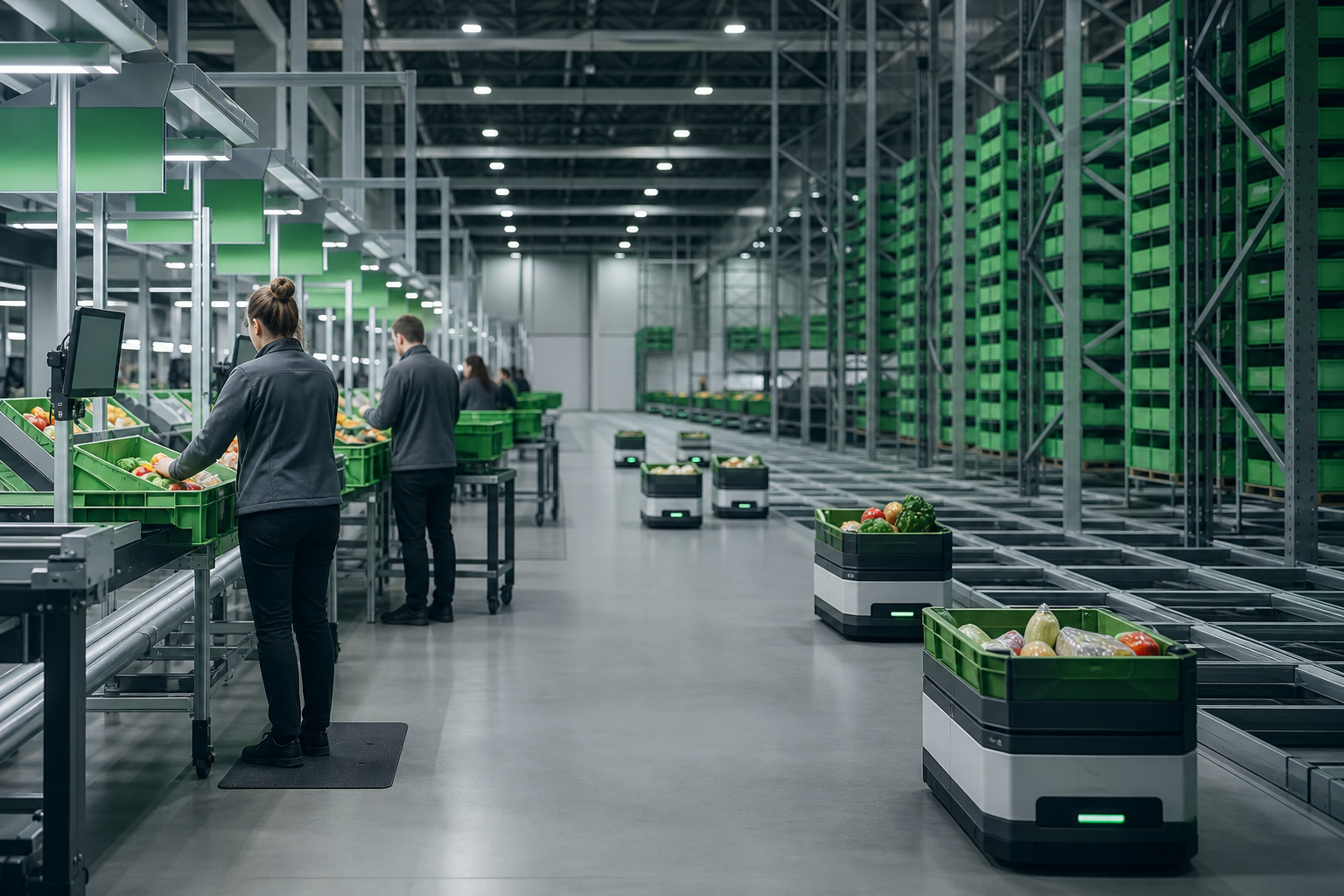
Situation. Online grocery is operationally brutal. Orders contain many low-value items, customers expect narrow delivery windows, freshness matters, and substitutions damage trust. Traditional store-picking or purely manual warehouse picking struggles when order density rises.
The move. Ocado developed the Ocado Smart Platform, combining automated fulfilment centre design, proprietary software, robotics and partner-facing grocery technology. In simple terms, inventory is stored densely, robots retrieve or move inventory through a grid-like system, and human pickers work at stations where the system brings the work to them.
The result and lesson. The lesson is not “robots win.” The primary driver is system integration: software, storage design, robot orchestration, picking ergonomics and delivery planning reinforce each other. Supporting drivers include grocery-specific process knowledge, dense storage, order batching, forecasting and carefully designed picking stations. The strategic point: high automation works best when the operating model is redesigned around it, not when robots are added to a broken manual process.
In India, quick-commerce and e-commerce warehouses face a different but related problem: dense urban demand, small baskets, tight delivery promises and high SKU churn. For a Zepto-style dark store or a large marketplace fulfilment centre, the automation question is often not full robotics first; it is better WMS discipline, slotting of fast movers, replenishment triggers, scanner-led accuracy and controlled pick paths. The so what: Indian operations often need modular automation before heavy fixed automation.
How AI Changes Warehouse Automation, Robotics & Picking Technology
AI is making warehouse automation more adaptive. Earlier systems followed fixed rules; newer systems learn from order patterns, congestion, labour availability and exceptions.
A practical student workflow: load a company annual report, a warehouse automation vendor note and your own process map into NotebookLM. Ask it to generate: “What warehouse bottlenecks does this company likely face, which automation options fit, what metrics should I use, and what risks should I mention?” Then pressure-test the output yourself - especially ROI assumptions and integration risks.
Interview Relevance
“An e-commerce company wants to automate its warehouse. How would you decide what technology to implement?”
Use the phrase “automation should follow process stability.” It signals maturity because you are not blindly recommending expensive robotics before fixing slotting, master data and replenishment.
Common Mistake
The most common error is recommending robots before diagnosing the warehouse bottleneck. It costs candidates because it sounds like technology shopping, not operations thinking. The one-line fix: first map flow and constraints, then match the simplest automation that improves the target metric.