
Route Planning, Milk Runs & Fleet Utilisation
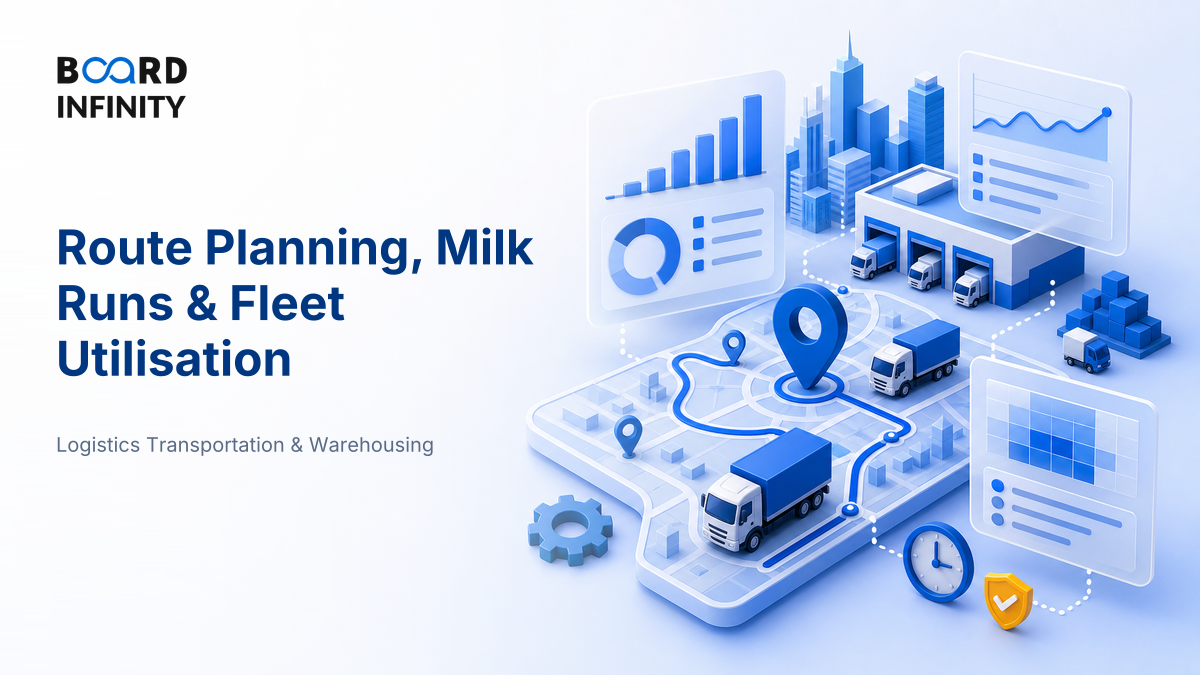
Why would a smart logistics manager send one truck to five locations instead of five trucks to one location each? Because in transport, the cheapest kilometre is often the one you never drive - and the second cheapest is the one you share across stops.
- Route planning decides the sequence, timing and vehicle assignment for pickups or deliveries at minimum cost while meeting service constraints.
- Milk runs combine multiple pickups or drops into one scheduled route, reducing empty kilometres and improving load consolidation.
- Fleet utilisation measures how well vehicle capacity, time and distance are converted into productive movement.
- Use milk runs when demand is repeatable, stop density is high, time windows are manageable and loads can be consolidated.
- The core trade-off is cost efficiency vs service reliability: a very full route can become fragile if one delay breaks the whole schedule.
- Track loaded-km ratio, vehicle fill, cube utilisation, on-time delivery, stops per hour and cost per drop.
- The most common mistake is optimising only distance, while ignoring time windows, vehicle capacity, unloading time and variability.
Big Picture: Transport Is a Constraint Game, Not Just a Map Problem
Route planning is not “find the shortest road.” It is the operating system that converts orders, vehicles, driver hours, customer promises and traffic uncertainty into executable trips. Milk runs and fleet utilisation are two ways to make that system efficient without breaking service.
Core Explanation: Route Planning, Milk Runs and Fleet Utilisation
Route planning answers four practical questions: which vehicle goes where, in what sequence, at what time and with what load. The objective is usually to minimise total landed transport cost while meeting delivery commitments.
Milk run is a planned route where one vehicle visits multiple points in a fixed or semi-fixed sequence to collect or deliver loads. The term comes from the old dairy collection route: one vehicle repeatedly collects milk from multiple farmers or societies instead of sending separate vehicles for every source.
Fleet utilisation asks: “Are my trucks earning their keep?” A truck sitting idle, running half-empty or returning empty is capacity paid for but not monetised.
When to Use a Milk Run: The 2x2 Shortcut
A milk run works best when stops are close enough to consolidate and demand is predictable enough to schedule. If demand is highly uncertain, dynamic routing may beat a fixed route. If stops are scattered, direct dispatch or cross-docking may be cleaner.
Think of the matrix this way:
- Scheduled direct: one regular supplier or customer with enough load to justify a direct vehicle.
- Milk run: many predictable stops that can be combined into one efficient route.
- Spot dispatch: irregular, scattered demand where pre-planned loops may waste capacity.
- Dynamic routing: dense but volatile demand, common in e-commerce, grocery and quick-commerce routing.
The Five-Step Route Planning Process
Route planning becomes stronger when linked to replenishment logic. For example, a fixed milk run to stores or production lines often works with Kanban and pull-based replenishment, where consumption triggers the next pickup or delivery instead of planners pushing stock blindly.
Milk Runs: Why the Same Truck Visiting More Stops Can Lower Cost
The power of a milk run comes from consolidation. Instead of five suppliers sending five partially loaded vehicles, one vehicle can collect smaller loads on a planned circuit and return to the plant fuller.
Milk runs create value through a bundle of drivers, not one magic lever:
- Primary driver - load consolidation: small loads are combined into a viable truckload.
- Supporting driver - schedule discipline: suppliers and customers know when the vehicle will arrive.
- Supporting driver - lower empty running: routes can be designed to reduce deadhead kilometres.
- Supporting driver - better dock planning: predictable arrivals reduce waiting at warehouses and plants.
- Supporting driver - inventory visibility: regular pickup cycles make replenishment more predictable.
Fleet Utilisation Metrics: What to Track
In interviews, do not say “we should improve utilisation” and stop there. Name the metric, give the formula and explain the trade-off. Good values are network-specific, so treat the ranges below as practical planning heuristics, not universal benchmarks.
Worked Example: Should We Combine Three Pickups?
Assume a plant needs pickups from three suppliers on the same corridor. Each supplier has a 1-tonne load. The truck capacity is 4 tonnes.
The milk run is not automatically better. It becomes better if the extra detour distance, supplier waiting time and schedule risk are lower than the saving from using fewer vehicles and improving fill. That is the interview-grade answer: optimise total system cost, not just truck count.
Definitions You Can Say in One Breath
- Route planning: assigning vehicles and stop sequences to meet transport demand at minimum feasible cost and required service level.
- Milk run: a scheduled multi-stop pickup or delivery route that consolidates small loads into fewer, fuller vehicle trips.
- Fleet utilisation: the productive use of vehicle capacity, time and distance relative to available fleet resources.
- Backhaul: carrying revenue-generating or useful load on the return leg instead of running empty.
- Deadhead kilometres: kilometres travelled without productive load, usually caused by empty repositioning or poor route pairing.
Case Study: Amul and the Original Logic of Milk Runs
Amul’s dairy supply chain shows why scheduled multi-point collection can turn fragmented rural supply into reliable plant inflow.
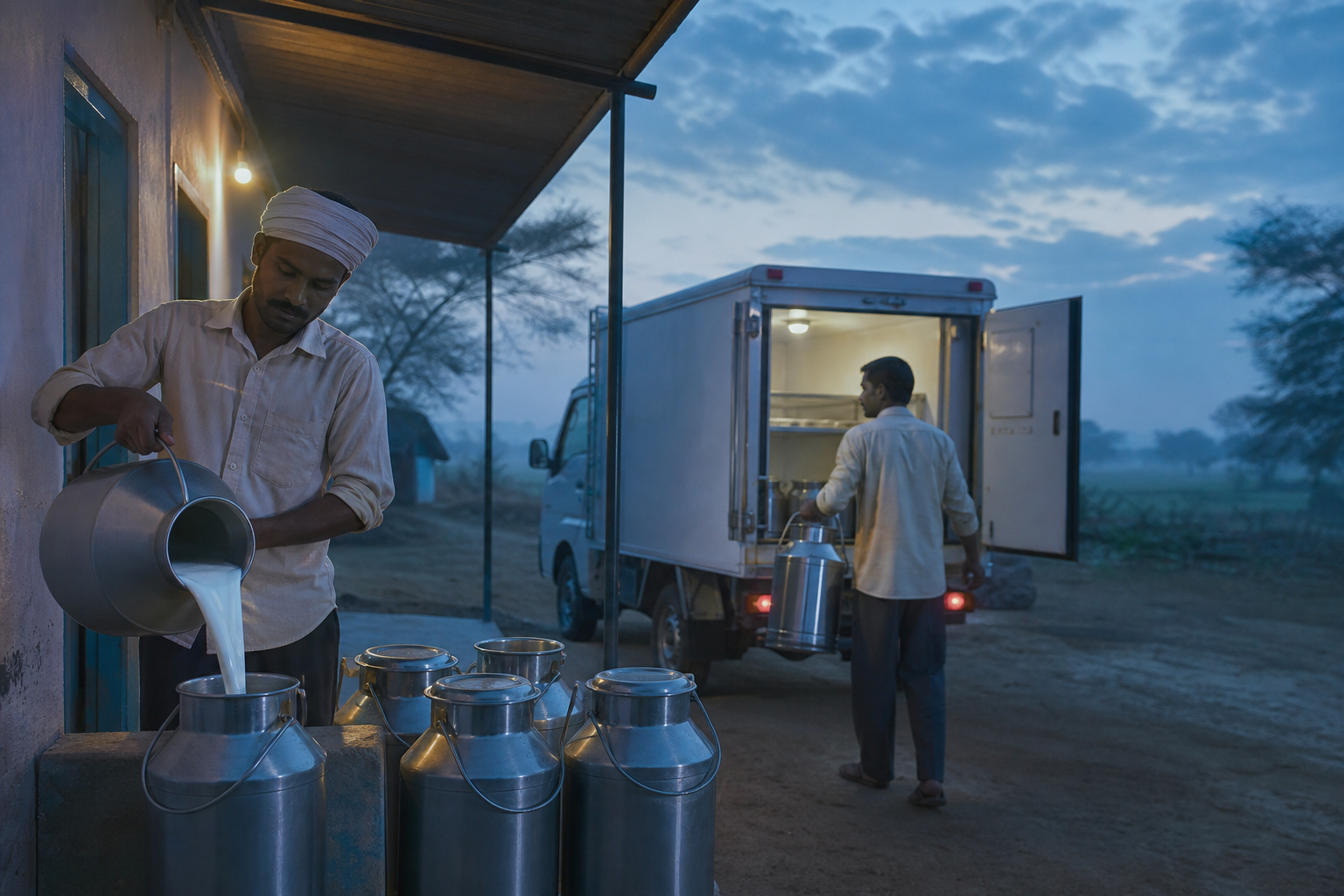
Amul is rooted in India’s dairy cooperative model, where milk from many small producers has to reach chilling centres and processing plants quickly. The operational challenge is severe: supply is geographically dispersed, the product is perishable and delays can damage quality.
Situation: Individual milk producers or village-level collection points generate relatively small quantities. Sending separate vehicles for every point would create poor vehicle utilisation and high collection cost.
The move: The system uses scheduled collection routes, aggregation points, chilling infrastructure and disciplined timing. In route-planning language, this is a classic milk-run logic: one planned vehicle circuit collects from multiple points and moves consolidated milk toward processing.
Outcome and lesson: The primary driver is consolidation of fragmented supply. The supporting drivers are collection discipline, local aggregation, cold-chain handling and repeatable route timing. The strategic lesson is simple: milk runs are not only a transport tactic - they are a network design choice that makes small suppliers economically serviceable.
How AI Changes Route Planning, Milk Runs & Fleet Utilisation
AI does not remove the fundamentals. It improves the speed and quality of decisions under uncertainty.
- Dynamic route optimisation: AI-enabled systems can adjust routes using live traffic, delivery priority, vehicle status and time-window risk instead of freezing routes the previous night.
- Demand prediction for milk runs: machine-learning forecasts can estimate pickup or delivery quantities by location, day and season, making fixed loops smarter. This connects naturally with AI for inventory optimisation and replenishment, because routing and replenishment signals improve each other.
- Fleet health and utilisation intelligence: telematics and predictive maintenance models can identify vehicles at risk of breakdown, excessive idle time or fuel inefficiency before they disrupt service.
Use ChatGPT or Claude to practise: paste a route-planning case with stops, vehicle capacities and time windows, then ask it to propose a route, list assumptions, identify hidden constraints and calculate utilisation metrics. Your job is to challenge the assumptions, not blindly accept the route.
Interview Relevance
“You are managing deliveries from one warehouse to 40 retail stores in a city. Costs are rising and trucks are returning half-empty. How would you improve route planning and fleet utilisation?”
Always say the trade-off aloud: “I would reduce cost, but not by overloading routes to the point that on-time delivery collapses.” That one sentence makes your answer sound operationally mature.
Common Mistake
The mistake is treating route planning as a shortest-distance problem only. It costs candidates because real routes are constrained by time windows, unloading time, vehicle capacity, driver hours, traffic variability and service promises. The fix: optimise total route performance - cost, utilisation and service level together.